
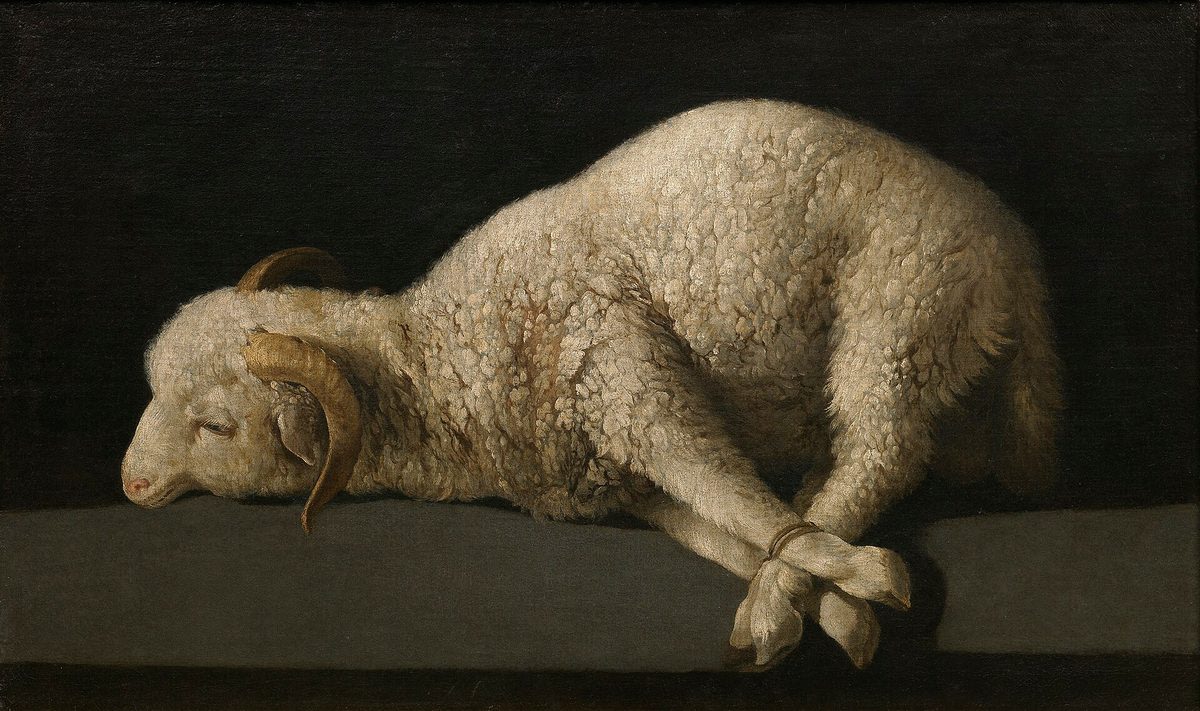
Agnus Dei (Lamb of God)
Agnus Dei — Zurbarán, c.1635-1640
Francisco de Zurbarán, Public domain, via Wikimedia Commons
Zurbarán's Agnus Dei is one of the most original and meditative religious paintings of the Spanish Baroque — a small canvas (approximately 38 by 62 cm) showing a single bound lamb lying on a stone ledge against a dark background. The lamb's feet are tied with a cord; its head is turned slightly to the right; its fleece is rendered with extraordinary observational specificity.
The painting has no narrative, no symbolic apparatus, no human figure — it is simply a bound lamb. The title identifies the subject theologically: this is the Lamb of God (Agnus Dei), the sacrificial animal whose blood prefigures the blood of Christ, the image from the beginning of John's Gospel ('Behold, the Lamb of God, who takes away the sin of the world') and from the Book of Revelation ('the Lamb that was slain'). The painting transforms a devotional image into an act of concentrated visual attention.
Zurbarán painted at least three versions of this subject. The Prado canvas is the finest.
The restraint of the composition — the dark ground, the stone ledge, the single figure, no narrative context — is typical of his austere aesthetic but pushed to an extreme here: this is the most minimal of his works. The lamb is depicted with the same sculptural specificity that Zurbarán gives to his white-habited monks — the fleece modelled in thick impasto, the shadows deep and specific.
The power of the painting rests on the viewer's awareness of what is not depicted: the slaughter of the lamb, the spilling of the blood, the sacrificial ritual. The lamb is alive — its eyes open, its nostril quivering (in the finest versions).
Its bound feet are the sign of its fate. The identification of this lamb with Christ makes the painting a meditation on the Passion without depicting the Passion: a preparation for suffering, a willing submission to death. The dark ground is not background but presence — the darkness that the Light came into.
When standing before this work, look carefully: Agnus Dei — Zurbarán, c.1635-1640. Give it time — what seems decorative often carries the central meaning.
When standing before this work, look carefully: The fleece — observational specificity in thick impasto. Give it time — what seems decorative often carries the central meaning.
When standing before this work, look carefully: The bound feet — sign of the lamb's fate. Give it time — what seems decorative often carries the central meaning.
When standing before this work, look carefully: The lamb's face — alive and attentive. Give it time — what seems decorative often carries the central meaning.
Museo Nacional del Prado, Madrid.