
Allegories of Good and Bad Government
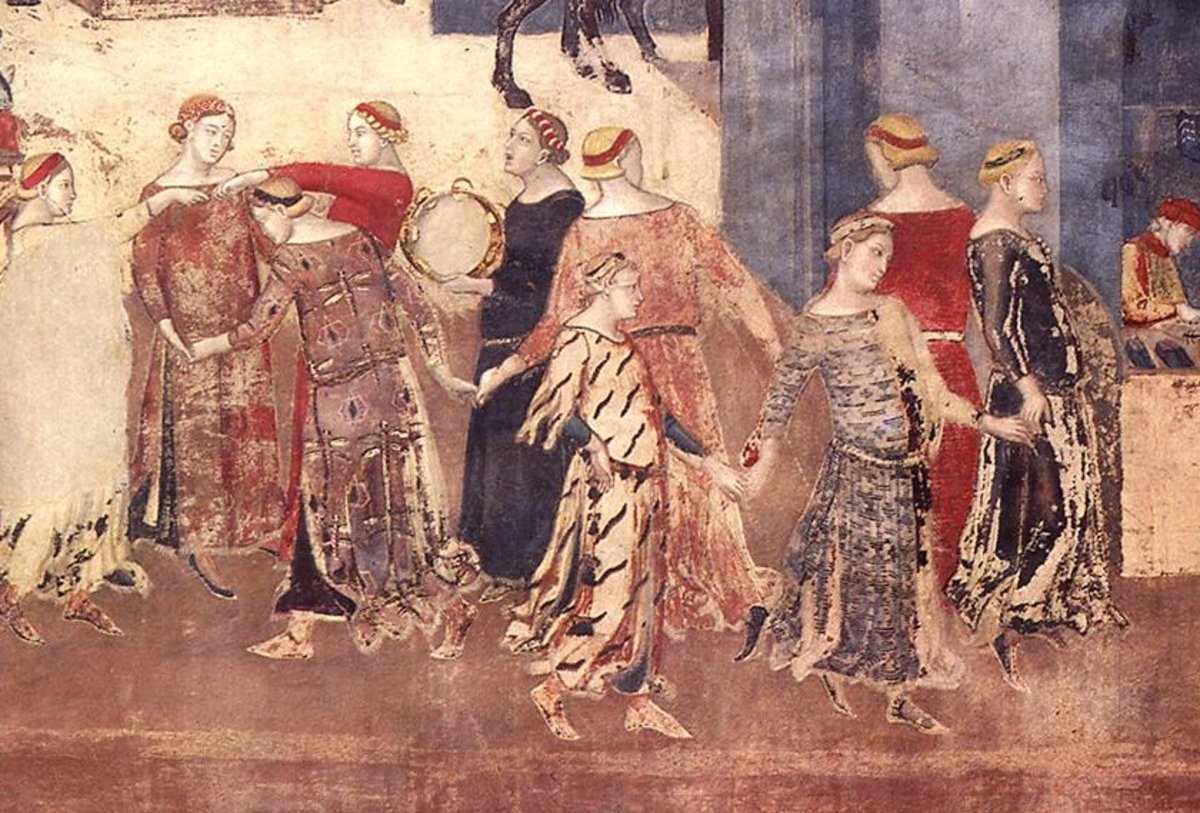
Effects of Good Government — Lorenzetti, 1338-1339, Siena
Ambrogio Lorenzetti, Public domain, via Wikimedia Commons
Ambrogio Lorenzetti's Allegories of Good and Bad Government in the Sala dei Nove of the Palazzo Pubblico in Siena is the most ambitious secular fresco cycle of the 14th century — three connected walls showing allegorical figures of Good and Bad Government, and the effects of good and bad government on the city and countryside. The Good Government wall shows the city of Siena as a prosperous, ordered community: buildings under construction, merchants trading, citizens dancing in the street, farmers working in the countryside outside the city gates.
The Bad Government wall shows Tyranny surrounded by vices and a ruined city. The cycle was painted for the Nine Governors (Nove) of Siena — a secular government — and is a statement of civic virtue rather than religious doctrine. It contains the earliest surviving accurate depiction of a medieval Italian city from life.
Ambrogio Lorenzetti (active c.1317-1348) was, with his brother Pietro, one of the two major Sienese painters of the generation after Duccio. While Duccio and Simone Martini developed the Sienese tradition of gold-background panel painting, Ambrogio was more interested in spatial realism and secular subject matter — the Allegories of Good and Bad Government is the extreme expression of this interest. Ambrogio is thought to have died in the Black Death of 1348; the frescoes in the Palazzo Pubblico are his major surviving work.
The Effects of Good Government in the City (the most preserved section of the cycle) is the painting's most immediately accessible part: the Sienese streets are shown with buildings at various stages of construction, a schoolmaster teaching, merchants on horseback, women dancing. The landscape outside the city gates shows farmers harvesting, hunters riding, travellers on the road. This is the first landscape painting in Western art to show the actual appearance of a contemporary agricultural landscape — not an idealised or symbolic landscape but a real one.
When standing before this work, look carefully: Effects of Good Government — Lorenzetti, 1338-1339, Siena. Give it time — what seems decorative often carries the central meaning.
When standing before this work, look carefully: Siena as prosperous city — earliest accurate cityscape. Give it time — what seems decorative often carries the central meaning.
When standing before this work, look carefully: Effects on the countryside — first landscape painting. Give it time — what seems decorative often carries the central meaning.
When standing before this work, look carefully: Bad Government — Tyranny surrounded by vices. Give it time — what seems decorative often carries the central meaning.
Palazzo Pubblico, Piazza del Campo, Siena. Open daily (hours vary by season). Admission fee applies; the Sala dei Nove is included in the museum entrance.