
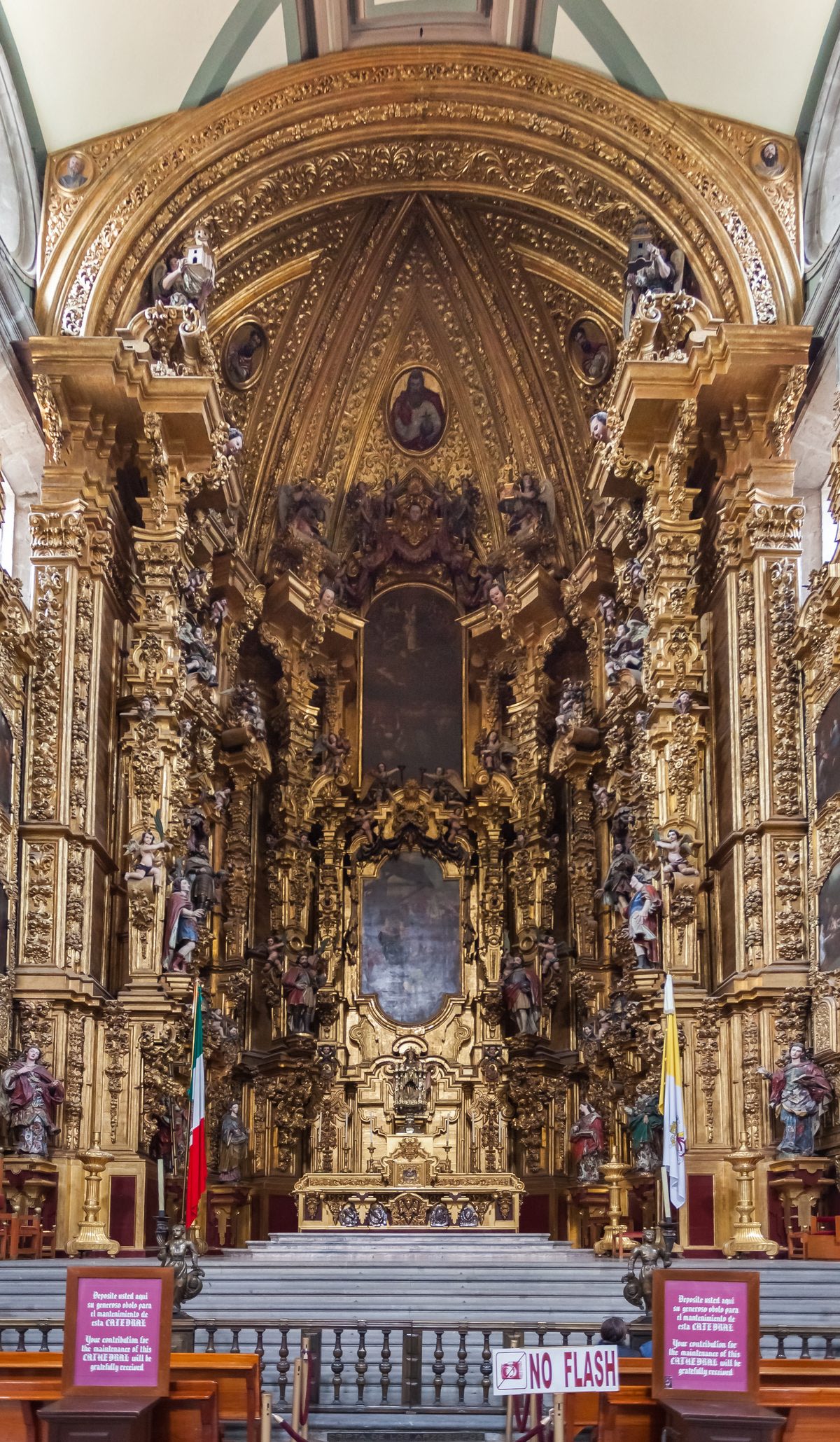
Altar of the Kings (Altar de los Reyes)
Altar de los Reyes — Balbas, 1718-1737
Public domain, via Wikimedia Commons
The Altar de los Reyes (Altar of the Kings) in Mexico City Metropolitan Cathedral is the greatest altarpiece in the New World and the supreme example of the Mexican Ultra-Baroque (Churrigueresque) style — a wall of gilded wood approximately 25 metres high and 13 metres wide, designed by the Spanish architect Jerónimo de Balbás and executed between 1718 and 1737. The altarpiece takes its name from the paintings that occupy the central niches: two large canvases by Juan Rodríguez Juárez depicting the Adoration of the Magi and the Adoration of the Shepherds, flanked and surrounded by an explosion of gilded estipites (tapering pilasters), niches with polychrome sculptures, and decorative carving of extraordinary density and complexity.
The central figure is a painting of the Assumption of the Virgin; above the whole composition, in the apex, the dove of the Holy Spirit. The total effect is overwhelming: the surface of the altarpiece is entirely covered with gilded carving, catching the candlelight in thousands of different facets.
Jerónimo de Balbás (c.1680-1748) brought the Churrigueresque style from Spain to Mexico; the Altar de los Reyes was his most ambitious commission and the founding document of Mexican Ultra-Baroque. The estipite — a pilaster that inverts the classical taper (narrow at the bottom, wide at the top) — was the defining motif of the Churrigueresque and here reaches its most complex and overwhelming development. The influence of the Altar de los Reyes was enormous: it inspired a generation of Mexican altarpiece makers who developed the style into the even more extreme examples found in provincial Baroque churches.
Stand in the crossing of the Metropolitan Cathedral and look east toward the Altar de los Reyes, which fills the entire wall of the apse. The overwhelming golden surface catches candlelight; the individual elements require a guidebook or binoculars to identify.
The two main paintings (Adoration of the Magi and Adoration of the Shepherds) are visible in the large central niches; the sculpted figures in the smaller niches represent kings and queens of Spain (saints of royal blood). The apex of the composition — approximately 25 metres above the floor — is visible only with binoculars.
When standing before this work, look carefully: Altar de los Reyes — Balbas, 1718-1737. Give it time — what seems decorative often carries the central meaning.
When standing before this work, look carefully: Churrigueresque estipites — gilded carving detail. Give it time — what seems decorative often carries the central meaning.
When standing before this work, look carefully: Adoration of the Magi — central canvas by Rodriguez Juarez. Give it time — what seems decorative often carries the central meaning.
When standing before this work, look carefully: Metropolitan Cathedral interior — the apse. Give it time — what seems decorative often carries the central meaning.
Mexico City Metropolitan Cathedral (Catedral Metropolitana de la Asuncion de Maria), Zocalo (Plaza de la Constitución), Mexico City Historic Centre. Open daily.
Free admission. The cathedral is one of the most visited buildings in Mexico.