
Anastasis Fresco and Mosaics
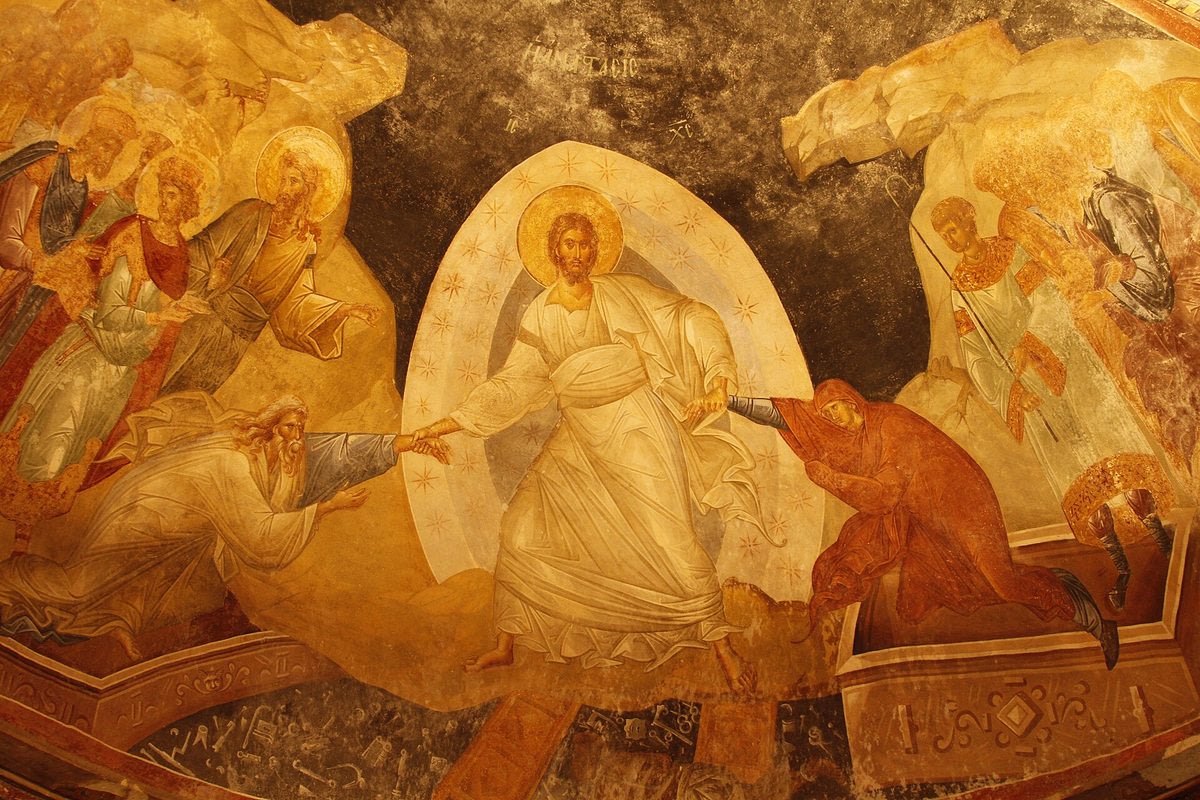
Anastasis fresco — Christ raising Adam and Eve, c.1315-1321
Byzantine, Public domain, via Wikimedia Commons
The Chora Church (Kariye Mosque/Museum) in Istanbul contains the most complete and finest cycle of Late Byzantine frescoes and mosaics in existence — made between approximately 1315 and 1321 for Theodore Metochites, a high official of the Palaeologan court. The church's two narthexes (outer and inner porches) contain a complete cycle of the life of Christ and the life of the Virgin in mosaic; the side chapel (parekklesion) contains frescoes, the supreme example of which is the Anastasis (Resurrection) in the apse.
The Anastasis shows Christ at the moment of the Resurrection/Harrowing of Hell: he stands triumphant on the broken gates of Hell, with Satan bound at his feet, and pulls Adam and Eve from their tombs. The energy and drama of the composition — Christ's swirling white mandorla, his dynamic posture, the rising figures of Adam and Eve — represents the height of Palaeologan artistic achievement.
The Chora decorations were commissioned by Theodore Metochites (1270-1332), who is depicted in the tympanum mosaic above the inner door presenting a model of the church to Christ. Metochites was a humanist scholar as well as an imperial official — his decorative programme shows a sophisticated engagement with both theological tradition and contemporary naturalism. The Palaeologan Renaissance (c.1260-1453) was the final flowering of Byzantine art before the Ottoman conquest: its naturalism, its psychological depth, and its engagement with the antique classical tradition make it a parallel development to the Italian proto-Renaissance of Duccio, Cimabue, and Giotto.
The Anastasis fresco in the parekklesion apse is the most dramatic image in the building — Christ's white mandorla radiates outward; his posture is that of athletic triumph (he leans forward, pulling Adam from his tomb with his right hand, Eve from hers with his left); Satan lies bound beneath his feet, surrounded by the broken locks and hinges of Hell's gates. The two figures being raised (Adam and Eve) represent all humanity — their resurrection is the guarantee of the general Resurrection. Look also at the side wall frescoes: the Anastasis is accompanied by the Last Judgment and the resurrection of the dead, creating a complete Eschatological programme.
When standing before this work, look carefully: Anastasis fresco — Christ raising Adam and Eve, c.1315-1321. Give it time — what seems decorative often carries the central meaning.
When standing before this work, look carefully: Christ's mandorla and dynamic posture. Give it time — what seems decorative often carries the central meaning.
When standing before this work, look carefully: Inner narthex mosaic cycle — Life of Christ. Give it time — what seems decorative often carries the central meaning.
When standing before this work, look carefully: Theodore Metochites presenting the church to Christ. Give it time — what seems decorative often carries the central meaning.
Kariye Mosque (Chora Museum), Edirnekapi, Istanbul. The building was converted to a mosque in 2020; visitor access is possible outside prayer times. The frescoes and mosaics have been covered with cloth in some areas.