
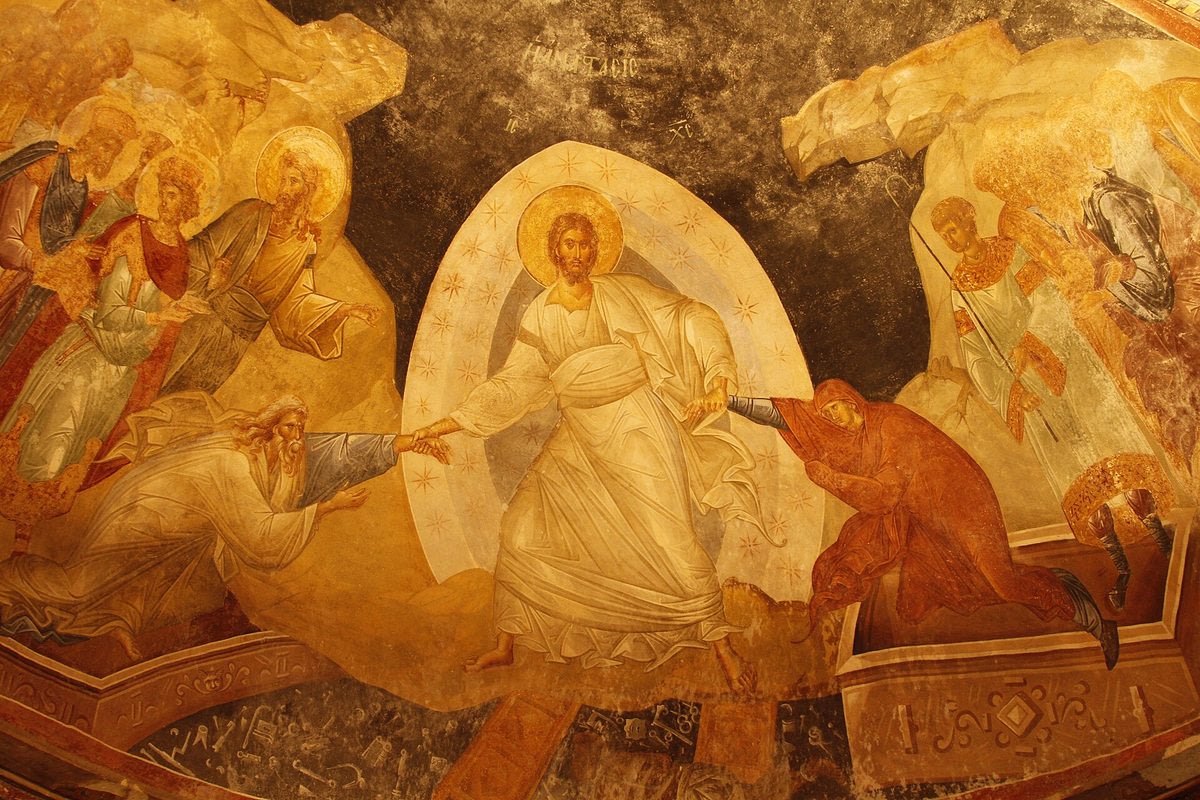
Anastasis (Resurrection) fresco
Anastasis — Byzantine, c.1316-1321, Chora Church Istanbul
Byzantine, Public domain, via Wikimedia Commons
The Anastasis fresco in the Chora Church (Kariye Camii) in Istanbul is universally regarded as the greatest surviving Byzantine fresco — a work of extraordinary theological complexity and artistic power. The Anastasis (Greek for 'Resurrection') shows Christ descending into Hades after his death on the cross to release the souls of the righteous: he stands at the centre, pulling Adam and Eve from their tombs with both hands simultaneously, while the figures of John the Baptist, the prophets, and the righteous kings await liberation on either side.
Behind him, the shattered gates of Hades lie broken on the ground; beneath his feet, the figure of Hades is bound in the depths. The composition is simultaneously a theological statement (the Harrowing of Hell) and a visual image of pure dynamic energy — Christ's movement is balletic, urgent, triumphant.
The Chora Church (Kariye) was rebuilt and decorated in approximately 1316-1321 by the Byzantine nobleman Theodore Metochites — a scholar and statesman who was, at the time of the commission, the most powerful administrator in the Byzantine court. The decoration includes a complete cycle of mosaics in the narthex and frescoes in the Parekklesion (side chapel), of which the Anastasis is the centrepiece in the semi-dome of the apse. The church survived the conversion to Islam (as Kariye Camii) with its decoration intact; it has been a museum (Kariye Müzesi) since 1945 and was reopened as a mosque in 2020.
The Anastasis is best approached as a theology in paint: Christ is not merely 'in' Hades but has shattered it — the doors of Hades lie in fragments beneath his feet, and the figure of the personified Hades (the pagan god of the underworld) is bound in the cavity below. The two figures being raised — Adam (on Christ's left) and Eve (on his right) — are the representatives of all humanity. The foreshortened Adam is one of the most dynamic figures in Byzantine art.
When standing before this work, look carefully: Anastasis — Byzantine, c.1316-1321, Chora Church Istanbul. Give it time — what seems decorative often carries the central meaning.
When standing before this work, look carefully: Christ pulling Adam and Eve — balletic energy. Give it time — what seems decorative often carries the central meaning.
When standing before this work, look carefully: Adam being raised — dynamic foreshortening. Give it time — what seems decorative often carries the central meaning.
When standing before this work, look carefully: Shattered gates of Hades — broken beneath Christ's feet. Give it time — what seems decorative often carries the central meaning.
Kariye Museum (Chora Church), Kariye Camii Sokak, Edirnekapı, Istanbul. Note: status as mosque/museum has fluctuated since 2020 — check current opening status before visiting. When open to public viewing, accessible as a mosque; interior visits may be restricted.