
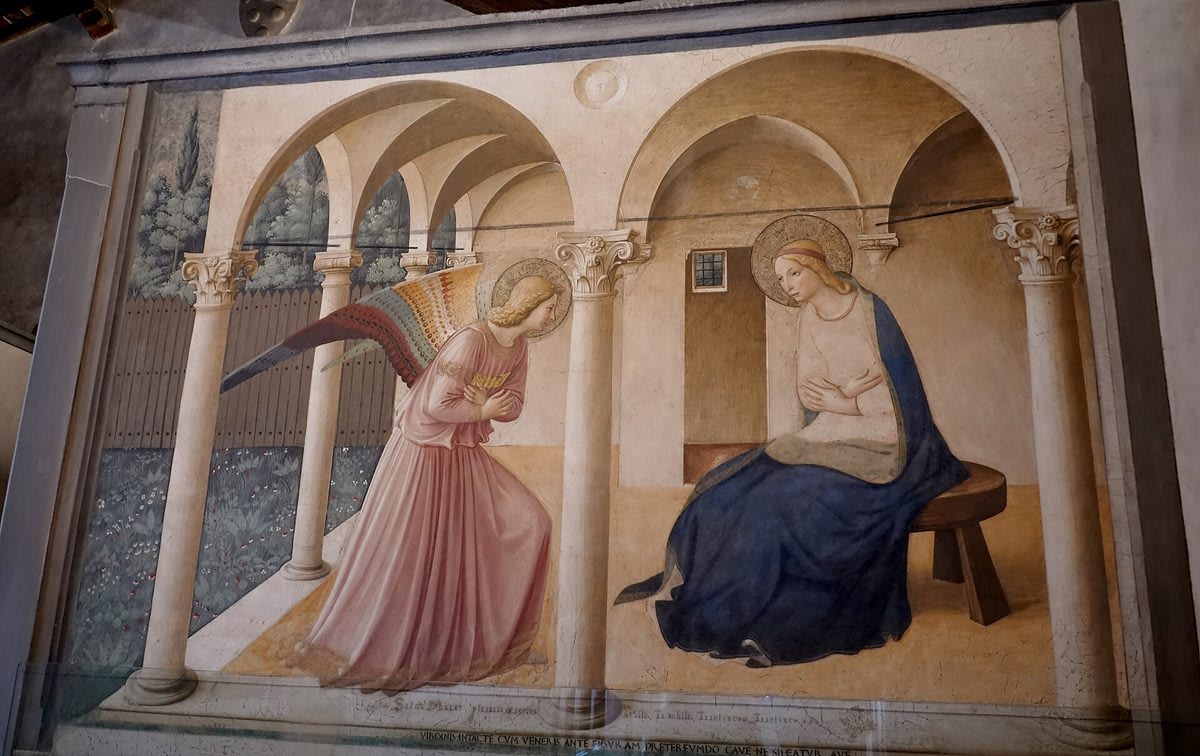
Annunciation (Convent of San Marco)
Annunciation — Fra Angelico, San Marco, c.1438
Fra Angelico, Public domain, via Wikimedia Commons
Fra Angelico's Annunciation at the Convent of San Marco is one of the most beloved images in all of Christian art — a fresco at the top of the dormitory stairs in the former Dominican convent, painted so that the friars would see it first thing each morning as they left their cells. The painting is quiet, spare, and luminous: the Angel Gabriel kneels before the Virgin in an open loggia of Brunelleschian simplicity, his hands crossed on his chest, his wings still; Mary sits and bows her head in acceptance.
The architecture of the loggia — the arches, the columns, the light garden beyond — creates a space of profound calm. At the lower left, a Dominican friar (in prayer) acknowledges that the painting was made for contemplation, not display.
Fra Angelico (Guido di Pietro, c.1395–1455) was a Dominican friar who painted as a form of devotion. He joined the San Marco community in Florence in 1436, when Cosimo de' Medici funded Michelozzo's renovation of the convent, and oversaw the painting of over fifty frescoes throughout the building — each monk's cell received its own fresco as an aid to private prayer.
The cell frescoes are smaller and more intimate; the dormitory landing Annunciation is the public statement. The simplicity and luminosity of Fra Angelico's style — the soft, clear colours, the absence of shadows in the conventional sense, the quality of absorbed spiritual attention in every figure — express a theological position: spiritual reality is luminous and clear, not dark and dramatic.
The composition's power lies in its restraint. There is no dramatic gesture, no narrative dynamism — only the stillness of acceptance. Gabriel's crossed arms signal his posture of humble service; Mary's bowed head signals acceptance ('Let it be done according to your word').
The loggia architecture — white arches, pale plaster — is typical of Brunelleschi's style and identical to the architecture of the actual San Marco convent, blurring the boundary between depicted space and real space. The garden beyond the arches (the garden from which Adam and Eve were expelled) is visible but closed — the Annunciation will undo the Fall. The small Dominican friar kneeling in the lower left is a meditation prompt: the viewer is invited to kneel beside him.
When standing before this work, look carefully: Annunciation — Fra Angelico, San Marco, c.1438. Give it time — what seems decorative often carries the central meaning.
When standing before this work, look carefully: Gabriel — arms crossed, wings folded. Give it time — what seems decorative often carries the central meaning.
When standing before this work, look carefully: The dormitory landing where the fresco is sited. Give it time — what seems decorative often carries the central meaning.
When standing before this work, look carefully: One of the cell frescoes — private devotion. Give it time — what seems decorative often carries the central meaning.
Museo di San Marco, Piazza San Marco, Florence. The museum is the former convent; you walk through the cells where Savonarola and Fra Angelico himself once lived.
The dormitory landing Annunciation is at the top of the stairs leading to the upper floor. Allow time to visit the individual cell frescoes — each a small masterpiece.