
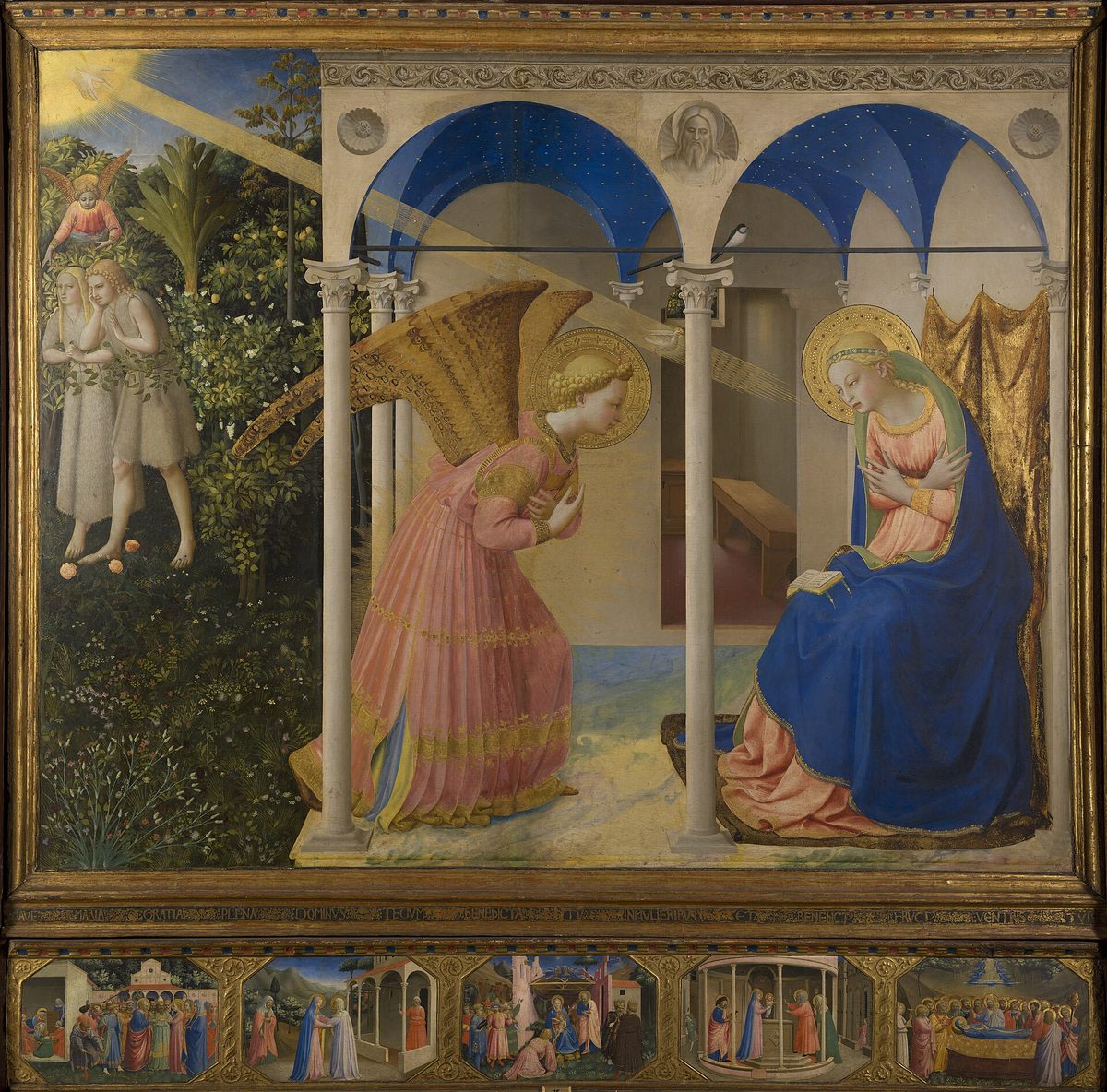
Annunciation (Prado)
Annunciation — Fra Angelico, c.1426, Prado
Fra Angelico, Public domain, via Wikimedia Commons
Fra Angelico's Annunciation in the Prado is one of his finest panel paintings — larger and more elaborate than the San Marco fresco (entry 38) and with a predella cycle depicting scenes from the Life of the Virgin below the main composition. It was made for the Convent of Santo Domingo in Fiesole (near Florence) around 1426 and acquired by the Spanish crown in the 17th century.
The main panel shows Gabriel kneeling before the Virgin in a garden loggia with Ionic columns; in the left panel, the Expulsion from Eden is depicted — Adam and Eve driven from the Garden by an angel, establishing the Annunciation (and the resulting Incarnation) as the reversal of the Fall. The predella below depicts the Birth of the Virgin, the Marriage of the Virgin, the Visitation, the Adoration of the Magi, the Presentation in the Temple, the Death of the Virgin, and the Pentecost.
Fra Angelico's panel Annunciation is larger and more hierarchically elaborate than the intimate San Marco fresco. The loggia setting — white columns, green garden beyond — is similar, but the scale is grander and the figures more architecturally embedded.
The inclusion of the Expulsion at the upper left is theologically precise: the Annunciation is the beginning of the Redemption; the Expulsion is the moment from which Redemption was needed. Gabriel's approach from the right (where the Expulsion has just occurred, on the left) traces the path of divine restoration from the fallen world back to grace. Fra Angelico used lapis lazuli for the Virgin's mantle — the most expensive pigment available, conventional for the most sacred figure.
The gold ground of the main panel is a deliberate formal choice by Fra Angelico — he worked at a time when spatial perspective was established by Brunelleschi and Masaccio, and deliberately chose to retain the gold ground as a statement that sacred space is not natural space. The predella scenes below are remarkable for their narrative clarity: each of the seven scenes is compressed to a minimum of figures and architectural setting, achieving extraordinary narrative efficiency. Look at the quality of the angel's wings (multicoloured, precisely feathered) and the specific depiction of the lily between Gabriel and Mary (the flower of purity and, by implication, of the Annunciation itself).
When standing before this work, look carefully: Annunciation — Fra Angelico, c.1426, Prado. Give it time — what seems decorative often carries the central meaning.
When standing before this work, look carefully: The Expulsion from Eden — upper left panel. Give it time — what seems decorative often carries the central meaning.
When standing before this work, look carefully: The predella — Life of the Virgin cycle. Give it time — what seems decorative often carries the central meaning.
When standing before this work, look carefully: Gabriel kneeling before the Virgin. Give it time — what seems decorative often carries the central meaning.
Museo Nacional del Prado, Madrid. Room 49 (Italian Primitives).