
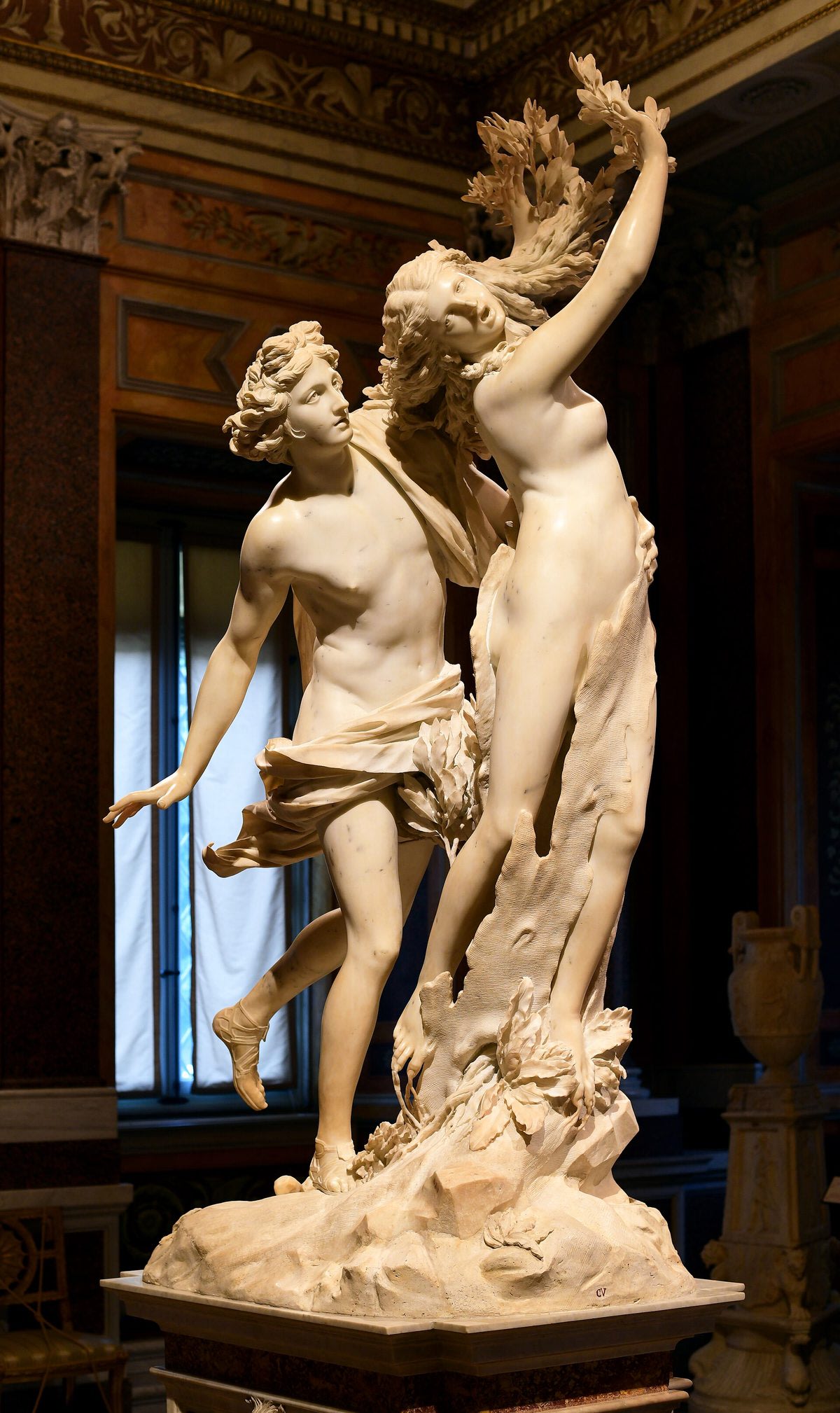
Apollo and Daphne
Apollo and Daphne — Bernini, 1622-1625
Gian Lorenzo Bernini, Public domain, via Wikimedia Commons
Though its subject is mythological, Bernini's Apollo and Daphne in the Galleria Borghese belongs in any survey of Christian sacred art because it was commissioned by Cardinal Scipione Borghese and displayed from the beginning with a Christian moralizing inscription: 'Whoever loves to pursue the form of fleeting beauty, fills his hands with leaves and bitter berries.' The sculpture depicts the moment of metamorphosis from Ovid's Metamorphoses — Apollo pursuing Daphne, who transforms into a laurel tree the instant his hand touches her. Bernini captures the precise split second of transformation: bark is spreading up Daphne's legs, her fingers and hair are becoming leaves and branches, her face is a picture of terrified surprise. Apollo's hand touches her side; he has not yet registered what is happening.
Bernini made Apollo and Daphne when he was between 24 and 27. The sculptural problem was extraordinary: marble — rigid, heavy — was asked to convey leaves, flying hair, running feet, and transformation.
Bernini solved it by drilling deeply into the marble to create transparent passages of light through the leaves and fingers, by polishing the skin surfaces to a smoothness that contrasts with the rough bark texture, and by designing the composition for a specific viewing angle from which the transformation reads as temporally sequential: Daphne's left leg is still human, her right is bark; her left arm is still reaching, her right is already leafing. The moral inscription on the base was added at the suggestion of Maffeo Barberini, who later became Pope Urban VIII — Bernini's great patron.
The optimal viewing position is from the front-right, from which the composition reads as a narrative with a temporal direction: Apollo arriving from the right, Daphne escaping to the left, the transformation occurring at the moment of contact. Circling the sculpture reveals different aspects — from the back, the bark covering Daphne's lower body is most visible; from the left, Apollo's expression of surprised discovery is clearest. The quality of the carving of the laurel leaves — thin as actual leaves, catching light on their edges — is possibly the most technically daring passage in all baroque sculpture.
When standing before this work, look carefully: Apollo and Daphne — Bernini, 1622-1625. Give it time — what seems decorative often carries the central meaning.
When standing before this work, look carefully: The transformation — bark spreading up Daphne's legs. Give it time — what seems decorative often carries the central meaning.
When standing before this work, look carefully: Daphne's fingers becoming laurel leaves. Give it time — what seems decorative often carries the central meaning.
When standing before this work, look carefully: Daphne's face — terror and surprise. Give it time — what seems decorative often carries the central meaning.
Galleria Borghese, Rome. The sculpture is in Room III and is the centrepiece of the room.
Timed entry required; two-hour visits are standard. This is one of the works most copied, most photographed, and most discussed in the history of art — seeing the original remains essential.