
Apotheosis of St Ignatius (Ceiling Fresco)
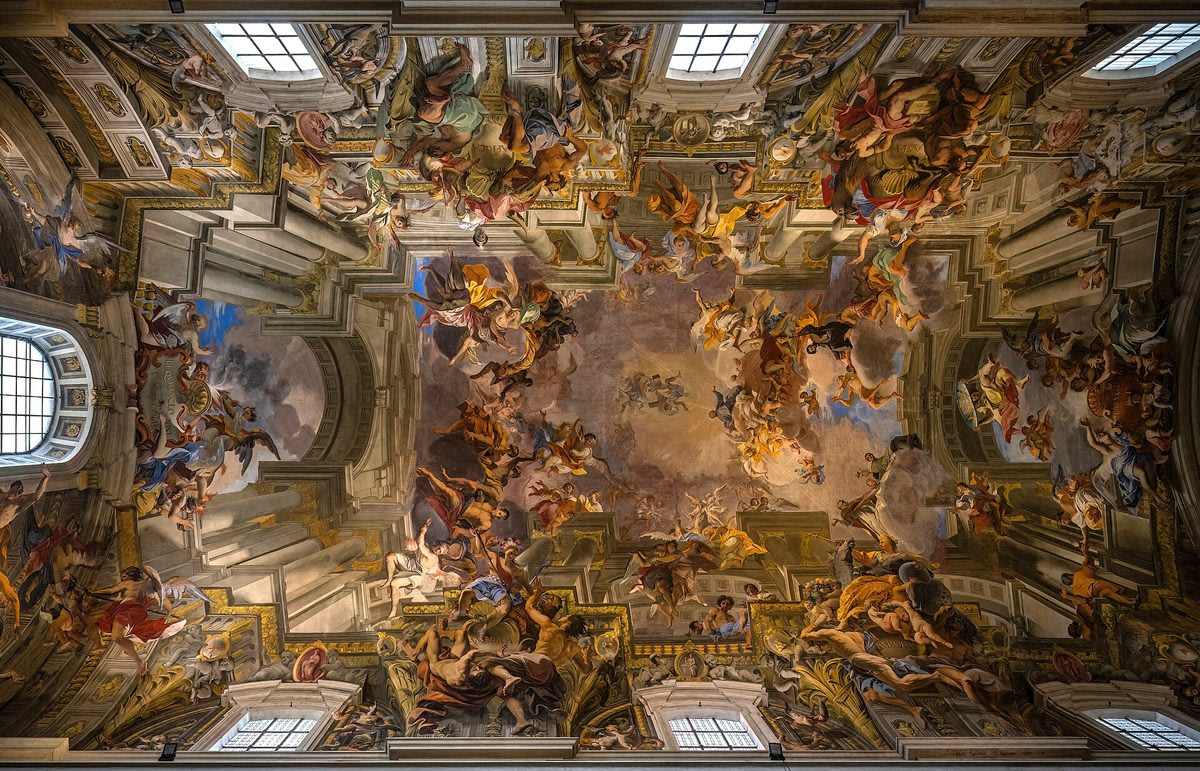
Apotheosis of St Ignatius — the ceiling from the viewing disc
Andrea Pozzo's Apotheosis of St Ignatius is perhaps the most sophisticated exercise in illusionistic architecture in the history of painting — a trompe-l'oeil ceiling fresco that extends the nave of the church of Sant'Ignazio into a completely convincing painted colonnade, arches, and open sky, all executed in perfect perspective from a single viewing point marked on the floor by a disc. From that disc, the painted architecture and the real architecture appear continuous; from any other point, the illusion collapses. The fresco celebrates the Jesuit missions to the four continents — Africa, Asia, the Americas, and Europe — and depicts St Ignatius being received into heaven.
Andrea Pozzo (1642–1709) was a Jesuit lay brother and architect-painter whose theoretical work on perspective (Perspectiva Pictorum et Architectorum, 1693-1700) became one of the most influential technical manuals in European art. The Sant'Ignazio ceiling gave him the opportunity to demonstrate his system at monumental scale.
The church had no budget to build a stone dome; Pozzo painted one instead (visible from a second disc on the nave floor), and the illusion is so convincing that the visitor must check the disc position to know whether the dome is real or painted. The Apotheosis fresco above the nave is even larger and more complex: hundreds of figures in an architectural framework that extends the real space by a fictive 20 metres.
The key to experiencing this fresco is to stand on the marble disc embedded in the nave floor. From there, the illusion is total: the painted columns appear to rise from the real cornice of the nave walls, and the open sky above is convincing in its depth and atmosphere.
Step off the disc in any direction and the perspective distorts immediately — the illusion becomes obvious. This dramatic contrast between 'correct' and 'incorrect' viewing positions is Pozzo's demonstration of the power of mathematical perspective. Look for St Ignatius in the upper centre, surrounded by allegorical figures of the four continents, receiving the rays of light from Christ above.
When standing before this work, look carefully: Apotheosis of St Ignatius — the ceiling from the viewing disc. Give it time — what seems decorative often carries the central meaning.
When standing before this work, look carefully: The nave of Sant'Ignazio — illusionistic architecture. Give it time — what seems decorative often carries the central meaning.
When standing before this work, look carefully: Pozzo's painted dome — visible from the second disc. Give it time — what seems decorative often carries the central meaning.
When standing before this work, look carefully: Detail — allegorical figures of the four continents. Give it time — what seems decorative often carries the central meaning.
Sant'Ignazio di Loyola is near the Pantheon on the Piazza di Sant'Ignazio. The church is free to enter.
The disc on the nave floor is clearly marked. A second disc a few metres closer to the entrance shows the trompe-l'oeil dome.