
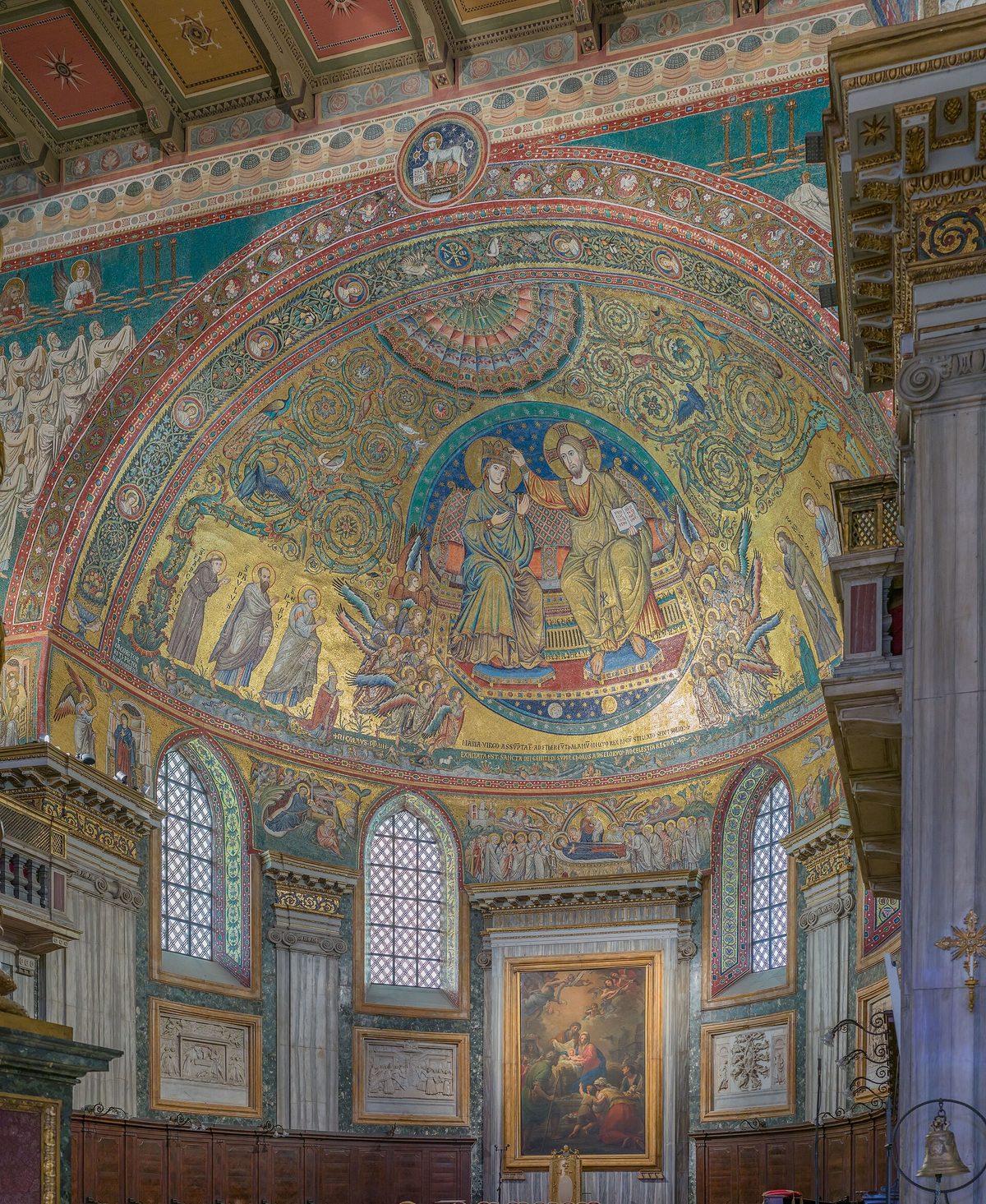
Apse Mosaic of Santa Maria Maggiore
Triumphal arch mosaics — the Marian programme
Santa Maria Maggiore contains the most extensive cycle of Early Christian mosaics in Rome — created under Pope Sixtus III (432-440) and still largely intact after 1,600 years. The nave walls carry twenty-seven Old Testament scenes in mosaic panels (episodes from Genesis, Exodus, and the books of Joshua and Judges), and the triumphal arch above the apse carries a remarkable programme relating to the Council of Ephesus (431), which defined Mary as Theotokos (God-bearer).
The arch shows the Annunciation, the Adoration of the Magi, the Presentation in the Temple, Herod ordering the Massacre of the Innocents, and the Holy Family's flight to Egypt — a comprehensive Marian programme that links Mary's role as Mother of God to the basilica's dedication. The apse mosaic itself (13th-century) shows the Coronation of the Virgin.
Sixtus III built the basilica in the immediate aftermath of the Council of Ephesus to celebrate the definition of Mary's divine maternity. The nave mosaics are the earliest extensive Biblical narrative cycle in monumental Christian art — predating by decades any comparable Byzantine programme.
They show remarkable narrative sophistication: the figures are active, the spatial settings believable, the scale of figures graduated to indicate importance (larger = more significant). Comparison with the roughly contemporary Ravenna mosaics reveals the distinctive Roman approach to Biblical narrative, which is more empirical and less schematic than the Byzantine tradition.
The nave mosaics are high on the walls and require binoculars for full appreciation — but even from the nave floor, the quality and narrative clarity of the scenes are evident. The triumphal arch mosaics are lower and more legible: the Annunciation scene at top left shows Gabriel appearing to Mary who is dressed in royal purple (a Marian iconographic convention that begins here). The later apse mosaic (Coronation of the Virgin, by Jacopo Torriti, 1296) is one of the finest medieval mosaics in Rome and should be viewed alongside the earlier material.
When standing before this work, look carefully: Triumphal arch mosaics — the Marian programme. Give it time — what seems decorative often carries the central meaning.
When standing before this work, look carefully: Nave mosaics — Old Testament narrative cycle. Give it time — what seems decorative often carries the central meaning.
When standing before this work, look carefully: Coronation of the Virgin — Jacopo Torriti, 1296. Give it time — what seems decorative often carries the central meaning.
When standing before this work, look carefully: Facade of Santa Maria Maggiore. Give it time — what seems decorative often carries the central meaning.
Basilica di Santa Maria Maggiore, Piazza di Santa Maria Maggiore, near Termini. One of Rome's four major basilicas; free entry.
Audio guides available. Visited by hundreds of thousands of pilgrims annually.