
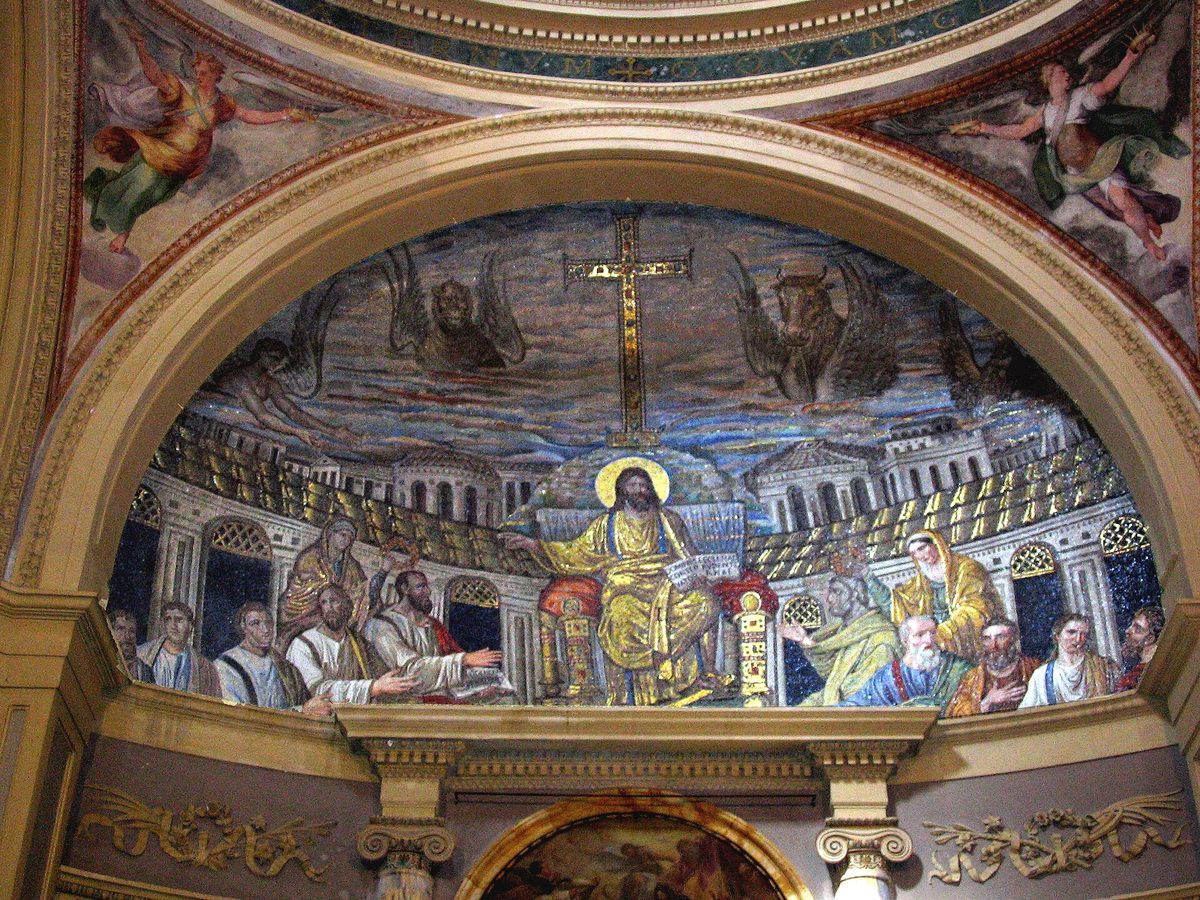
Apse Mosaic of Santa Pudenziana
Santa Pudenziana apse mosaic — full composition
The apse mosaic of Santa Pudenziana is the oldest major Christian mosaic in Rome and one of the oldest in the world — created around the end of the 4th century, when the Roman Empire had recently become Christian under Theodosius I. It depicts Christ enthroned in the centre, clothed in the golden toga of a Roman senator rather than Palestinian robes, surrounded by the twelve apostles also in Roman dress.
Above Christ's head is a jewelled cross rising from a hill, and behind the apostles stands a Jerusalem cityscape with Roman-style buildings — the New Jerusalem of Christian prophecy depicted in the architectural vocabulary of the Imperial city. Two female figures (representing the Church from among the Jews and the Church from among the Gentiles) place laurel crowns on the heads of Peter and Paul.
The mosaic was made during the pontificate of Innocent I (401-417) and possibly begun under Siricius (384-399). Its significance in art history is that it represents the moment when Christian imagery began appropriating the visual vocabulary of Imperial Rome.
Christ is not the Good Shepherd of the catacombs; he is an emperor, enthroned and authoritative, presiding over an assembly of senators. The four apocalyptic creatures (winged man, lion, ox, eagle) appear above the arch — among their earliest appearances in Christian monumental art. Though the mosaic was heavily damaged by medieval alterations and 16th-century restoration work, what survives is sufficient to read the programme clearly.
Look at Christ's face — it is the face of a mature, authoritative ruler, not a suffering servant. The Imperial throne, the gold garments, the frontal pose: these are all adapted from Imperial portrait conventions.
The apostles arranged around him on semicircular benches recall the seating arrangement of the Roman Senate. Behind the cross, the Jerusalem cityscape includes recognisable early Christian basilicas. The two female figures crowning Peter and Paul are the earliest known depiction of Ecclesia ex Gentibus and Ecclesia ex Circumcisione — allegorical figures that would become standard in medieval art.
When standing before this work, look carefully: Santa Pudenziana apse mosaic — full composition. Give it time — what seems decorative often carries the central meaning.
When standing before this work, look carefully: Christ enthroned in Imperial robes. Give it time — what seems decorative often carries the central meaning.
When standing before this work, look carefully: The apostles in Roman dress. Give it time — what seems decorative often carries the central meaning.
When standing before this work, look carefully: Basilica of Santa Pudenziana. Give it time — what seems decorative often carries the central meaning.
Basilica di Santa Pudenziana, Via Urbana 160, near Termini station. One of Rome's oldest churches; the mosaic is above the apse at the end of the nave. The church is relatively uncrowded and frequently open during morning hours.