
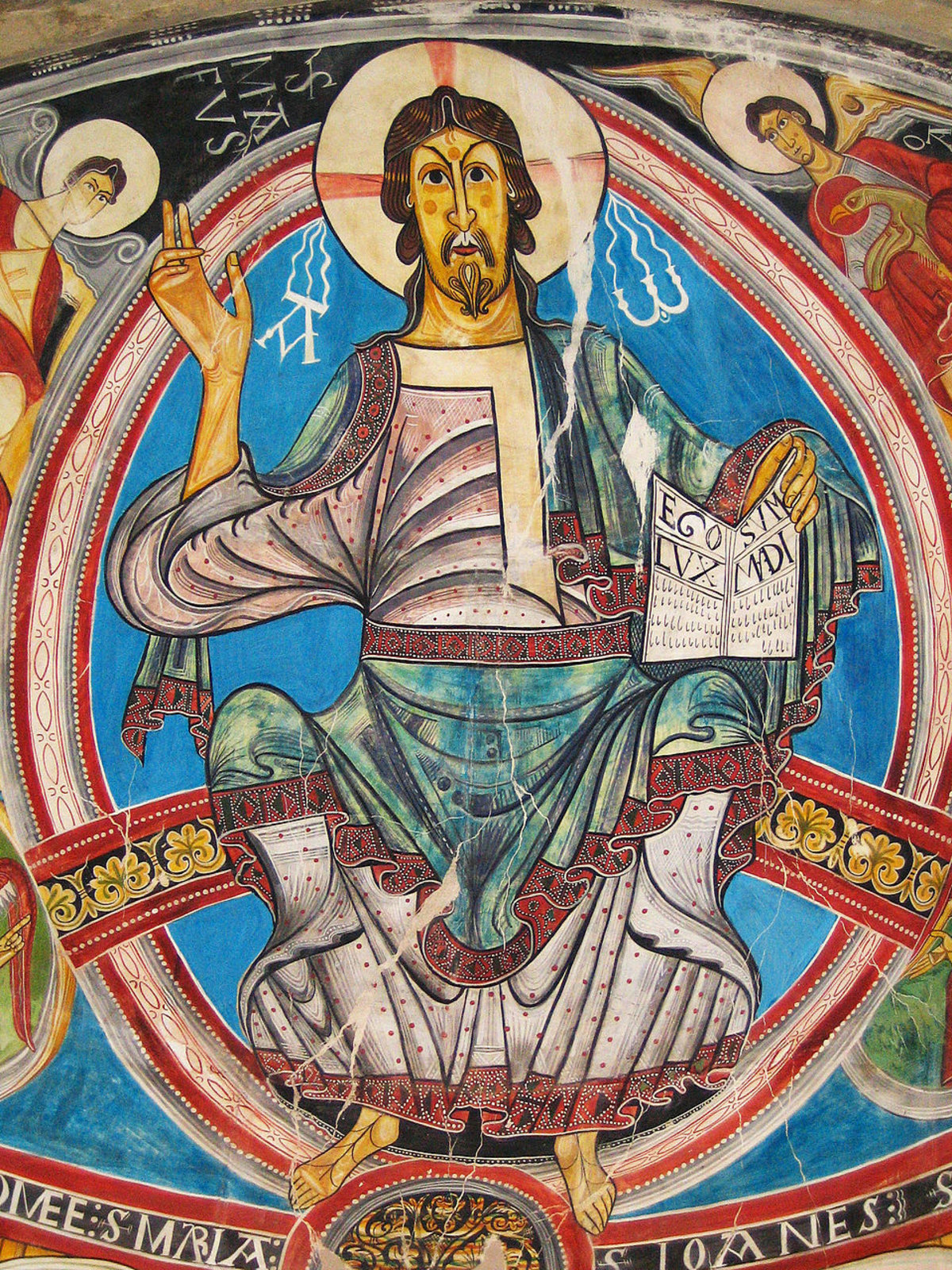
Apse of Sant Climent de Taüll (Pantocrator)
Christ Pantocrator — Sant Climent de Taüll apse, MNAC
Public domain, via Wikimedia Commons
The apse fresco from Sant Climent de Taüll is the masterpiece of Catalan Romanesque painting and one of the most powerful images of Christ Pantocrator in all of Western art. The apse was painted in 1123 — the year of the church's consecration — by the anonymous painter known as the Master of Taüll.
It shows Christ in Mandorla, seated in glory, holding an open book whose inscription reads 'EGO SUM LUX MUNDI' (I am the light of the world), surrounded by the four Evangelists' symbols and the archangels Michael and Gabriel. The figure of Christ has a quality of intense abstract power unique in Romanesque art: the face is built from concentric oval lines, the eyes are enlarged beyond naturalistic proportion, the drapery follows schematic abstract patterns. The effect is of confrontation with an absolute presence — not a human figure but a theological statement in paint.
The Pyrenean churches of the Vall de Boí in Catalonia — of which Sant Climent de Taüll was the finest — were decorated simultaneously in 1123 by a group of painters who appear to have arrived from a single workshop. The Master of Taüll's style is the most distinctive: more austere, more abstract, and more psychologically forceful than his contemporaries.
The frescoes were detached from the church walls in 1919 and transferred to the Museu Nacional d'Art de Catalunya (MNAC) in Barcelona for conservation, where they are now displayed in a reconstruction of the original apse space. A facsimile has been installed in the church at Taüll.
The Christ figure in the apse mandorla should be read from the feet up: the enthroned posture (feet resting on a stool representing the earth), the book, the blessing right hand (the fingers in the gesture of blessing), the face. The face is the culmination: the enlarged eyes (direct frontality, no spatial modelling), the structured drapery of the face's planes, the strict bilateral symmetry — all create an image of divine authority that has no equivalent in contemporary Italian painting. Look also at the feet of the angels and the Evangelists' symbols arranged below the mandorla: the precision of the feet and the careful architectural framing of the lower zone contrast with the abstraction of the central figure.
When standing before this work, look carefully: Christ Pantocrator — Sant Climent de Taüll apse, MNAC. Give it time — what seems decorative often carries the central meaning.
When standing before this work, look carefully: The Christ face — abstract power of the Master of Taüll. Give it time — what seems decorative often carries the central meaning.
When standing before this work, look carefully: Sant Climent de Taüll church — the original site. Give it time — what seems decorative often carries the central meaning.
When standing before this work, look carefully: The MNAC Romanesque galleries, Barcelona. Give it time — what seems decorative often carries the central meaning.
Museu Nacional d'Art de Catalunya (MNAC), Palau Nacional, Parc de Montjuïc, Barcelona. The Romanesque collection at MNAC is the finest in the world — it contains the transferred frescoes from over a dozen Catalan Romanesque churches. The Sant Climent apse is the centrepiece.