
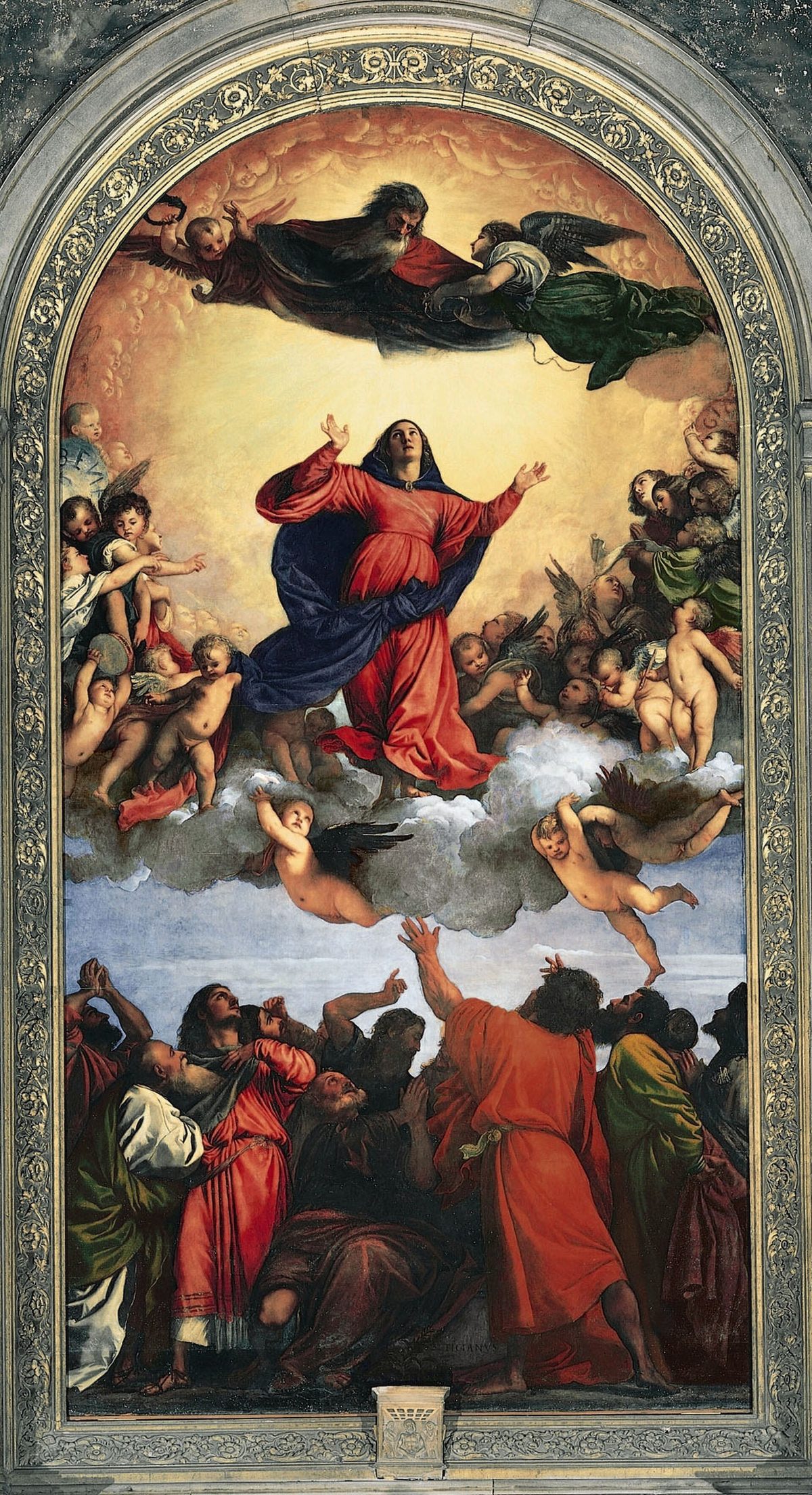
Assumption of the Virgin (Assunta)
Assunta — Titian, 1516-1518, on the Frari high altar
Titian, Public domain, via Wikimedia Commons
Titian's Assunta is the founding work of Venetian High Renaissance painting — a monumental altarpiece (approximately 6.9 metres tall) commissioned for the high altar of the Franciscan Basilica dei Frari. When it was unveiled in 1518, the response was immediate and overwhelming: Titian, at approximately 30 years old, had produced a painting that made everything in Venice look old.
The composition in three registers — the apostles gesticulating below, the Virgin carried upward on clouds by angels in the centre, and God the Father receiving her above — achieves a quality of upward dynamism and heavenly light that no previous Venetian painting had attempted. The Virgin's red dress and her attitude of rapturous acceptance are the centrepiece; the apostles below react with the abandon of witnesses to something beyond comprehension.
Titian (c.1488/90-1576) was in his late twenties or early thirties when he received the Frari commission. Before the Assunta, Venetian painting was dominated by the gentle devotional style of Bellini and the emerging Renaissance vocabulary of Giorgione.
The Assunta transformed both: its theatrical dynamism, its warm luminous colour, its physical expressiveness were all new qualities in Venetian painting. The painting was so successful that Emperor Charles V and King Francis I competed to purchase it; the Franciscans refused to sell. It has been on the high altar of the Frari ever since, visible from the entrance of the church as a golden vision at the end of the nave — one of the great architectural experiences in Western art.
Enter the Frari through the main door and look down the nave: the Assunta is at the end, framed by the medieval choir screen, glowing with warm colour in the church's dim light — a deliberately planned viewing experience. The apse light behind the altar illuminates the painting naturally; Titian calculated the lighting conditions carefully.
The central figure of the Virgin — arms raised, face upturned, red dress against a golden sky — is the largest single figure in Venetian altarpiece painting. The twelve apostles below are individually characterised: some reach upward, some turn to each other, some point toward the ascending Virgin. The whole composition has the quality of arrested upward movement, as if the painter has captured a split second of cosmic transition.
When standing before this work, look carefully: Assunta — Titian, 1516-1518, on the Frari high altar. Give it time — what seems decorative often carries the central meaning.
When standing before this work, look carefully: The ascending Virgin — red dress and golden sky. Give it time — what seems decorative often carries the central meaning.
When standing before this work, look carefully: The apostles below — twelve reactions to the miracle. Give it time — what seems decorative often carries the central meaning.
When standing before this work, look carefully: The Assunta seen from the Frari nave entrance. Give it time — what seems decorative often carries the central meaning.
Basilica dei Frari, Campo dei Frari, San Polo district, Venice. The church is open to visitors (entrance fee).
The Assunta is on the high altar — visible from the nave entrance. The Frari also contains Giovanni Bellini's magnificent triptych (in the sacristy) and Donatello's wooden St John the Baptist.