
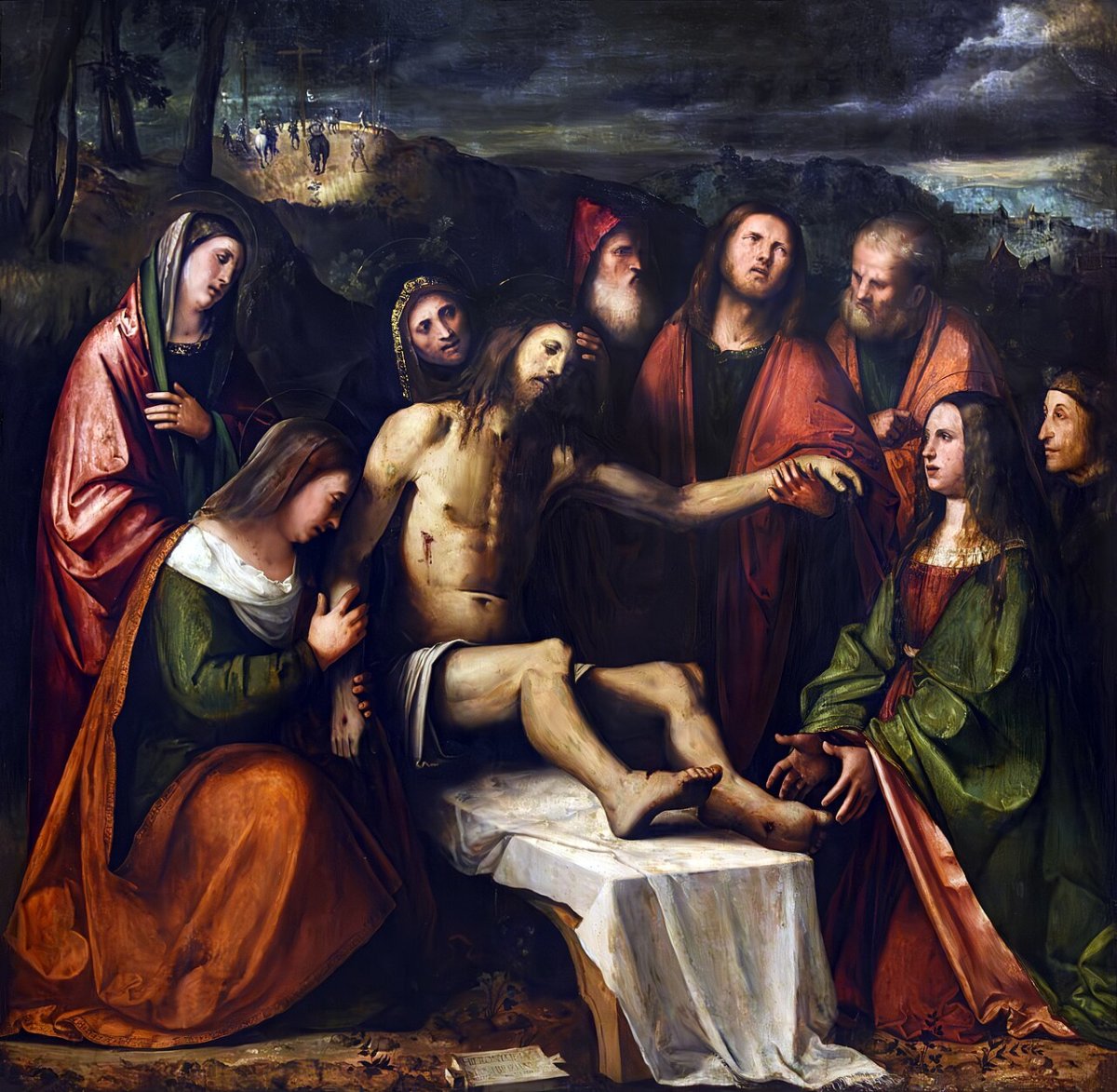
Bandini Pietà (Deposition)
Bandini Pietà — Michelangelo, c.1547-1555
Michelangelo, Public domain, via Wikimedia Commons
Michelangelo's Bandini Pietà — also called the Deposition or the Florence Pietà — is the most personal of his four Pietà sculptures and the one he is reported to have been carving for his own tomb. It shows four figures: the Nicodemus figure supporting Christ's body from above, the Virgin Mary on Christ's left, Mary Magdalene on his right, and Christ himself — limp, heavy, a body in the full weight of death.
The Nicodemus figure is almost universally identified as a self-portrait: Michelangelo appears as the witness and bearer of Christ's body, his aged face bent over the dead Christ in a posture of total involvement. In a documented act of self-destructive frustration, Michelangelo attacked the sculpture with a hammer around 1555, breaking off Christ's left leg and damaging several other areas. The sculpture was repaired by his pupil Tiberio Calcagni.
Michelangelo worked on the Bandini Pietà from around 1547, in his seventies — the period of his life dominated by intense religious meditation (he had joined the spirituali, a reformist Catholic movement) and by the final development of his sculptural style toward increasing simplification and unfinishedness. The sculpture was originally intended for his tomb in Santa Maria Maggiore but he abandoned it after the hammer attack; it was eventually purchased by Francesco Bandini (after whom it is named) and came to the Museo dell'Opera after passing through various collections. The self-portrait of Nicodemus — the man who supplied the linen for Christ's burial (John 19:39-40) — is Michelangelo identifying himself with the act of preparation for burial, appropriate for a tomb sculpture.
The Nicodemus/Michelangelo face is carved with extraordinary old-age specificity — the bagged eyes, the sunken cheeks, the weight of age — in contrast to the idealized faces of the Virgin and Magdalene (the latter recarved by Calcagni) and the polished body of Christ. The deliberately unfinished quality of the Nicodemus figure — rougher than the other figures, with the marks of the chisel still visible — may be intentional: the sculptor appears in the work less finished than his creation. The broken-off left leg of Christ (present at the bottom left of the composition) was not replaced by Calcagni; the missing leg makes the posture of the body more complex and the sense of collapse more complete.
When standing before this work, look carefully: Bandini Pietà — Michelangelo, c.1547-1555. Give it time — what seems decorative often carries the central meaning.
When standing before this work, look carefully: Nicodemus face — Michelangelo's self-portrait. Give it time — what seems decorative often carries the central meaning.
When standing before this work, look carefully: The broken leg — the hammer attack. Give it time — what seems decorative often carries the central meaning.
When standing before this work, look carefully: The Museo dell'Opera del Duomo, Florence. Give it time — what seems decorative often carries the central meaning.
Museo dell'Opera del Duomo, Florence. One of the most moving rooms in the museum is the one dedicated to late Michelangelo — containing both the Bandini Pietà and the Palestrina Pietà (another late work). The museum underwent a major expansion in 2015 and now houses one of the great collections of medieval and Renaissance sculpture in the world.