
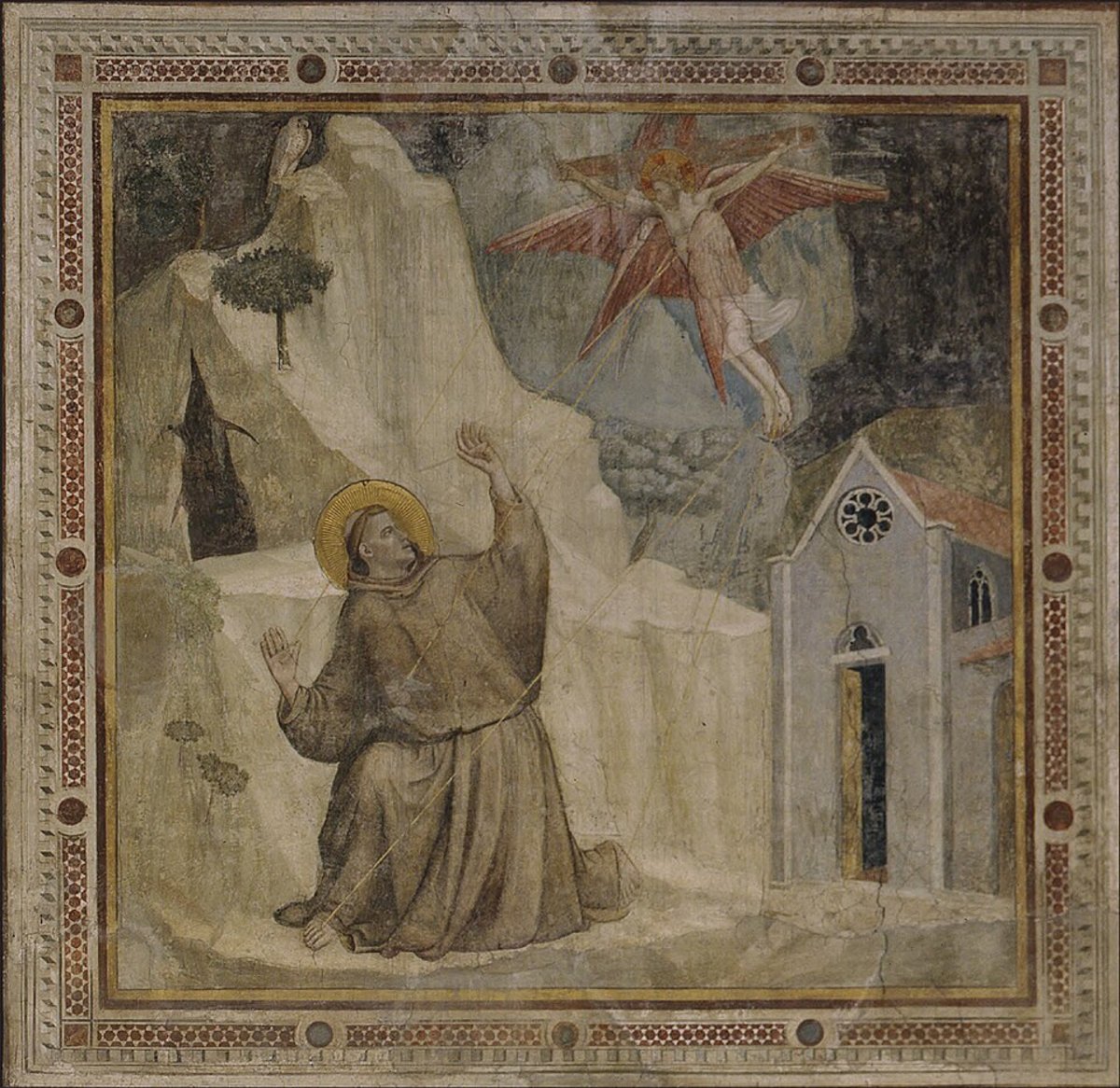
Bardi and Peruzzi Chapel Frescoes (Life of St Francis)
Death of St Francis — Giotto, Bardi Chapel
Giotto di Bondone, Public domain, via Wikimedia Commons
Giotto's frescoes in the Bardi and Peruzzi Chapels in Santa Croce are the only major fresco cycles by his hand that survive in Florence. The Bardi Chapel depicts scenes from the Life of St Francis; the Peruzzi Chapel depicts scenes from the Lives of John the Baptist and John the Evangelist.
They were painted approximately a decade after the Arena Chapel in Padua — Giotto's acknowledged masterwork — and represent his mature style: the figures are larger and more monumental, the narrative more condensed, the architectural settings more elaborate. Vasari praised these frescoes lavishly; they later influenced Masaccio and (through Masaccio) the entire High Renaissance. They were whitewashed in the 17th century, rediscovered in 1852, and imperfectly restored — what we see today has significant losses and 19th-century restoration.
The Franciscan church of Santa Croce was the main Dominican competitor to the Dominican Santa Maria Novella. Both were rebuilt in the late 13th and early 14th centuries with patronal chapels flanking the choir, which were decorated by the leading painters of the age.
Giotto's Bardi Chapel frescoes are the more complete of the two cycles. The scenes include St Francis Renouncing His Father's Goods (where Francis strips off his clothing in the bishop's courtyard), the Ordeal by Fire before the Sultan, the Stigmatization of St Francis, the Death and Funeral of St Francis, and the Apparition of St Francis to his Brothers. Despite the restorations, the scenes demonstrate Giotto's narrative economy: each event is depicted with the minimum number of figures and gestures necessary, and every figure communicates a specific emotional response.
Look at the Death of St Francis: the saint lies on the ground, the friars grouped around him in postures of grief, the angels bearing his soul upward. The arrangement — the ring of mourners, the hierarchical grouping, the angels above — would be repeated in Florentine representations of the Lamentation for the next century.
In the Renunciation scene, Giotto stages the confrontation between the merchant father (gesturing angrily, held back by a bystander) and Francis (naked, turning toward the bishop who shelters him) with the clarity of drama: every body position states an emotional position. The frescoes are badly damaged but sufficiently intact to demonstrate Giotto's mastery of this form.
When standing before this work, look carefully: Death of St Francis — Giotto, Bardi Chapel. Give it time — what seems decorative often carries the central meaning.
When standing before this work, look carefully: St Francis Renouncing His Father's Goods. Give it time — what seems decorative often carries the central meaning.
When standing before this work, look carefully: The Bardi Chapel in Santa Croce. Give it time — what seems decorative often carries the central meaning.
When standing before this work, look carefully: The Stigmatization of St Francis. Give it time — what seems decorative often carries the central meaning.
Basilica di Santa Croce, Piazza Santa Croce, Florence. The Bardi Chapel is the first on the right of the high altar; the Peruzzi Chapel is the second. The church also contains tombs of Michelangelo, Galileo, Machiavelli, and Dante.