
Bathsheba at Her Bath / Holy Family with Angels
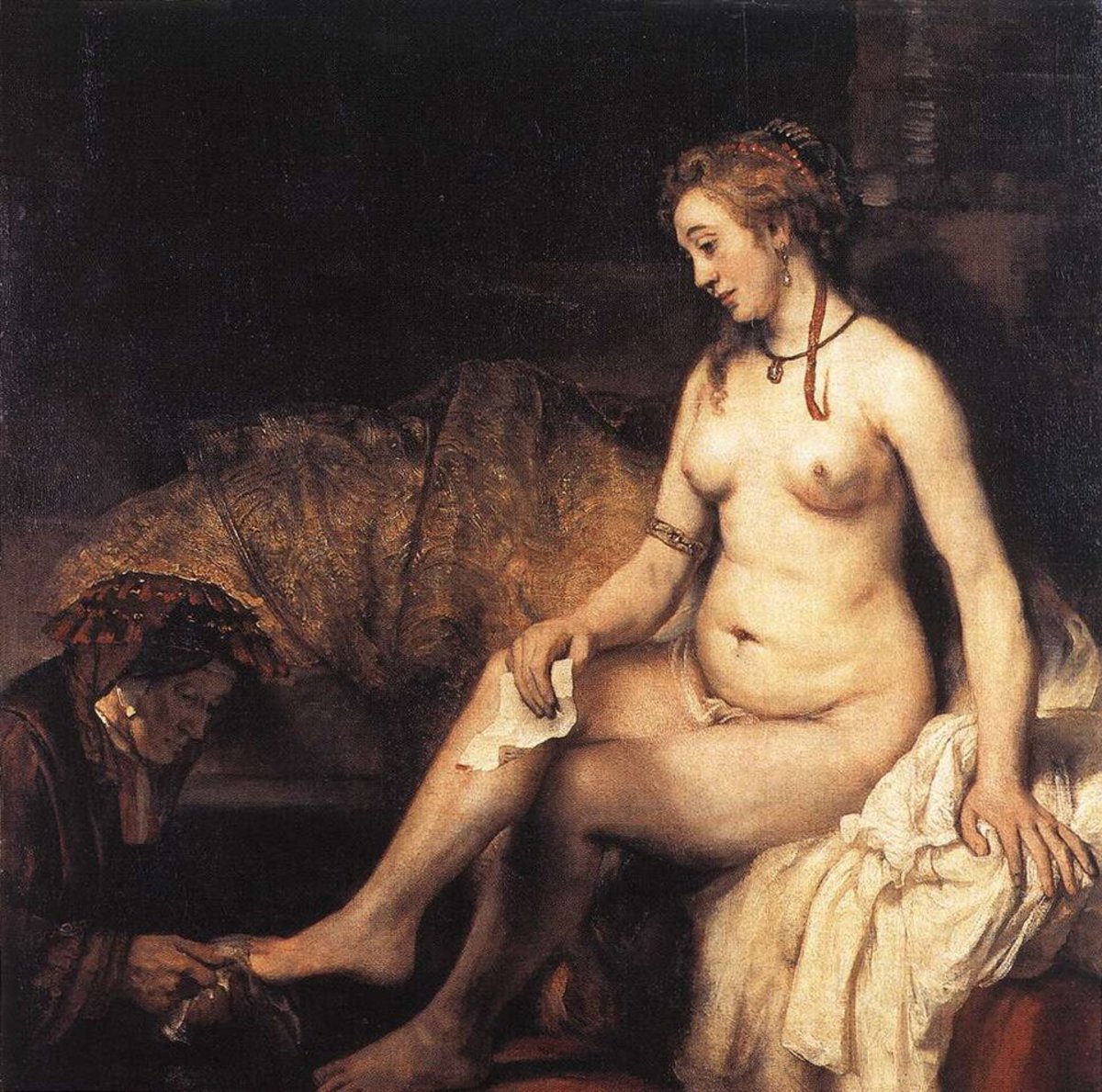
Bathsheba at Her Bath — Rembrandt, 1654, Louvre
Rembrandt van Rijn, Public domain, via Wikimedia Commons
The Louvre holds two major Rembrandt paintings with biblical themes from different periods of his career. Bathsheba at Her Bath (1654) is considered among Rembrandt's greatest achievements: a life-size nude figure of Bathsheba reading David's letter, her body painted from his companion Hendrickje Stoffels, her expression combining the knowledge of what the letter demands (she will be summoned to the king) with a complex mixture of desire, resignation, and melancholy. The Holy Family with Angels (1645) shows the Virgin nursing the Christ Child in a domestic Dutch interior while Joseph works as a carpenter and angels descend from above — the sacred made intimate and domestic in Rembrandt's characteristic way.
Bathsheba at Her Bath (1654) was painted at the height of Rembrandt's mature powers, when his handling of paint had become maximally free — the impasto of Bathsheba's skin and drapery is extraordinarily varied in its texture and thickness. The model for Bathsheba was Hendrickje Stoffels, who was then living with Rembrandt and was pregnant with his child; Rembrandt's contemporaries knew this, and the painting's emotional intensity is inseparable from this biographical context. The Holy Family with Angels (1645) was painted at the happiest period of Rembrandt's life — before the death of his wife Saskia and the beginning of his financial difficulties.
In Bathsheba at Her Bath, the letter is the key element: Bathsheba holds it open, having read it, and the expression on her face (Hendrickje's face) is the painting's entire psychological content — the face of a woman who knows what will happen and is not in a position to refuse. The servant washing her feet is unaware of the letter's content. In the Holy Family with Angels, the angels descending from the upper right break through the domestic normality of a Dutch carpenter's workshop — the sacred interruption of the ordinary, characteristic of Rembrandt's theological imagination.
When standing before this work, look carefully: Bathsheba at Her Bath — Rembrandt, 1654, Louvre. Give it time — what seems decorative often carries the central meaning.
When standing before this work, look carefully: Bathsheba's face reading the letter — psychological depth. Give it time — what seems decorative often carries the central meaning.
When standing before this work, look carefully: Holy Family with Angels — Rembrandt, 1645, Louvre. Give it time — what seems decorative often carries the central meaning.
When standing before this work, look carefully: Angels descending into the domestic interior. Give it time — what seems decorative often carries the central meaning.
Musée du Louvre, Richelieu Wing, Room 844 (Rembrandt). Open Wednesday-Monday 9:00-18:00. Admission fee applies.