
Byzantine Icons Collection (including Deesis and Transfiguration)
Transfiguration apse mosaic — c.565 AD, St Catherine's
Byzantine, Public domain, via Wikimedia Commons
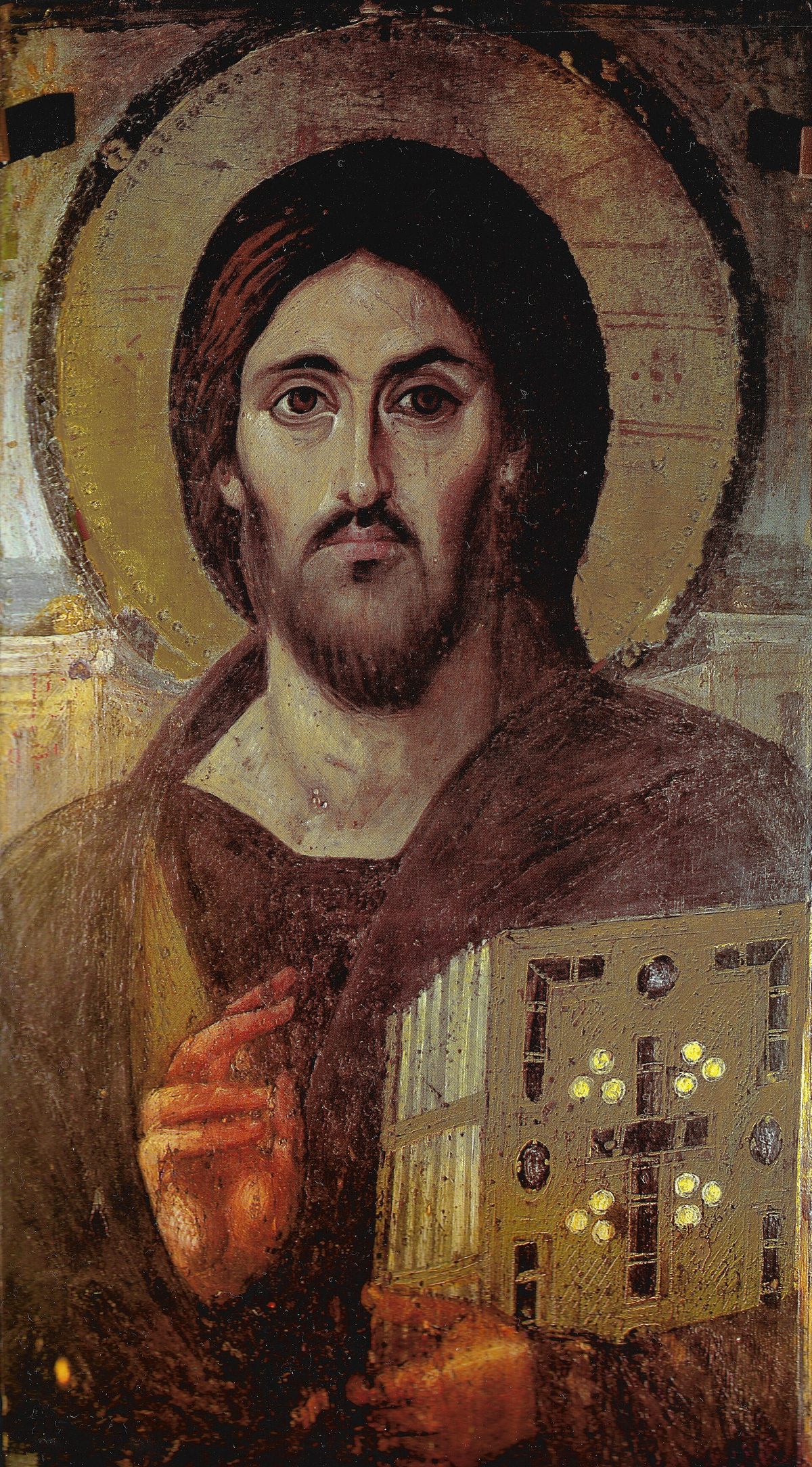
St Catherine's Monastery on Mount Sinai possesses the largest and most important collection of early Byzantine icons in the world — approximately 2,000 icons spanning from the 6th century (the oldest surviving panel icons anywhere) through the 18th century, with the most important concentration in the 6th-century encaustic panels and the 12th-13th-century Byzantine panels. Key works include: a 12th-century Transfiguration mosaic in the apse of the main church (the Basilica of the Transfiguration) depicting Christ in white with Moses and Elias, c.565 AD — one of the oldest Christian apse mosaics in situ; a Deesis icon (Christ flanked by Mary and John in bust) of extraordinary quality; and a series of 13th-century icons in the Palaeologan style including a remarkable icon of the Ladder of Paradise (based on the spiritual text of the monastery's own St John Climacus). The monastery library also contains the Codex Sinaiticus (the oldest surviving complete New Testament in Greek, partially preserved here).
St Catherine's Monastery (officially the Monastery of the God-Trodden Mountain of Sinai) was founded by the Emperor Justinian I in 548-565 at the foot of the mountain traditionally identified as Sinai (Jebel Musa, 2,285 metres). The monastery has been continuously inhabited by Greek Orthodox monks for over 1,400 years; its remoteness protected it from Byzantine Iconoclasm (726-843) and from the various invasions that destroyed Byzantine art elsewhere.
The icon collection is therefore the primary source for understanding the development of early Byzantine icon painting. The Codex Sinaiticus was partly discovered here by Constantine von Tischendorf in 1844 and 1859 (he removed portions, now in the British Library and other collections; a portion remains at the monastery).
Access to the full icon collection requires a special arrangement (academic researchers must apply in advance). General visitors can view icons in the main church and in the icon museum during visiting hours.
The apse mosaic (Transfiguration, c.565 AD) is visible in the main church; it predates the Iconoclasm and shows Christ in white between Moses and Elias — one of the oldest in-situ Christian mosaics. The 6th-century encaustic icons (the Pantocrator, a Peter icon, and others) are in the monastery's collection and accessible in the icon museum.
When standing before this work, look carefully: Transfiguration apse mosaic — c.565 AD, St Catherine's. Give it time — what seems decorative often carries the central meaning.
When standing before this work, look carefully: Deesis icon — Christ with Mary and John. Give it time — what seems decorative often carries the central meaning.
When standing before this work, look carefully: Ladder of Paradise icon — 12th-century Sinai. Give it time — what seems decorative often carries the central meaning.
When standing before this work, look carefully: St Catherine's Monastery — aerial view at foot of Mount Sinai. Give it time — what seems decorative often carries the central meaning.
St Catherine's Monastery, South Sinai, Egypt. Open Monday-Thursday and Saturday (mornings only).
Modest dress required. Accessible by bus or taxi from the town of Saint Catherine (approximately 3.5 km).