
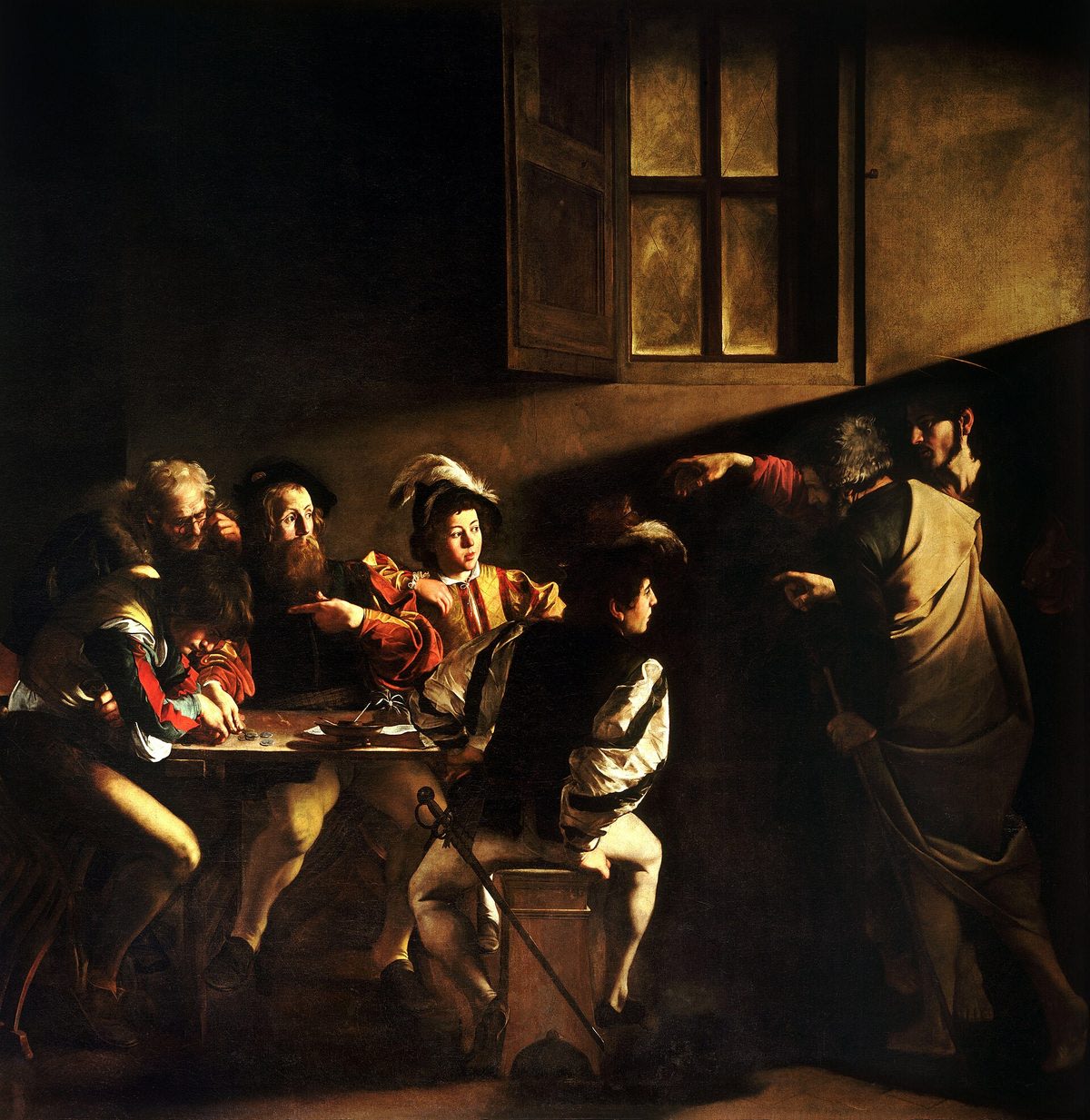
Calling of St Matthew
The Calling of St Matthew — full composition
Caravaggio, Public domain, via Wikimedia Commons
The Calling of St Matthew is one of the greatest paintings in Rome and the work that established Caravaggio's revolutionary style for the entire 17th century. It occupies the left wall of the Contarelli Chapel in San Luigi dei Francesi — the French national church in Rome — facing the Martyrdom of St Matthew on the right wall.
In the Calling, Christ enters from the right with St Peter, his arm extended in a gesture borrowed from Michelangelo's Creation of Adam, pointing across the room at Matthew — the tax collector who sits at a table counting money with four companions. A shaft of supernatural light follows Christ's gesture and illuminates the scene. Matthew's response — he points at himself, as if asking 'me?' — is the human centre of the painting.
Michelangelo Merisi da Caravaggio (1571–1610) was 28 when he received the Contarelli Chapel commission in 1599 — his first major public commission. He had been working in Rome since about 1592, had already painted several significant works (the Penitent Magdalene, the Fortune Teller), and had been supported by Cardinal Francesco Maria del Monte.
The chapel commission required three large paintings and transformed his career. Caravaggio's revolutionary contribution was the use of chiaroscuro (extreme light-dark contrast) not as a modelling technique but as a theological tool: light in his paintings is divine energy, entering ordinary space from an unseen source, illuminating some figures and leaving others in shadow. In the Calling, the shaft of light that follows Christ's gesture makes the ordinary space of a Roman tavern a site of divine intrusion.
Christ's extended arm and Matthew's self-pointing response are the compositional and theological poles. Notice that Christ's face is almost invisible — in shadow, partly obscured by Peter — while his gesture is entirely visible. The divine intrudes through action, not presence.
Matthew is dressed in contemporary Roman street clothes, surrounded by figures in similar dress — one of whom (the young man in yellow) appears oblivious to Christ's entry. The counting coins on the table catch light as well as the human faces: money and grace occupy the same space. The shaft of light enters from the upper right (a window not shown in the painting) and strikes Matthew's face and hands. Caravaggio uses his thumb and two fingers to count in a gesture contemporary Roman audiences would have immediately recognised.
When standing before this work, look carefully: The Calling of St Matthew — full composition. Give it time — what seems decorative often carries the central meaning.
When standing before this work, look carefully: Christ's arm and Matthew's response. Give it time — what seems decorative often carries the central meaning.
When standing before this work, look carefully: The Contarelli Chapel — all three Caravaggio paintings. Give it time — what seems decorative often carries the central meaning.
When standing before this work, look carefully: Matthew pointing at himself — 'Me?'. Give it time — what seems decorative often carries the central meaning.
San Luigi dei Francesi is near the Piazza Navona. The Contarelli Chapel is the last chapel on the left nave.
A coin-operated light system illuminates the paintings (bring coins/small change). The three Caravaggio paintings are among the most important in Rome; the chapel is usually crowded but viewing is possible from the entrance. Photography is technically prohibited.