
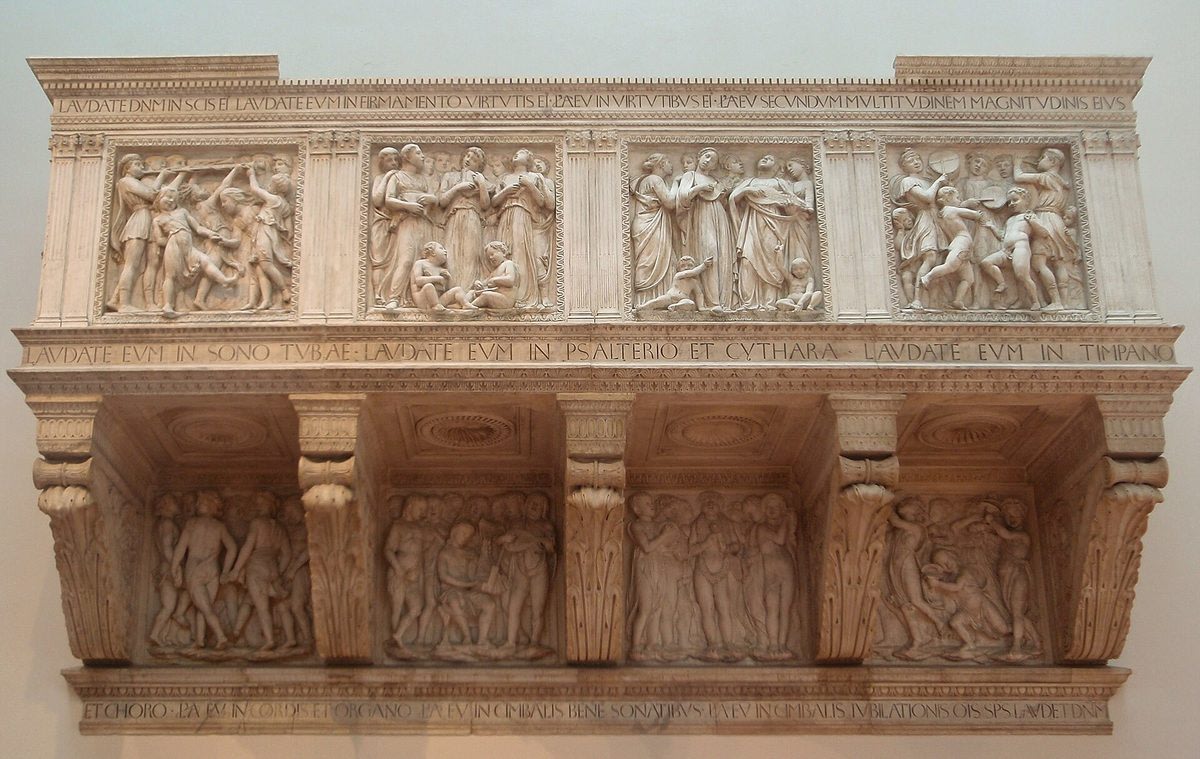
Cantoria (Singing Gallery) reliefs
Cantoria — Luca della Robbia, 1431-1438, Museo dell'Opera
Luca della Robbia, Public domain, via Wikimedia Commons
Luca della Robbia's Cantoria (singing gallery) for Florence Cathedral (1431-1438) is one of the most exuberant and joyful works of 15th-century sculpture — a marble relief series showing children singing, dancing, and playing musical instruments in celebration of Psalm 150 ('Praise him with the sound of the trumpet... with dancing... with stringed instruments... with organs'). The Cantoria was commissioned to face Donatello's Cantoria (1433-1438) across the nave of the cathedral at the level of the sacristy doors; both were dismantled in 1688 for the wedding of Ferdinand de' Medici and are now in the Museo dell'Opera del Duomo. Luca's ten relief panels show groups of children (pueri cantores — the boys of the cathedral choir) in various musical activities; each panel captures a different aspect of musical celebration.
Luca della Robbia (1399/1400-1482) received the Cantoria commission as a young sculptor at the beginning of his career. The work demonstrates his mastery of marble carving and his ability to represent children in movement with a naturalness unprecedented in Italian sculpture.
The Cantoria gave him his reputation in Florence; he later developed the glazed terracotta technique that made the workshop commercially and artistically dominant. The comparison between Luca's Cantoria and Donatello's across the same room in the Museo dell'Opera is one of the great exercises in understanding contrasting approaches to Renaissance sculpture.
The individual panels of Luca's Cantoria each show a different musical activity: a group of singers reading from a manuscript; children playing trumpets; children dancing; children playing cymbals. The quality of observation — the children's faces, the physicality of their movement, the variety of their poses — is Luca at his most classical. In the Museo dell'Opera del Duomo, the Cantoria is displayed on one wall while Donatello's Cantoria faces it across the room: the contrast between Luca's lyrical classicism and Donatello's intense expressionism is immediately visible.
When standing before this work, look carefully: Cantoria — Luca della Robbia, 1431-1438, Museo dell'Opera. Give it time — what seems decorative often carries the central meaning.
When standing before this work, look carefully: Children singing — joyful marble relief. Give it time — what seems decorative often carries the central meaning.
When standing before this work, look carefully: Children dancing — movement in marble. Give it time — what seems decorative often carries the central meaning.
When standing before this work, look carefully: Children playing instruments — Psalm 150. Give it time — what seems decorative often carries the central meaning.
Museo dell'Opera del Duomo, Piazza del Duomo 9, Florence. Open Monday-Saturday 9:00-19:00, Sunday 9:00-13:45. Admission fee applies.