
Cathedral Mosaics (Christ Pantocrator)
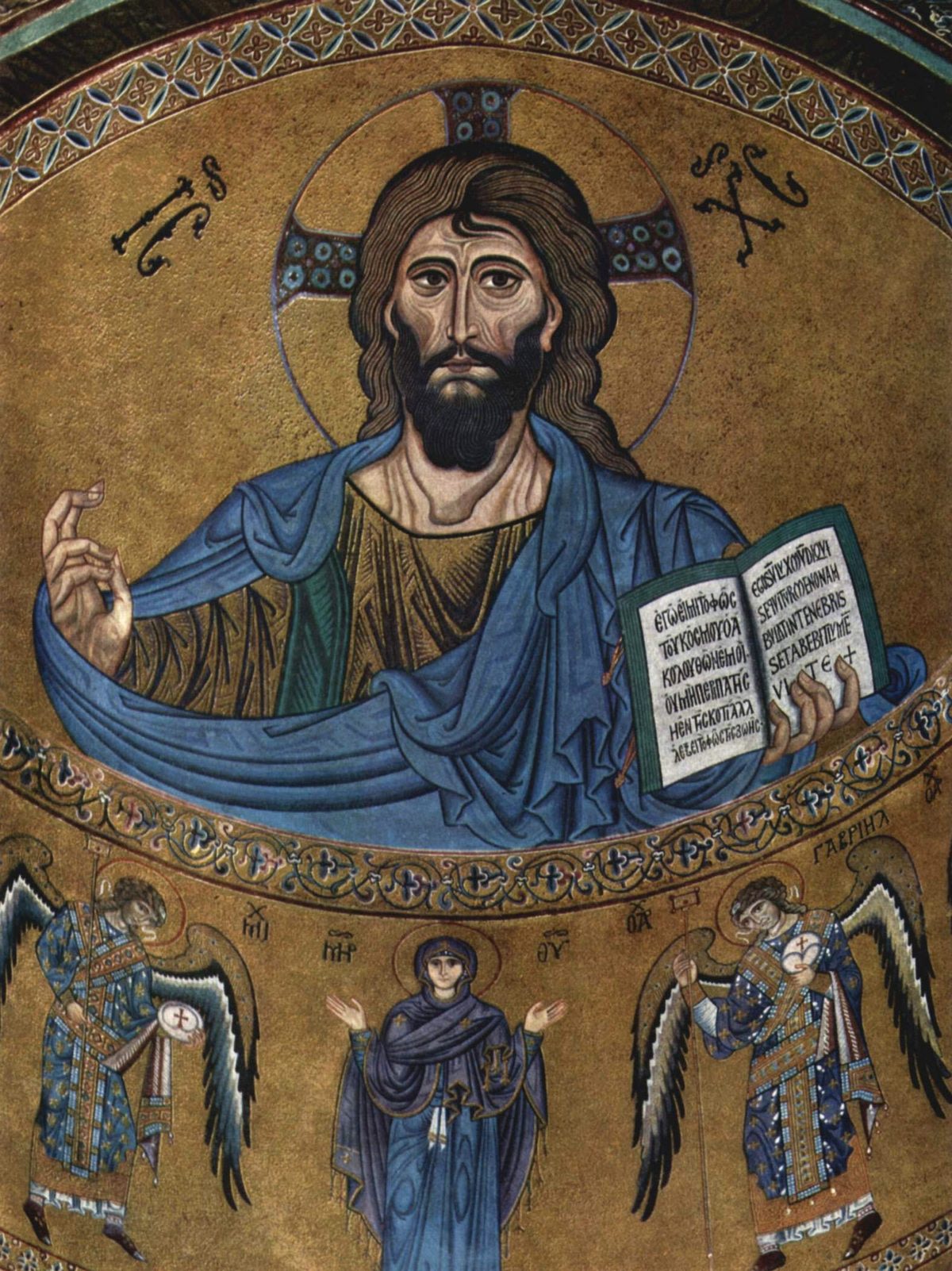
Christ Pantocrator — Monreale Cathedral apse mosaic
Public domain, via Wikimedia Commons
The mosaics of Monreale Cathedral in Sicily are the most extensive cycle of medieval mosaics in the world outside Hagia Sophia — covering approximately 6,340 square metres of wall and vault surfaces with gold-ground mosaics depicting the entire Bible from Genesis to the Acts of the Apostles. The most celebrated single image is the enormous Christ Pantocrator (All-Ruler) in the apse: a half-figure of Christ holding an open Bible (in Greek and Latin: 'I am the light of the world'), his right hand raised in blessing, filling a mosaic field approximately 13 metres wide and occupying the entire curved apse wall.
His face, approximately 2.5 metres tall, is among the supreme images of divine authority in Christian art — serene, remote, absolute. Monreale was built by the Norman king William II of Sicily (r.1166-1189) as a statement of royal power and dynastic piety.
The Norman kingdom of Sicily (1130-1194) was a unique cultural synthesis: a French-Norman royal house ruling a population of Byzantines, Arabs, Italians, and Jews, employing Byzantine artists to decorate Christian churches in Latin liturgical contexts. The Monreale mosaics were made by Byzantine craftsmen — probably from Constantinople — working on commission from the Norman kings.
The programme is entirely Western Catholic in its theology and iconography (Old and New Testament in sequential narrative) but entirely Byzantine in its technique and its pictorial conventions (gold ground, frontal figures, Greek inscriptions). The result is a visual language of exceptional coherence and authority: the systematic gold background unifies the entire interior into a single luminous environment.
Stand at the entrance to the cathedral nave and look toward the apse: the Christ Pantocrator fills the entire apse above the altar with a presence that is overwhelming from the entrance and grows as you approach. Then read the nave walls: the Old Testament cycle (Genesis through Moses) runs along the upper register of the nave walls; the Life of Christ runs in the choir and transepts.
The individual scenes are Byzantine narrative formula but executed with extraordinary quality and variety. Look at the mosaic of the Last Supper: twelve figures arranged at table, Judas dark-faced opposite Christ, the apostles in attitudes of agitation — narrative quality within Byzantine convention. The cloister adjacent to the cathedral is one of the most beautiful Norman-Arab architectural spaces in the world.
When standing before this work, look carefully: Christ Pantocrator — Monreale Cathedral apse mosaic. Give it time — what seems decorative often carries the central meaning.
When standing before this work, look carefully: The nave mosaics — Old Testament cycle. Give it time — what seems decorative often carries the central meaning.
When standing before this work, look carefully: Monreale Cathedral interior — 6,340 sq m of mosaics. Give it time — what seems decorative often carries the central meaning.
When standing before this work, look carefully: The Norman-Arab cloister adjacent to the cathedral. Give it time — what seems decorative often carries the central meaning.
Monreale Cathedral (Duomo di Monreale), Piazza Guglielmo II, Monreale. Monreale is approximately 8 km southwest of Palermo, accessible by bus or taxi from central Palermo. Entry to the cathedral is free; the roof, the cloister, and the treasury require separate admission.