
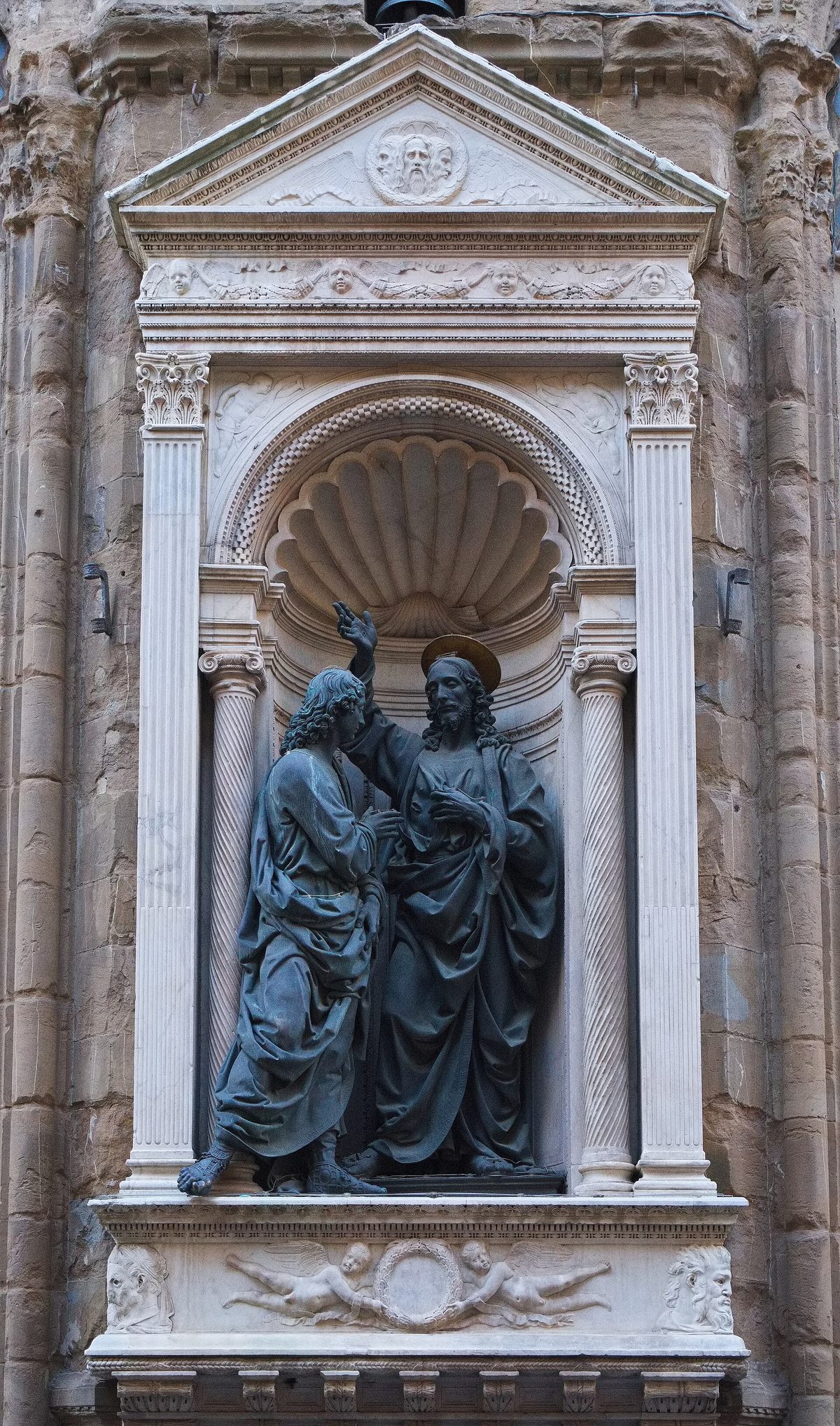
Christ and St Thomas
Christ and St Thomas — Verrocchio, 1467-1483, Orsanmichele
Andrea del Verrocchio, Public domain, via Wikimedia Commons
Verrocchio's bronze group of Christ and St Thomas, installed in one of the external niches of Orsanmichele in Florence, is one of the masterpieces of 15th-century bronze sculpture. The subject is the moment after the Resurrection when the doubting Thomas is invited to place his hand in Christ's wound: 'Reach your hand here, and put it into my side; and do not be unbelieving, but believing' (John 20:27).
Verrocchio's solution to the commission — which replaced an existing figure in the niche — was unprecedented: instead of filling the deep Gothic niche with a single figure, he placed two figures (Christ and Thomas) in the niche mouth, with Thomas's foot actually stepping out of the niche onto the street, breaking the architectural boundary. The group was the most ambitious secular-religious bronze commission of the Florentine Quattrocento.
Andrea del Verrocchio (c.1435-1488) was the leading sculptor and painter of Florence in the 1460s-1480s — and the master of Leonardo da Vinci. He received the commission for the Orsanmichele group from the Tribunal of Merchants in 1467 and completed it in 1483 — a sixteen-year gestation that reflects the extraordinary care and ambition he brought to the project.
The original bronze group is now displayed inside Orsanmichele museum to protect it from weathering; bronze replicas are in the external niche. Verrocchio also created the famous equestrian statue of Bartolomeo Colleoni in Venice (cast after his death in 1496).
The physical posture of the two figures embodies the theological moment: Christ draws back his robe to expose the wound in his side; Thomas leans forward, one hand raised toward the wound, his expression caught between doubt and dawning belief. The moment of touch — Thomas's finger entering the wound — is the moment of faith: 'My Lord and my God.' Verrocchio gives both figures equal psychological weight; this is not a confrontation but an exchange, a conversion, taking place in the space between two extraordinary faces.
When standing before this work, look carefully: Christ and St Thomas — Verrocchio, 1467-1483, Orsanmichele. Give it time — what seems decorative often carries the central meaning.
When standing before this work, look carefully: Thomas reaching toward the wound — doubt to belief. Give it time — what seems decorative often carries the central meaning.
When standing before this work, look carefully: The two faces — exchange not confrontation. Give it time — what seems decorative often carries the central meaning.
When standing before this work, look carefully: External niche — Thomas's foot breaking the boundary. Give it time — what seems decorative often carries the central meaning.
Orsanmichele, Via dell'Arte della Lana, Florence. The bronze replicas are in the external niche (street-level, visible at all hours). The original bronzes are inside the Orsanmichele museum, accessible when open (typically Tuesday-Sunday).