
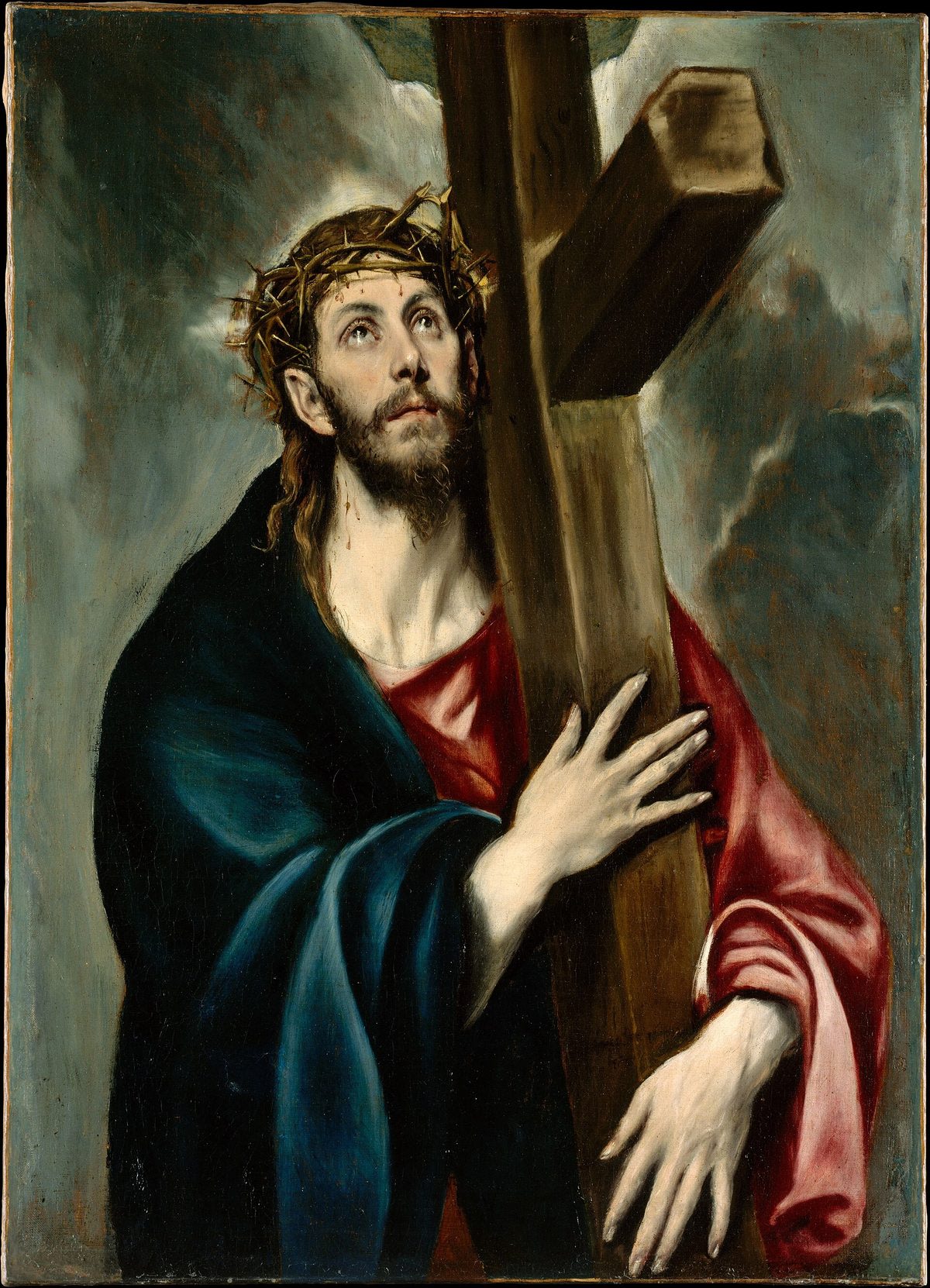
Christ Carrying the Cross
Christ Carrying the Cross — El Greco, c.1577-1587
El Greco, Public domain, via Wikimedia Commons
El Greco's Christ Carrying the Cross in the Metropolitan Museum is a devotional half-length image showing Christ bearing the cross, his eyes turned upward toward heaven, the wooden cross beam over his shoulder, his expression a combination of physical effort and spiritual transcendence. El Greco repeated this composition numerous times throughout his career in Toledo — the type was extremely popular as a devotional image for private contemplation. The Metropolitan's version (approximately 105 by 79 cm) is from his mature period and demonstrates the characteristic qualities of his Toledo style: the elongated figure, the expressionistic distortion of anatomy, the cool blues and acid greens of his palette, and the sense of divine light emanating from within the figure rather than falling upon it from outside.
El Greco (Domenikos Theotokopoulos, 1541-1614) was born in Crete, trained in Venice under Titian, worked briefly in Rome, and settled permanently in Toledo (Spain) in 1577 — where he developed his fully personal style, combining Byzantine icon-painting tradition, the influence of Titian and Tintoretto's Venetian colour, and Michelangelo's figure sculpture into something entirely new. His Christ Carrying the Cross was one of his most commercially successful subject types: he and his workshop produced numerous versions for the private devotional market of Counter-Reformation Spain, where the meditative contemplation of the Passion was central to spiritual practice.
The specific quality of El Greco's Christ is the contrast between physical suffering and spiritual peace: the posture (bent under the weight of the cross) and the face (eyes lifted toward heaven, expression of transcendent calm) simultaneously express the agony of the Passion and its ultimate meaningfulness. The upturned eyes are Byzantine in origin — the prayer gesture of the Byzantine icon tradition — but transformed by El Greco's Venetian painterly technique into something psychologically vivid.
When standing before this work, look carefully: Christ Carrying the Cross — El Greco, c.1577-1587. Give it time — what seems decorative often carries the central meaning.
When standing before this work, look carefully: The upturned eyes — Byzantine prayer gesture. Give it time — what seems decorative often carries the central meaning.
When standing before this work, look carefully: El Greco's palette — cool blues and acid greens. Give it time — what seems decorative often carries the central meaning.
When standing before this work, look carefully: Divine light emanating from within the figure. Give it time — what seems decorative often carries the central meaning.
Metropolitan Museum of Art, Gallery 621, Fifth Avenue and 82nd Street, New York. The Met holds several El Grecos; the Spanish collection is in the second floor European galleries.