
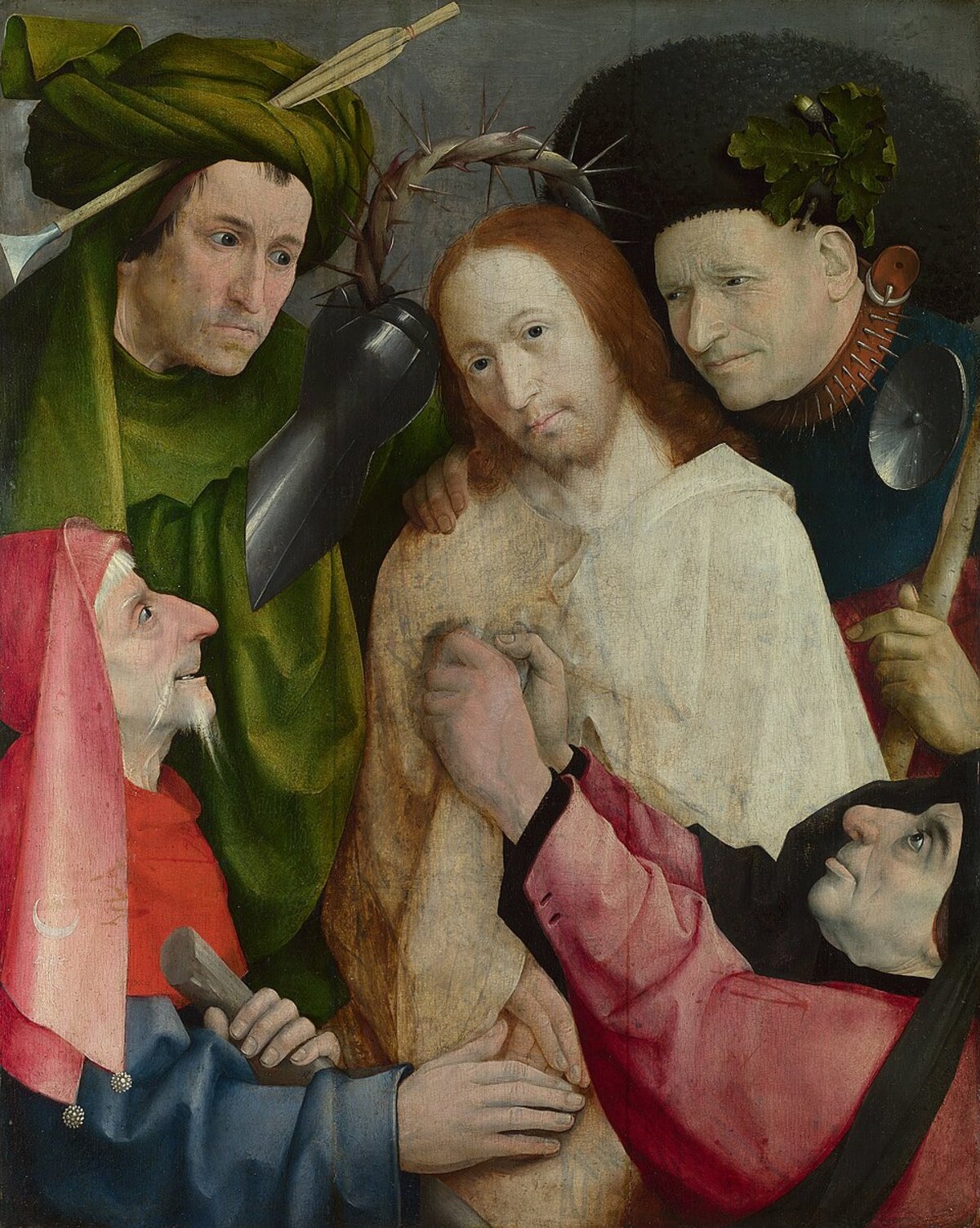
Christ Crowned with Thorns
Christ Crowned with Thorns — Bosch, National Gallery London
Hieronymus Bosch, Public domain, via Wikimedia Commons
Bosch's Christ Crowned with Thorns (National Gallery, London) is one of the most psychologically intense works in Northern Renaissance painting. A close-up composition shows Christ at the centre, surrounded by four tormentors who press in from all sides — above, below, left, and right.
Bosch does not show the physical action of the crowning but the psychological moment just after or just before: four faces, each a study in a different form of cruelty or indifference, crowd in on the patient, suffering face of Christ. The painting demonstrates Bosch's mastery of physiognomy — the reading of character through facial expression — which he uses here to contrast Christ's serene suffering with the grotesque variety of human sin.
Hieronymus Bosch (c.1450-1516) was a Netherlandish painter whose work combines detailed realism in the tradition of Jan van Eyck with a fantastical, allegorical imagination that has no parallel in Western art. Born in 's-Hertogenbosch (from which his name derives), Bosch spent his entire career in that city. His work was highly prized in his own lifetime — King Philip II of Spain collected many of his paintings — and has attracted scholarly debate about its sources and meanings since the early twentieth century.
Each of the four tormentors embodies a different vice: the figure at the upper left wears the helmet of a warrior and represents pride or military violence; the figure at the upper right wears the collar of a dog and represents brutish cruelty; the two lower figures push with hands and instruments. Christ, at the centre, looks out directly at the viewer — his expression is one of patient endurance rather than suffering. This direct gaze is the painting's most powerful element: Christ looks at you.
When standing before this work, look carefully: Christ Crowned with Thorns — Bosch, National Gallery London. Give it time — what seems decorative often carries the central meaning.
When standing before this work, look carefully: Christ's direct gaze — patient suffering. Give it time — what seems decorative often carries the central meaning.
When standing before this work, look carefully: The four tormentors — physiognomic variety of sin. Give it time — what seems decorative often carries the central meaning.
When standing before this work, look carefully: Full panel — close composition. Give it time — what seems decorative often carries the central meaning.
National Gallery, Trafalgar Square, London WC2N 5DN. Free admission.
Open daily 10:00-18:00 (21:00 Fridays). The painting is in the Northern European galleries.