
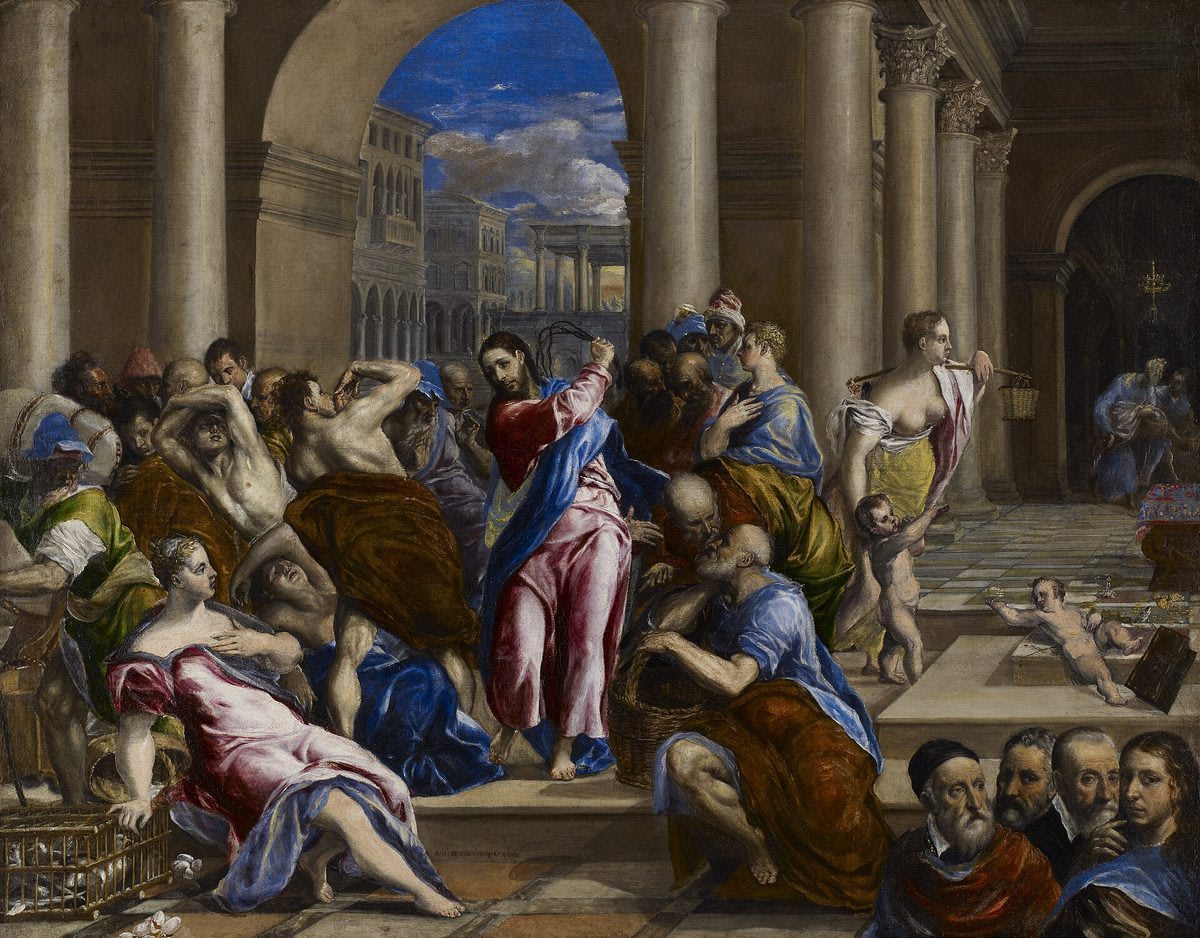
Christ Driving the Traders from the Temple
Christ Driving the Traders — El Greco, c.1600
El Greco, Public domain, via Wikimedia Commons
El Greco's Christ Driving the Traders from the Temple in the National Gallery is a mature version of a subject he treated at least six times across his career — the subject allowed him to combine a complex multi-figure composition with the expression of spiritual authority and religious zeal that were central to his Counter-Reformation programme. The National Gallery canvas (approximately 106 by 130 cm) shows Christ in the centre of the Temple court, raising his scourge against the money changers and dove sellers who flee in disarray on all sides. In the lunette reliefs at the top corners of the composition, El Greco includes two earlier moments of divine judgement: the Expulsion of Adam and Eve from Paradise (left) and Noah's Flood or the Sacrifice of Isaac (right) — connecting the Temple Cleansing to the broader narrative of divine intervention in human history.
El Greco painted the Temple Cleansing throughout his career, from his early phase (a version in the Minneapolis Institute of Art, c.1570) through his mature Toledo period. The National Gallery version is from his mature period and shows the full development of his personal style: the elongated, dynamically posed figures, the cool palette, and the sense of spiritual energy radiating from the central figure of Christ.
Christ at the centre of the composition is depicted with a specific energy — not the suffering Christ of the Passion scenes but the prophetic Christ of divine anger. The scourge he carries is raised; his posture is that of physical action.
Around him, the money changers and dove sellers flee or cower — their poses of confusion and flight create the compositional dynamic. In the corners, the lunette reliefs are unusual: El Greco integrates a sculptural relief into a painting, creating a self-referential image within an image.
When standing before this work, look carefully: Christ Driving the Traders — El Greco, c.1600. Give it time — what seems decorative often carries the central meaning.
When standing before this work, look carefully: Christ at the centre — prophetic anger. Give it time — what seems decorative often carries the central meaning.
When standing before this work, look carefully: Lunette: Expulsion of Adam and Eve. Give it time — what seems decorative often carries the central meaning.
When standing before this work, look carefully: The money changers fleeing. Give it time — what seems decorative often carries the central meaning.
National Gallery, Room 30, London.