
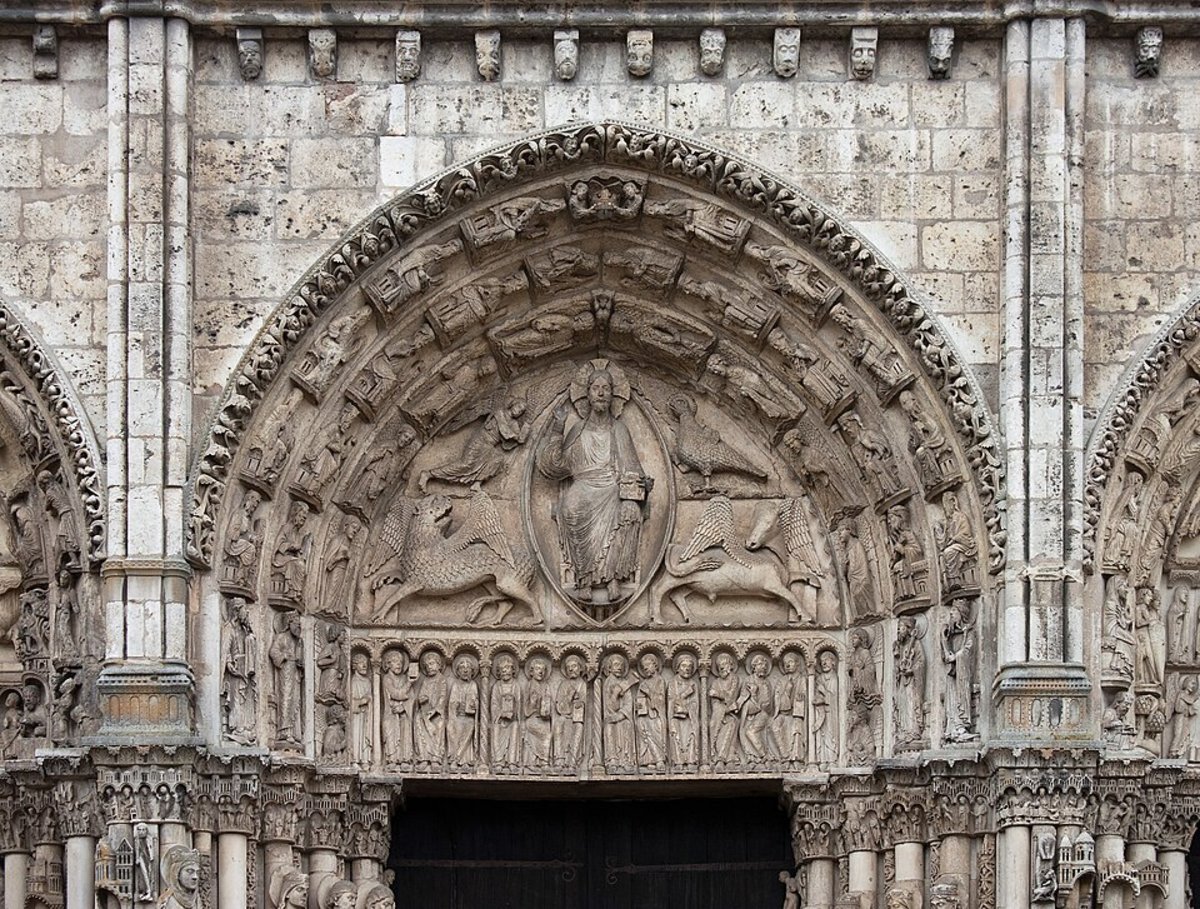
Christ in Majesty (Royal Portal Tympanum)
Christ in Majesty — Chartres Royal Portal, c.1145-1155
Public domain, via Wikimedia Commons
The Royal Portal of Chartres Cathedral (c.1145-1155) is the defining monument of Romanesque portal sculpture and the prototype for all subsequent Gothic portal programmes. The central tympanum shows Christ in Majesty — enthroned, frontal, within a mandorla, surrounded by the four Evangelist symbols (the Tetramorphs: the eagle of John, the lion of Mark, the ox of Luke, and the angel of Matthew) — in the tradition of Apocalyptic imagery from Revelation 4.
The archivolts above are filled with the elders of the Apocalypse playing musical instruments. The jamb figures flanking the three portals are the Old Testament kings, queens, and prophets who prefigured Christ — the earliest large-scale column figures in French Gothic sculpture, elongated, frontal, absorbed into the architecture. The combination of the Apocalyptic Christ with the prophets who foretold him creates a theological programme that is both coherent and overwhelming.
Chartres Cathedral is the supreme surviving Gothic church — its stained glass (c.1194-1220), its sculpture (both the Royal Portal of c.1145 and the transept portals of c.1194-1220), and its architectural programme together constitute the most complete Gothic ensemble in France. The Royal Portal predates the main Gothic rebuilding of 1194 (after a fire) and is the last major Romanesque ensemble at Chartres; the three portal tympana (Christ in Majesty at the centre, the Ascension at the left, the Nativity/Presentation at the right) form a Christological programme running from Incarnation to Ascension to the final coming of Christ in glory.
The Christ in Majesty tympanum is experienced at scale: the tympanum is approximately 3 metres wide and 2 metres tall at the apex. The frontal, symmetrical Christ is not the suffering Christ of the Passion but the triumphant Christ of the Second Coming — the Judge who will separate the saved from the damned.
The jamb figures below the portal are not portraits but ideal types: Old Testament kings and prophets absorbed into the columns, their bodies elongated to match the column proportions, their faces specific, individual, and absorbing. These column figures are the predecessors of all Gothic portal sculpture.
When standing before this work, look carefully: Christ in Majesty — Chartres Royal Portal, c.1145-1155. Give it time — what seems decorative often carries the central meaning.
When standing before this work, look carefully: Jamb figures — Old Testament kings and prophets. Give it time — what seems decorative often carries the central meaning.
When standing before this work, look carefully: The Royal Portal — three tympana overview. Give it time — what seems decorative often carries the central meaning.
When standing before this work, look carefully: Chartres Cathedral west facade. Give it time — what seems decorative often carries the central meaning.
Chartres Cathedral (Notre-Dame de Chartres), Place de la Cathédrale, Chartres. Approximately 1 hour by train from Paris (Montparnasse station).
The cathedral is open daily; free admission. Guided visits of the crypt available. The roof (tower climbs) offers views of the flying buttresses.