
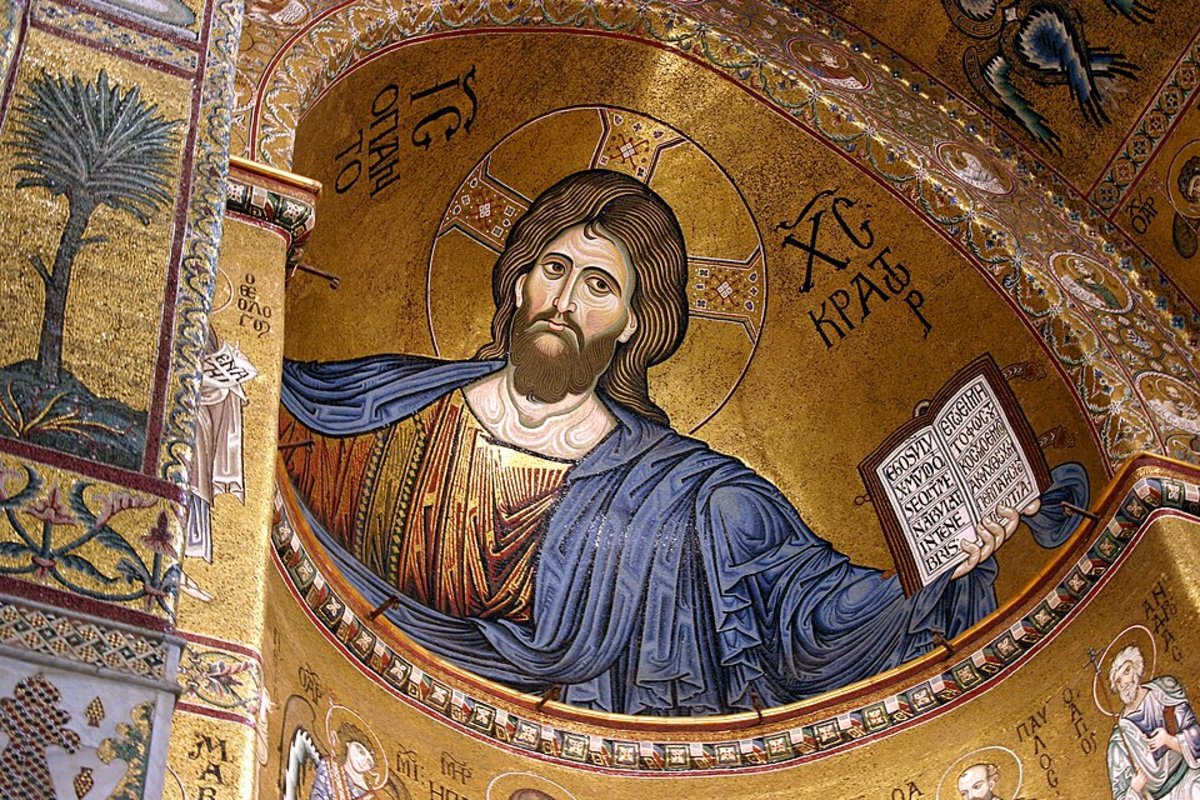
Christ Pantocrator and Nativity Mosaics
Christ Pantocrator — Hosios Loukas, c.1040-1100
Byzantine, Public domain, via Wikimedia Commons
Hosios Loukas Monastery in Boeotia (approximately 160 km from Athens, near Delphi) contains one of the finest and most complete Byzantine mosaic cycles surviving from the 11th century — executed in the katholikon (the main church, dedicated to St Luke the Stiris) and the adjacent Theotokos church. The primary mosaics include: the Pantocrator in the main dome, the Nativity and Presentation in the Temple (narthex vaults), the Anastasis (Harrowing of Hell) in the narthex, and a full programme of standing saints in the nave.
The quality of the individual mosaic panels — particularly the Nativity, the Anastasis, and the portrait busts in the squinches (the transitional zones between the dome and the walls) — represents the middle Byzantine style at its finest. The monastery is a UNESCO World Heritage Site (1990) and one of the best-preserved Byzantine monastic churches in Greece.
Hosios Loukas (St Luke of Stiris, c.896-953) was a Greek hermit and ascetic who became one of the most venerated Byzantine saints. He died in 953 and the monastery on the site of his hermitage was built approximately 50 years later by the Byzantine Emperor Romanos II. The decoration of the katholikon (c.1040-1100) is the primary example of Byzantine mosaic on a moderately small architectural scale — in contrast to the gigantic Pantocrators of Monreale (entry 216) or Daphni (entry 147), the Hosios Loukas mosaics are at an intimate human scale that allows close study.
The Anastasis (Harrowing of Hell) in the narthex is the finest individual mosaic in the programme: Christ pulling Adam and Eve from their tombs, the broken gates of Hell beneath his feet, a dramatic composition of compact energy. Compare this Anastasis with the slightly later Chora Anastasis fresco (entry 146) — the two are in the same theological and iconographic tradition but executed a century apart, the Hosios Loukas version being more hieratic and austere, the Chora version more dynamically energetic.
When standing before this work, look carefully: Christ Pantocrator — Hosios Loukas, c.1040-1100. Give it time — what seems decorative often carries the central meaning.
When standing before this work, look carefully: Anastasis (Harrowing of Hell) — narthex mosaic. Give it time — what seems decorative often carries the central meaning.
When standing before this work, look carefully: The Nativity — narthex vault mosaic. Give it time — what seems decorative often carries the central meaning.
When standing before this work, look carefully: Hosios Loukas Monastery exterior — Byzantine architecture. Give it time — what seems decorative often carries the central meaning.
Hosios Loukas Monastery, Distomo, Boeotia, Greece. Open daily; admission fee.
Approximately 3 hours by bus or car from Athens (via Delphi). Modest dress required (shoulders and knees covered; skirts provided at the entrance for visitors appropriately dressed).