
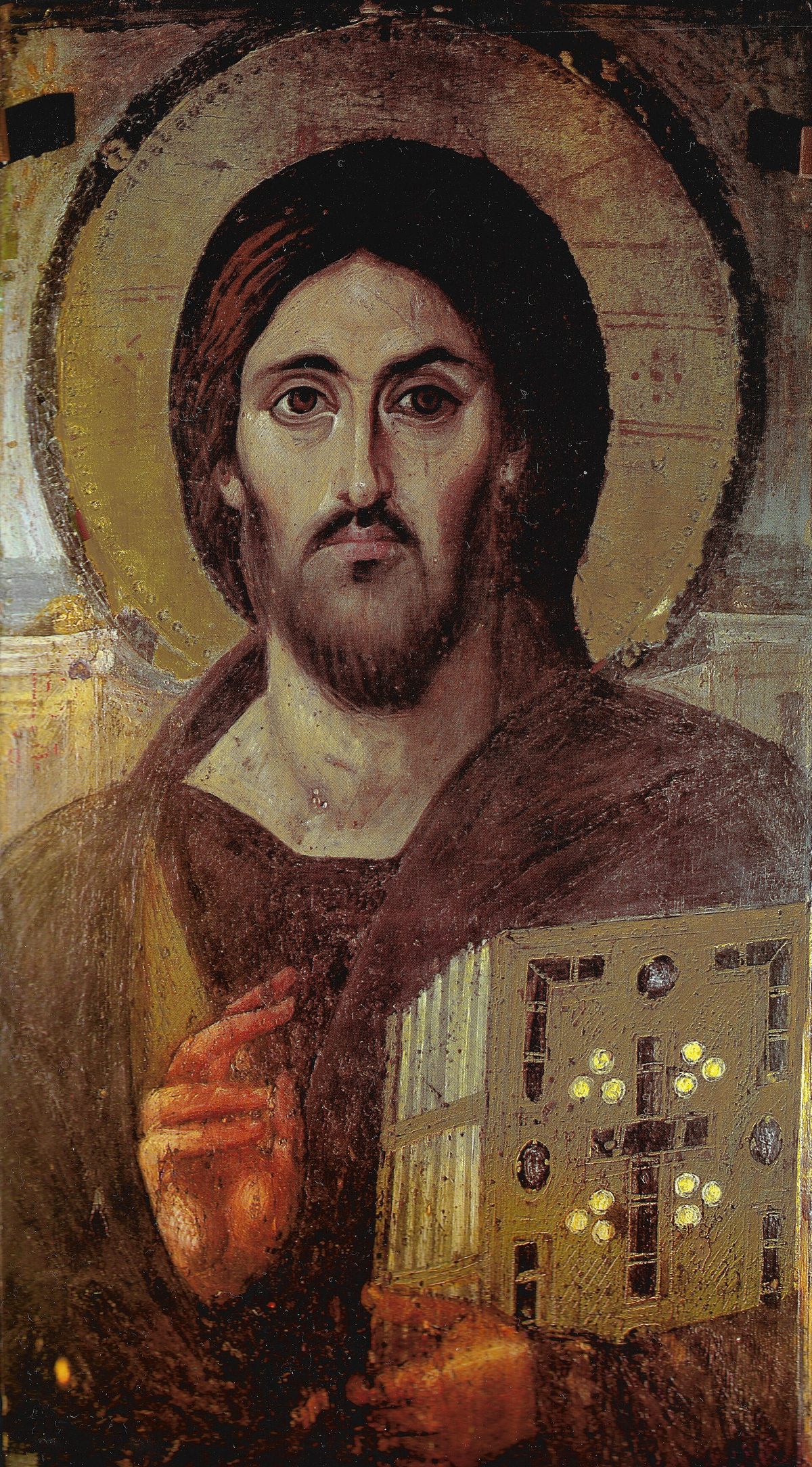
Christ Pantocrator (Icon)
Christ Pantocrator icon — St Catherine's, 6th century
Byzantine, Public domain, via Wikimedia Commons
The Pantocrator icon at St Catherine's Monastery on Mount Sinai is the oldest surviving large-scale icon of Christ in existence and one of the most important objects in the history of Christian art. Painted in encaustic (wax-based paint) on a wooden panel approximately 84 by 45.5 cm, the icon dates from the 6th century (probably during the reign of Justinian I, when St Catherine's was built) and has survived intact because the monastery's remote location protected it from the Byzantine Iconoclast destruction of icons in the 8th and 9th centuries. The Christ is depicted in bust, with the Gospel book and the blessing hand — the Pantocrator type — but with a quality different from later Byzantine Pantocrators: the two sides of the face are subtly different (the left side is more severe, the right gentler — read as the dual nature of Christ, divine judge and merciful saviour), the eyes are large and direct, and the painting technique is that of late antique Roman portrait painting.
St Catherine's Monastery was founded by the Emperor Justinian I in 548-565 at the foot of the mountain traditionally identified as Mount Sinai (Jebel Musa) — where God spoke to Moses. The monastery has been continuously inhabited by Greek Orthodox monks for over 1,400 years and has never been destroyed or abandoned.
Its collection of icons, manuscripts, and mosaics is among the most important in the Eastern Christian world. The encaustic icons at St Catherine's — including the Pantocrator — are the only surviving large-scale examples of the early Christian icon tradition, predating the Byzantine Iconoclasm of 726-843.
The asymmetry of the Christ face is the key to this icon. The right side (from the viewer's perspective) is softer, more compassionate — some scholars read it as the divine mercy. The left side is more severe, more judicial — the divine justice.
Whether this asymmetry is intentional theology or the natural variation of encaustic painting technique remains debated. The encaustic technique — hot wax mixed with pigment — gives the paint surface a translucency and depth different from egg tempera: the skin tones have a warmth and luminosity that later egg tempera icons cannot replicate. The icon is best studied in reproduction (high-quality facsimiles are available) as the original is kept in controlled conditions.
When standing before this work, look carefully: Christ Pantocrator icon — St Catherine's, 6th century. Give it time — what seems decorative often carries the central meaning.
When standing before this work, look carefully: The asymmetrical face — mercy and judgment. Give it time — what seems decorative often carries the central meaning.
When standing before this work, look carefully: St Catherine's Monastery at the foot of Mount Sinai. Give it time — what seems decorative often carries the central meaning.
When standing before this work, look carefully: Encaustic technique — wax paint with late antique quality. Give it time — what seems decorative often carries the central meaning.
St Catherine's Monastery, Mount Sinai, Egypt. The monastery is open to visitors in the morning (generally 9am-noon, except Sundays and holidays).
Access requires a permit and appropriate dress. The icon collection is partially accessible to visitors.