
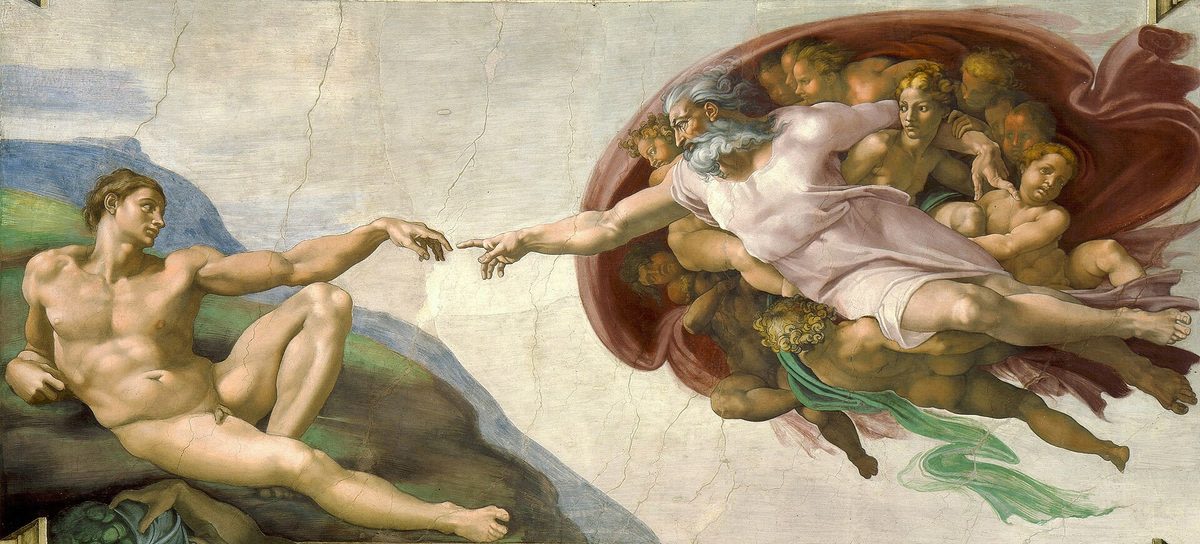
The Creation of Adam
The most reproduced artwork in history — the suspended moment before God's finger touches Adam's, transmitting the divine spark of life.
Michelangelo, Public domain, via Wikimedia Commons
The Creation of Adam is the most reproduced artwork in history — a detail from the fourth bay of the Sistine ceiling in which God the Father, borne aloft by a company of angels in a billowing red cloak, reaches his right hand toward the recumbent Adam to transmit the divine spark of life.
The image's power lies in the gap between the two outstretched index fingers — the space that represents the boundary between Creator and creation, the moment before contact, the suspended instant of divine gift. The composition has entered the vocabulary of global visual culture far beyond any religious context.
Michelangelo painted the Creation of Adam in 1511, during the second phase of the ceiling. Art historians have noted that the shape formed by God's red cloak and the figures within it closely resembles the outline of a human brain in cross-section — possibly intentional, given Michelangelo's known interest in anatomy and his participation in cadaver dissection.
Michelangelo di Lodovico Buonarroti Simoni (1475–1564) was first and always a sculptor — he accepted the Sistine ceiling commission from Pope Julius II reluctantly, insisting he was not a painter. By the time he painted the Creation of Adam, he had already redefined sculpture with the Pietà (1499) and the David (1504).
The brain-shape theory — that the form of God's cloak deliberately mirrors a human brain — speaks to Michelangelo's extraordinary knowledge of anatomy, acquired through years of cadaver dissection. Whether or not the theory is correct, it has added another layer to an image already saturated with meaning about the divine origin of human intelligence.
The gap between the fingers is everything. God's hand is extended vigorously, with certainty and creative energy; Adam's is raised languidly, receiving rather than reaching. The contrast between divine activity and human receptivity is the theological content of the image rendered in pure visual form.
Notice the woman sheltered under God's left arm — identified variously as Eve (not yet created), the Virgin Mary, or a Platonic Sophia figure. Notice also the children and figures within the divine cloak, interpreted as souls awaiting birth, angels, or allegorical figures. The painting rewards extended looking: bring binoculars or a high-resolution reproduction.
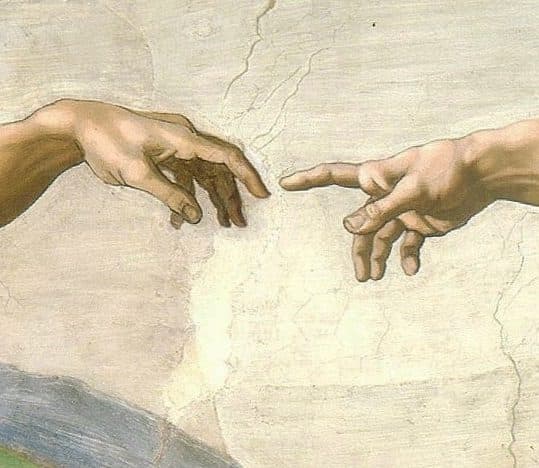
This is the most important detail in the painting — and the fingers never actually touch. God's index finger is extended with muscular purpose and directional energy; Adam's droops at the wrist, passive. The narrow gap between them represents the membrane between the divine and human, the moment before consciousness sparks into being. It is the most studied centimetre in the history of Western art.
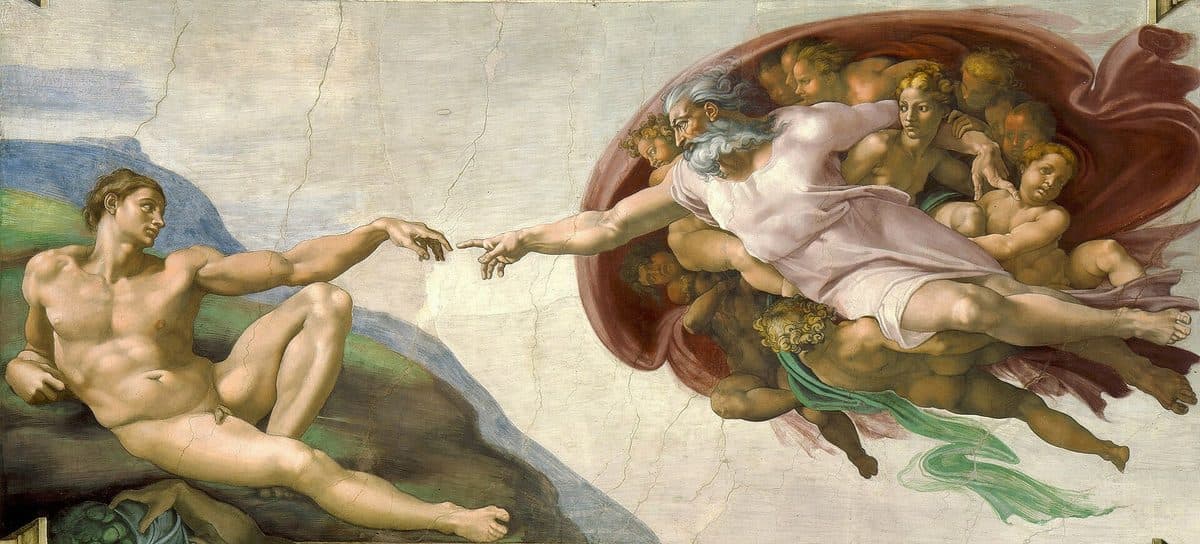
Seen at full width, the composition is a study in contrasts: Adam's earth-toned body curves to the left along the lower edge of the frame while God and his company sweep in from the upper right, wrapped in a swirling crimson cloak. The diagonal energy runs from lower-left to upper-right, carrying the eye from passive matter to the active divine. The woman held under God's arm on the right is not yet created — she watches the event with an expression of knowing.
In 1990, Dr Frank Meshberger published an analysis in the Journal of the American Medical Association proposing that the shape formed by God's billowing red mantle and the bodies within it precisely matches a sagittal cross-section of the human brain — including the frontal lobe, brain stem, and basilar artery. The theory suggests Michelangelo, who had dissected cadavers extensively, may have encoded an assertion that divine intelligence is transmitted through the human mind. When you look at the painting, trace the outer edge of the cloak: the upper curve corresponds to the cortex, the trailing green fabric to the pituitary stalk. Whether intentional or not, it has transformed how the image is read.
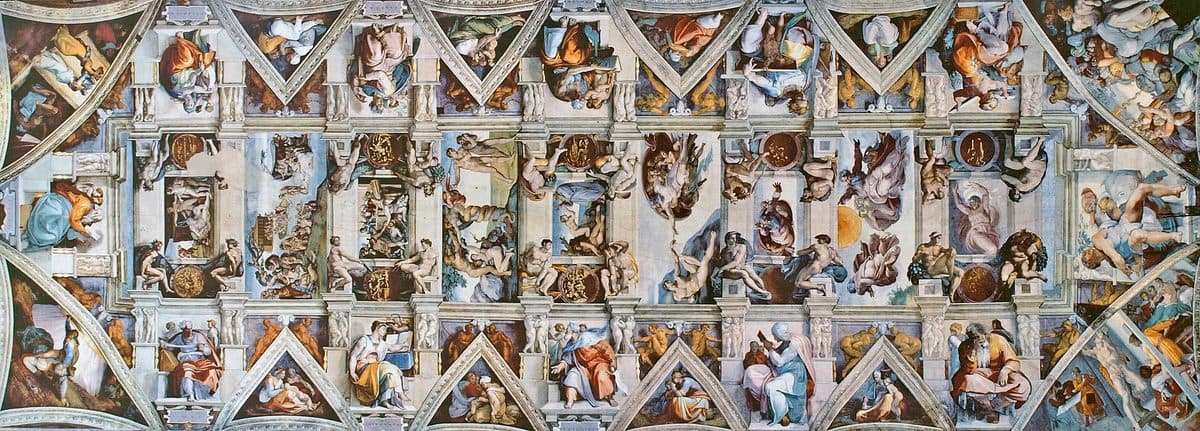
The Creation of Adam is the fourth of nine central panels — the pivot point of the entire ceiling. Looking at the ceiling as a whole, you can count the panels from the altar end: Separation of Light and Dark, Separation of Waters, Creation of the Plants, then the Creation of Adam at centre. After it come the Creation of Eve, the Temptation and Fall, the Sacrifice of Noah, the Flood, and the Drunkenness of Noah. The programme moves from primordial creation toward human frailty — Adam and Eve's panel is the hinge of that descent.
Part of the Sistine Chapel ceiling — the same visiting information applies as for the ceiling as a whole. The Creation of Adam occupies the fourth bay counting from the altar end, roughly the centre of the vault.
It is typically the most heavily photographed spot in the chapel. The original cartoons used to transfer the design to the wet plaster do not survive. Vatican Museums timed tickets are required and should be booked well in advance at museivaticani.va.