
Crucifix
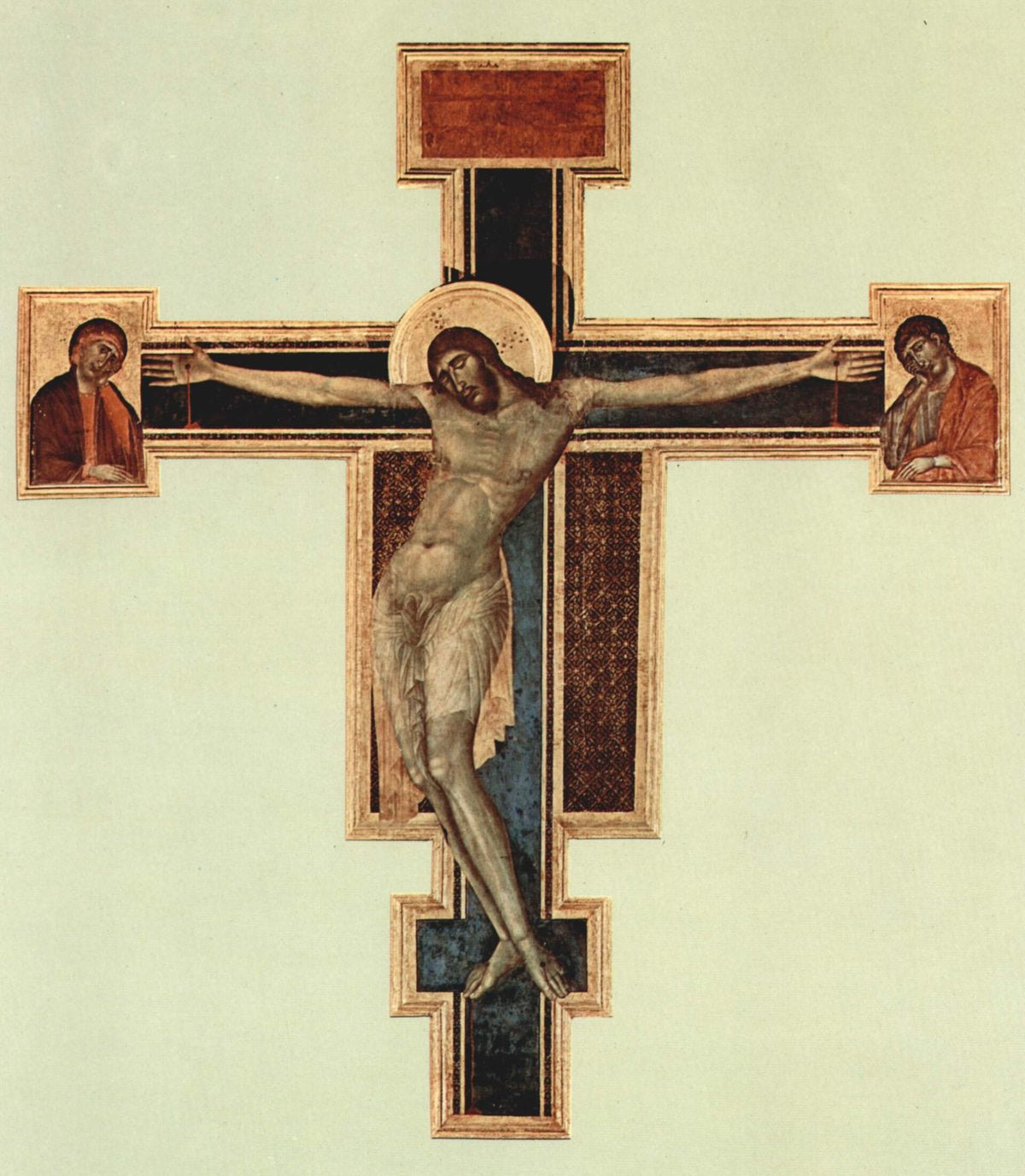
Crucifix — Cimabue, c.1287-1288, after restoration
Cimabue, Public domain, via Wikimedia Commons
Cimabue's Crucifix for Santa Croce is the most poignant image in Florentine painting — a monumental painted crucifix approximately 4.48 metres tall and 3.9 metres wide, made around 1287-1288 for the right transept of the Basilica di Santa Croce, severely damaged in the Florence flood of November 1966 and partially restored over the following forty years. Before the flood, it was considered the finest of Cimabue's surviving works; the flood water destroyed approximately 60% of the paint surface, leaving the figure of Christ a ruin of paint losses and stained vellum.
The restoration (1966-2010) is one of the most complex and technically innovative conservation projects ever undertaken; the restored crucifix is displayed in the museum attached to Santa Croce (the Museo dell'Opera di Santa Croce). The surviving portions of the paint demonstrate the revolutionary quality of Cimabue's approach: the body of Christ is not the stylised Byzantine figure of earlier Tuscan crucifixes but a physically specific, weighted, suffering human body — the beginning of the naturalistic tradition that Giotto would complete.
Cimabue (Cenni di Pepo, c.1240-1302) was the greatest Florentine painter before Giotto — Dante placed him at the summit of the painting tradition in his own day ('Cimabue thought to hold the field in painting, now Giotto has the cry', Purgatorio XI). His surviving works — the Assisi frescoes, the Santa Trinità Madonna (Uffizi), and this Crucifix — demonstrate a painter working at the boundary between the Byzantine tradition and the proto-Renaissance: the Byzantine formal conventions (elongated proportions, gold lines indicating drapery, stylised anatomy) are present, but the emotional intensity and the sense of physical weight are new.
The damaged state of the Crucifix is itself theologically resonant — its condition after the flood was compared by contemporaries to the suffering depicted: a broken image of a broken body. The head of Christ (largely preserved) is among the finest portraits of suffering in Italian painting: the crown of thorns, the closed eyes, the slightly open mouth.
The body's posture — sagging from the arms, the knees slightly bent — anticipates the fully naturalistic treatment of Giotto's Arena Chapel crucifix. The museum setting (with excellent lighting and close viewing distance) allows study of both the surviving original paint and the evidence of the restoration.
When standing before this work, look carefully: Crucifix — Cimabue, c.1287-1288, after restoration. Give it time — what seems decorative often carries the central meaning.
When standing before this work, look carefully: The Crucifix after the 1966 flood — before restoration. Give it time — what seems decorative often carries the central meaning.
When standing before this work, look carefully: Christ's head — the finest surviving portion. Give it time — what seems decorative often carries the central meaning.
When standing before this work, look carefully: The Crucifix in the Museo dell'Opera di Santa Croce. Give it time — what seems decorative often carries the central meaning.
Museo dell'Opera di Santa Croce, Piazza Santa Croce, Florence. Admission fee (includes the basilica and the Pazzi Chapel). The Cimabue Crucifix is displayed in the former refectory of the convent.