
Crucifix (Ognissanti) and Maddalena panel
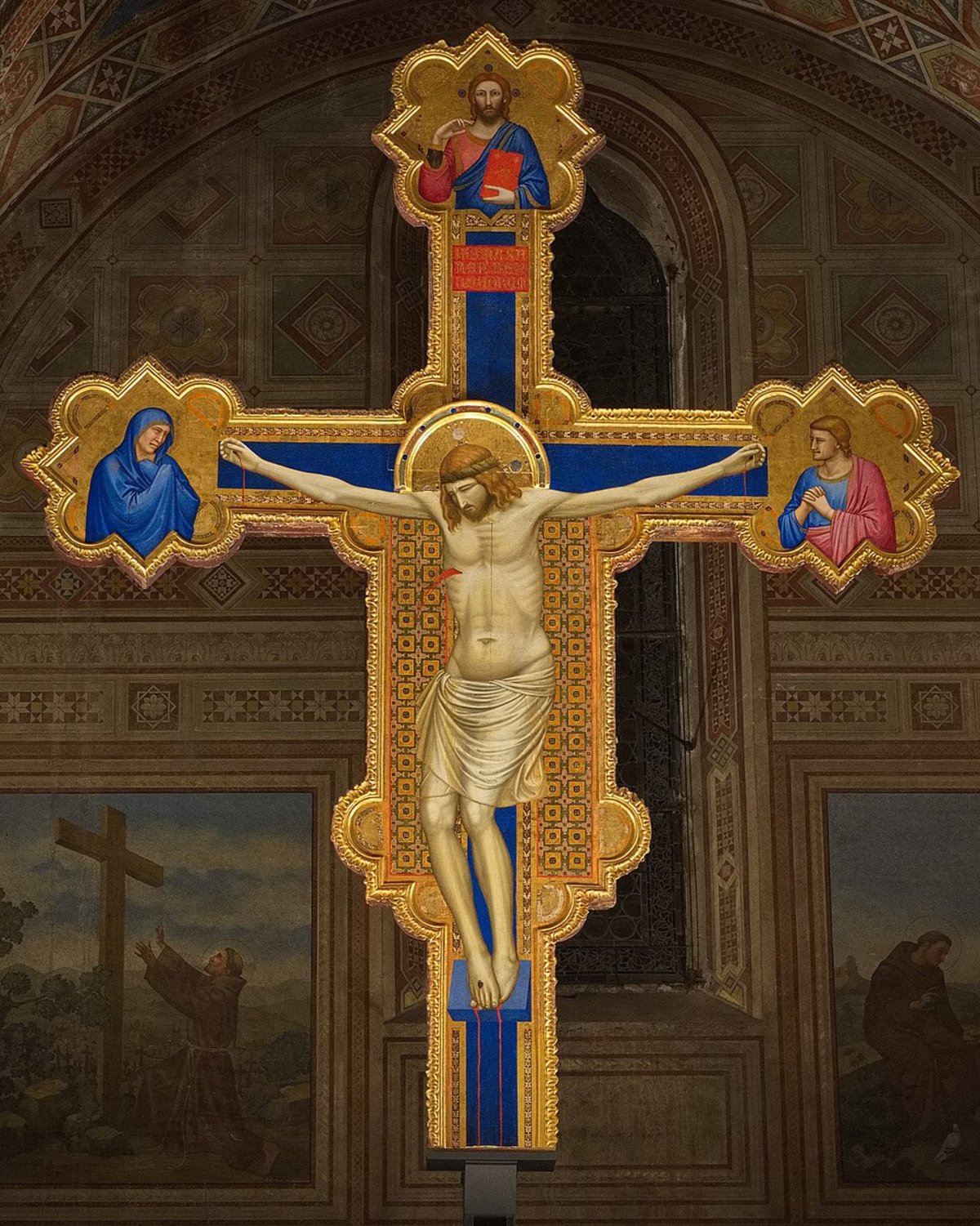
Ognissanti Crucifix — Giotto, c.1310-1315
Giotto di Bondone, Public domain, via Wikimedia Commons
Giotto's Ognissanti Crucifix (now in Santa Maria Novella) and the Maddalena panel (Accademia, Florence) represent Giotto's approach to the devotional panel painting — the same painter who transformed Italian fresco in the Scrovegni Chapel (entry 5) working at smaller scale on individual objects for church and private use. The Ognissanti Crucifix (approximately 578 by 406 cm) is the largest of Giotto's three surviving crucifixes — a monumental painted cross with the figure of Christ depicted in the Christus Patiens type (suffering, dead, the body's weight pulling downward against the arms) that Giotto had pioneered in Italian painting.
The Maddalena panel (c.1310-1315) shows Mary Magdalene at full length in a gold-ground hieratic format, surrounded by eight narrative scenes from her life. For Giotto's main biographical entry, see entry 5 (Scrovegni Chapel, Padua).
See entry 5 for Giotto's biographical context. The Ognissanti Crucifix is generally dated to approximately 1310-1315 — the mature period of Giotto's career after the Scrovegni Chapel (c.1303-1305).
The Magdalene panel is usually attributed to Giotto's workshop. Both works are in Florence and accessible in different institutions.
The Ognissanti Crucifix is installed in the nave of Santa Maria Novella. Compare it with Cimabue's Crucifix in the same church (now damaged and in the museum — entry 161): the difference between the two treatments (Cimabue's is more austere and Byzantine; Giotto's is more physically specific and emotionally direct) captures the revolution Giotto brought to Italian religious art. The Maddalena panel is in the Accademia (Gallery of the Accademia, Florence), the same museum that holds Michelangelo's David.
When standing before this work, look carefully: Ognissanti Crucifix — Giotto, c.1310-1315. Give it time — what seems decorative often carries the central meaning.
When standing before this work, look carefully: Christ's body — Christus Patiens, pulling downward. Give it time — what seems decorative often carries the central meaning.
When standing before this work, look carefully: Mary Magdalene panel — Giotto workshop, Accademia. Give it time — what seems decorative often carries the central meaning.
When standing before this work, look carefully: The Ognissanti Crucifix in Santa Maria Novella. Give it time — what seems decorative often carries the central meaning.
Santa Maria Novella (Ognissanti Crucifix), Piazza Santa Maria Novella, Florence (admission fee for the museum section). Galleria dell'Accademia (Maddalena panel), Via Ricasoli 58, Florence (admission fee; advance booking essential).