
Crucifixion / Calvary
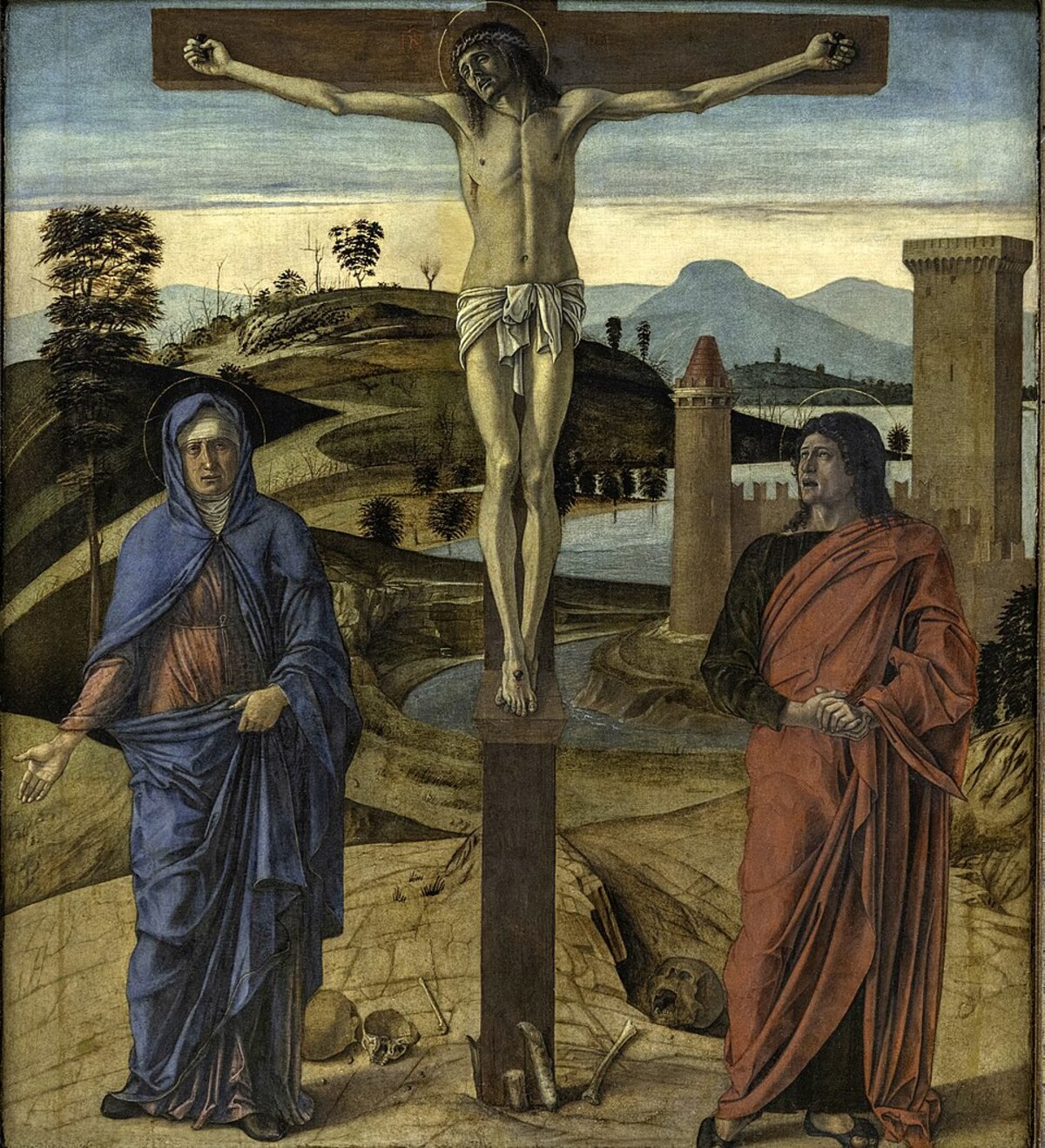
Crucifixion — Antonello da Messina, c.1475, KMSKA Antwerp
Antonello da Messina, Public domain, via Wikimedia Commons
Antonello da Messina's Crucifixion (Calvary) in the KMSKA Antwerp shows Christ on the cross between the two thieves, set in a wide Venetian landscape. The composition is unusual: instead of the concentrated close-up of many Italian Crucifixions, Antonello sets the three crosses in a wide outdoor space — a green hill against a sky with clouds — with small figures of mourners at the base of the crosses.
This spatial openness is a Flemish influence: the tradition of the wide landscape Crucifixion comes from Flemish painting (Jan van Eyck, Rogier van der Weyden), and Antonello absorbed it through his knowledge of Flemish technique and composition. The three crosses are placed at different distances, creating depth; the central cross with the dying Christ is slightly forward.
Antonello's Crucifixion in Antwerp dates from approximately 1475, just before his Venetian visit (1475-1476). The work demonstrates that Antonello was already thinking in Flemish terms about the Crucifixion landscape before he went to Venice — the wide sky, the recession of the hill, the placement of the crosses in open space are all characteristics absorbed from Flemish Crucifixion painting. The KMSKA holds the painting as part of its major collection of Flemish and Italian Renaissance works.
The Christ on the central cross is shown at the moment of death or just after: the body sags, the head falls forward. The thieves on either side are in different postures — the good thief (traditionally on the right, to Christ's left) turns toward Christ; the bad thief turns away. The mourners at the base of the central cross are small figures in the middle distance, their grief expressed in posture rather than face.
When standing before this work, look carefully: Crucifixion — Antonello da Messina, c.1475, KMSKA Antwerp. Give it time — what seems decorative often carries the central meaning.
When standing before this work, look carefully: Three crosses in wide landscape — Flemish influence. Give it time — what seems decorative often carries the central meaning.
When standing before this work, look carefully: Christ on the central cross — body at death. Give it time — what seems decorative often carries the central meaning.
When standing before this work, look carefully: Mourners at the base — distant and small. Give it time — what seems decorative often carries the central meaning.
Royal Museum of Fine Arts Antwerp (KMSKA), Leopold de Waelplaats 1-9, 2000 Antwerp. Open Tuesday-Sunday 10:00-17:00. Admission fee applies.