
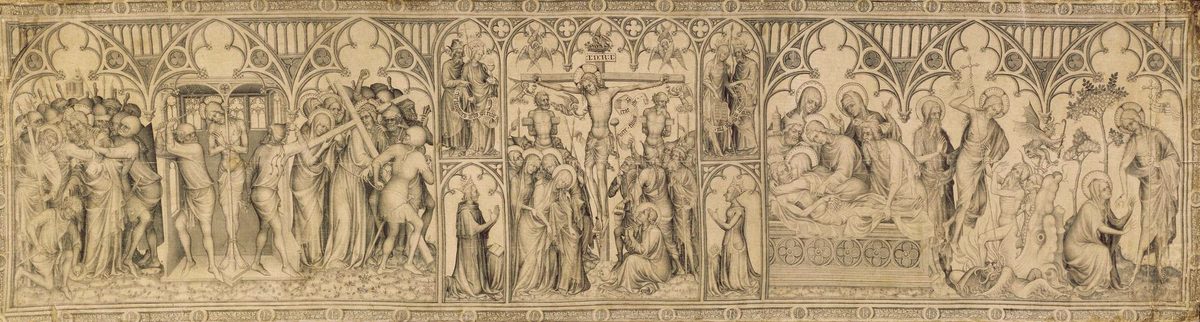
Crucifixion (Parement de Narbonne)
Parement de Narbonne — c.1375, Louvre
Public domain, via Wikimedia Commons
The Parement de Narbonne is a liturgical hanging in grisaille (grey ink) on white silk, approximately 286 cm wide and 77 cm tall, showing six scenes from the Passion of Christ and kneeling portraits of King Charles V of France and his queen Jeanne de Bourbon. The central scene is the Crucifixion — Christ on the cross with the Virgin, St John, and the Magdalene, flanked by scenes of the Last Supper, the Betrayal, the Descent from the Cross, the Entombment, and the Descent into Hell.
The Parement (literally 'hanging') was designed to hang over the altar on Ash Wednesday and through Lent, replacing the coloured altar hangings. The grisaille technique — drawing in ink on white — creates a quality of austere mourning appropriate to the Lenten season.
The Parement de Narbonne (named for the city of Narbonne, whose bishop owned it at one point) is one of the most important surviving examples of International Gothic painting in France. It was made for the French court around 1375, probably by Jean d'Orléans (royal painter to Charles V), or at least in his workshop. The International Gothic style — characterised by elegant, elongated figures, delicate detail, and a preference for line over mass — is perfectly expressed in the grisaille medium, which foregrounds draftsmanship over colour.
The Crucifixion at the centre shows the characteristic International Gothic elongation of figure: the body of Christ on the cross is slender and refined, the curve of the body more graceful than agonised. The mourning figures of the Virgin and St John have the elegant postures of court art. The kneeling portraits of Charles V and Jeanne de Bourbon on either side of the central group are among the earliest surviving individual portraits of French monarchs from life.
When standing before this work, look carefully: Parement de Narbonne — c.1375, Louvre. Give it time — what seems decorative often carries the central meaning.
When standing before this work, look carefully: Crucifixion — grisaille International Gothic. Give it time — what seems decorative often carries the central meaning.
When standing before this work, look carefully: Kneeling Charles V — early French royal portrait. Give it time — what seems decorative often carries the central meaning.
When standing before this work, look carefully: Full hanging — six Passion scenes in grisaille. Give it time — what seems decorative often carries the central meaning.
Musée du Louvre, Richelieu Wing, Medieval and medieval objects galleries. Open Wednesday-Monday 9:00-18:00. Admission fee applies.