
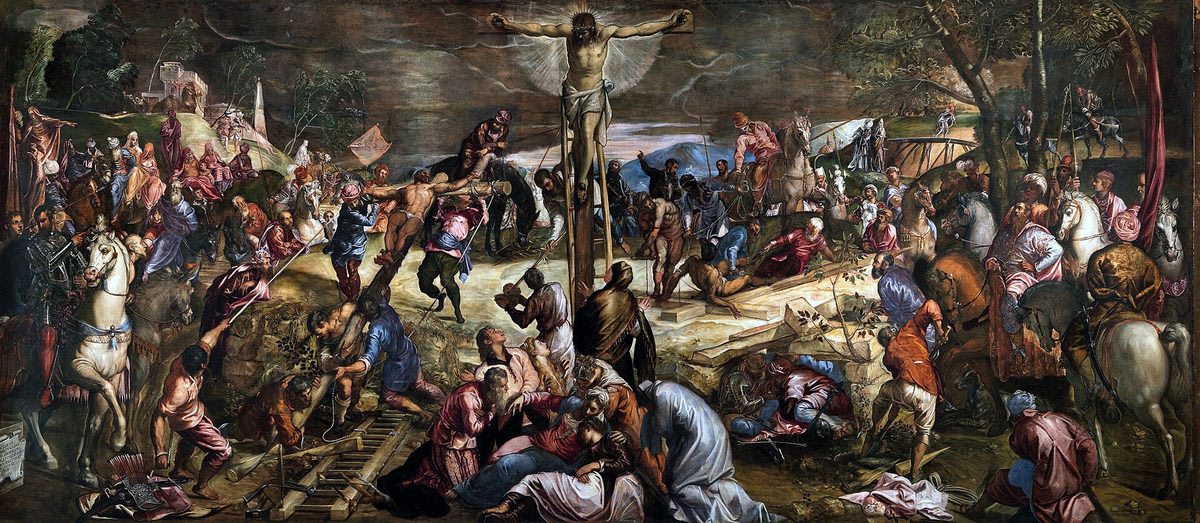
Crucifixion (Scuola Grande di San Rocco)
Crucifixion — Tintoretto, 1565, Scuola Grande di San Rocco
Tintoretto, Public domain, via Wikimedia Commons
Tintoretto's Crucifixion in the Albergo (the main meeting room) of the Scuola Grande di San Rocco is the largest canvas painting in Venice and one of the most overwhelming in the world — approximately 5.4 by 12.2 metres. It depicts the Crucifixion not as a devotional icon but as a historical event: a huge crowd fills the canvas, the three crosses are being raised simultaneously (the side crosses still in the process of being erected, the central cross already upright with Christ on it), soldiers, mourners, and bystanders populate the edges, and a wide landscape with Jerusalem in the background extends behind.
The scale and complexity create the impression of being present at the event — not witnessing a devotional symbol but seeing what actually happened. Henry James wrote that it was 'the greatest picture in the world.'
Jacopo Tintoretto (1518-1594) was born and died in Venice, almost never leaving the city. He was self-consciously radical in his ambitions: his stated artistic goal was to combine the drawing of Michelangelo with the colour of Titian — and in works like the San Rocco Crucifixion, he achieved something beyond either.
The Scuola Grande di San Rocco was a lay confraternity; Tintoretto competed for (and won by a trick — delivering a finished painting on the ceiling when competitors had submitted only drawings) the commission to paint the entire building from 1564 to 1588. The Crucifixion was the first major work in the programme, and it established the approach: maximum dramatic scale, inventive lighting, and a tendency to populate every corner of the canvas with specific human incident.
The painting is so large that it wraps around the viewer's peripheral vision. Stand in the centre of the Albergo and look at it whole: the three crosses rise at different stages of erection; Christ is already crucified at the centre, his head bowed; the two thieves are still in the process of being raised on either side. Below the crosses, a crowd of figures in motion — soldiers on horseback, mourners, passersby, workers — fill the ground.
Look for the specific vignettes: the soldiers gambling for Christ's garments (lower right), Mary Magdalene at the foot of the cross, the mounted figure of a Roman officer observing. Every figure tells a specific story within the larger event. The light source is from the upper left — an unnatural, dramatic illumination that makes the central cross glow above the crowd.
When standing before this work, look carefully: Crucifixion — Tintoretto, 1565, Scuola Grande di San Rocco. Give it time — what seems decorative often carries the central meaning.
When standing before this work, look carefully: Christ on the cross — the illuminated centre. Give it time — what seems decorative often carries the central meaning.
When standing before this work, look carefully: The crowd below — historical documentary. Give it time — what seems decorative often carries the central meaning.
When standing before this work, look carefully: Scuola Grande di San Rocco — the building. Give it time — what seems decorative often carries the central meaning.
Scuola Grande di San Rocco, Campo San Rocco, Venice. The building contains an enormous cycle of Tintoretto paintings — the Albergo (ground floor), the Sala dell'Albergo (upper floor with the Crucifixion), and the Upper Hall.
A full visit takes 2-3 hours; an audio guide is essential for identifying the compositions. The Crucifixion is on the wall of the Sala dell'Albergo.