
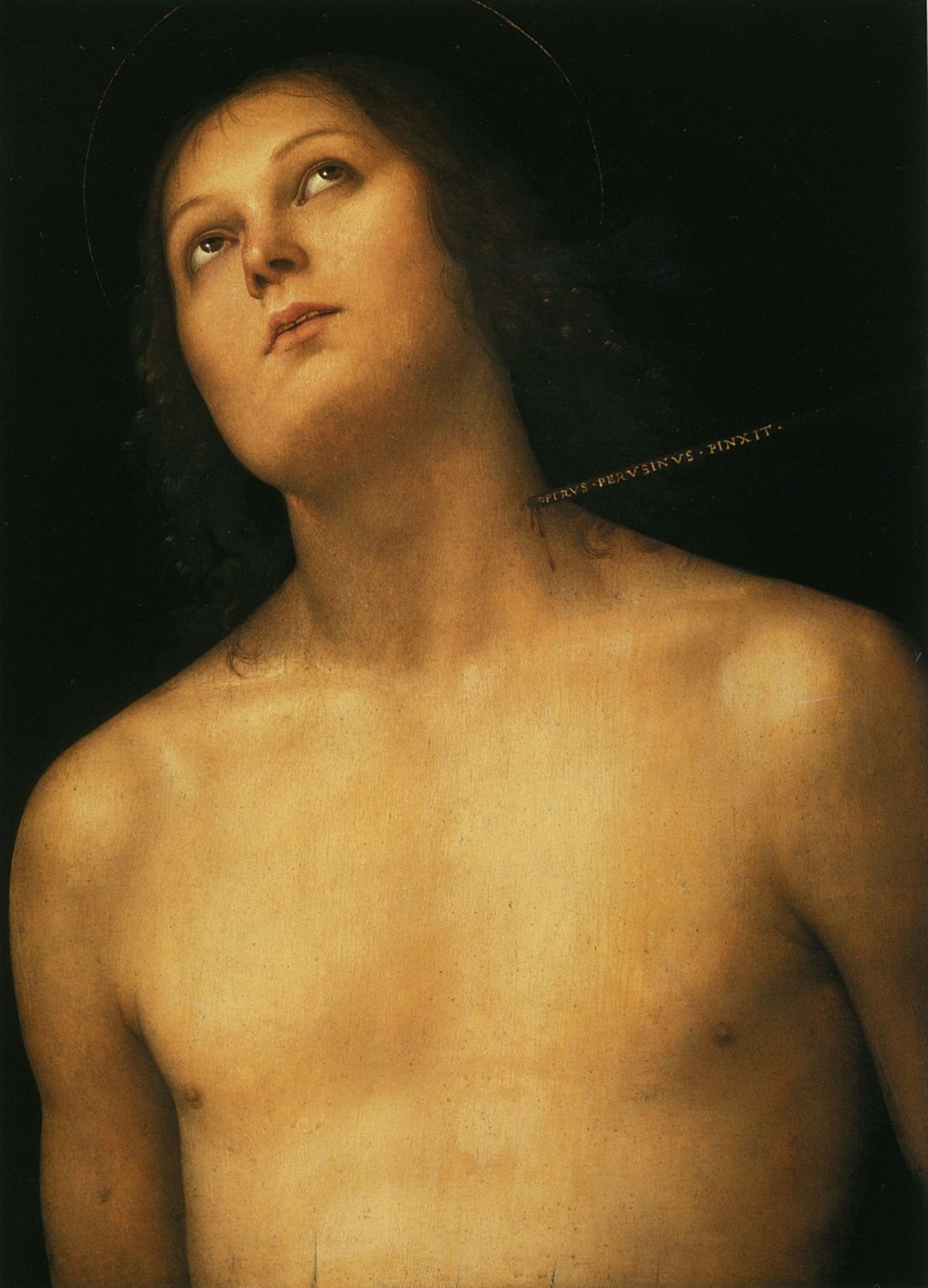
Crucifixion with Saints
Perugino's Sistine Chapel frescoes — 1481-1483
Pietro Perugino, Public domain, via Wikimedia Commons
Pietro Perugino's Crucifixion with Saints is one of the narrative frescoes on the south wall of the Sistine Chapel, painted during the first campaign of decorations commissioned by Pope Sixtus IV in 1481-1482. Perugino was the lead artist of this campaign (also including Botticelli, Ghirlandaio, Rosselli, Signorelli, and others) and painted several of the cycle's most significant scenes.
The frescoes on the south wall depict scenes from the Life of Christ; those on the north wall depict the parallel scenes from the Life of Moses. Perugino's characteristic qualities — serene, luminous figures in wide Umbrian landscapes — are fully expressed in his contributions to the cycle. The Crucifixion fresco (sometimes called the Delivery of the Keys — see also entry 265) demonstrates his mastery of perspective and spatial organisation.
Pietro Perugino (c.1446-1523) was the master of Raphael and the dominant painter of Umbria in the late fifteenth century. His style — serene, idealised figures, soft atmospheric landscapes, clarity of composition — was the foundation on which Raphael built.
Perugino's reputation was very high in his own time (Agostino Chigi called him 'the best master in Italy') and he was the natural choice to lead the first major papal pictorial commission in the Sistine Chapel. Raphael later surpassed his master, and Perugino's reputation declined — but the Sistine frescoes remain evidence of his immense abilities.
The Sistine Chapel's cycle of fifteenth-century frescoes (1481-1483) is less visited than Michelangelo's ceiling (1508-1512) but is of equal historical importance. The cycle was designed to link the Old Testament (Moses) with the New Testament (Christ), and the individual scenes are carefully chosen to establish theological parallels. Perugino's contribution occupies the altar wall (later replaced by Michelangelo's Last Judgment) and the flanking sections.
When standing before this work, look carefully: Perugino's Sistine Chapel frescoes — 1481-1483. Give it time — what seems decorative often carries the central meaning.
When standing before this work, look carefully: South wall — Life of Christ cycle. Give it time — what seems decorative often carries the central meaning.
When standing before this work, look carefully: Crucifixion with Saints — Perugino. Give it time — what seems decorative often carries the central meaning.
When standing before this work, look carefully: The 15th-century fresco cycle overview. Give it time — what seems decorative often carries the central meaning.
Sistine Chapel, Vatican Museums, Vatican City. Admission via Vatican Museums.
Open Monday-Saturday 9:00-18:00 (last entry 16:00); closed Sundays (except last Sunday of month, free). Booking strongly recommended.