
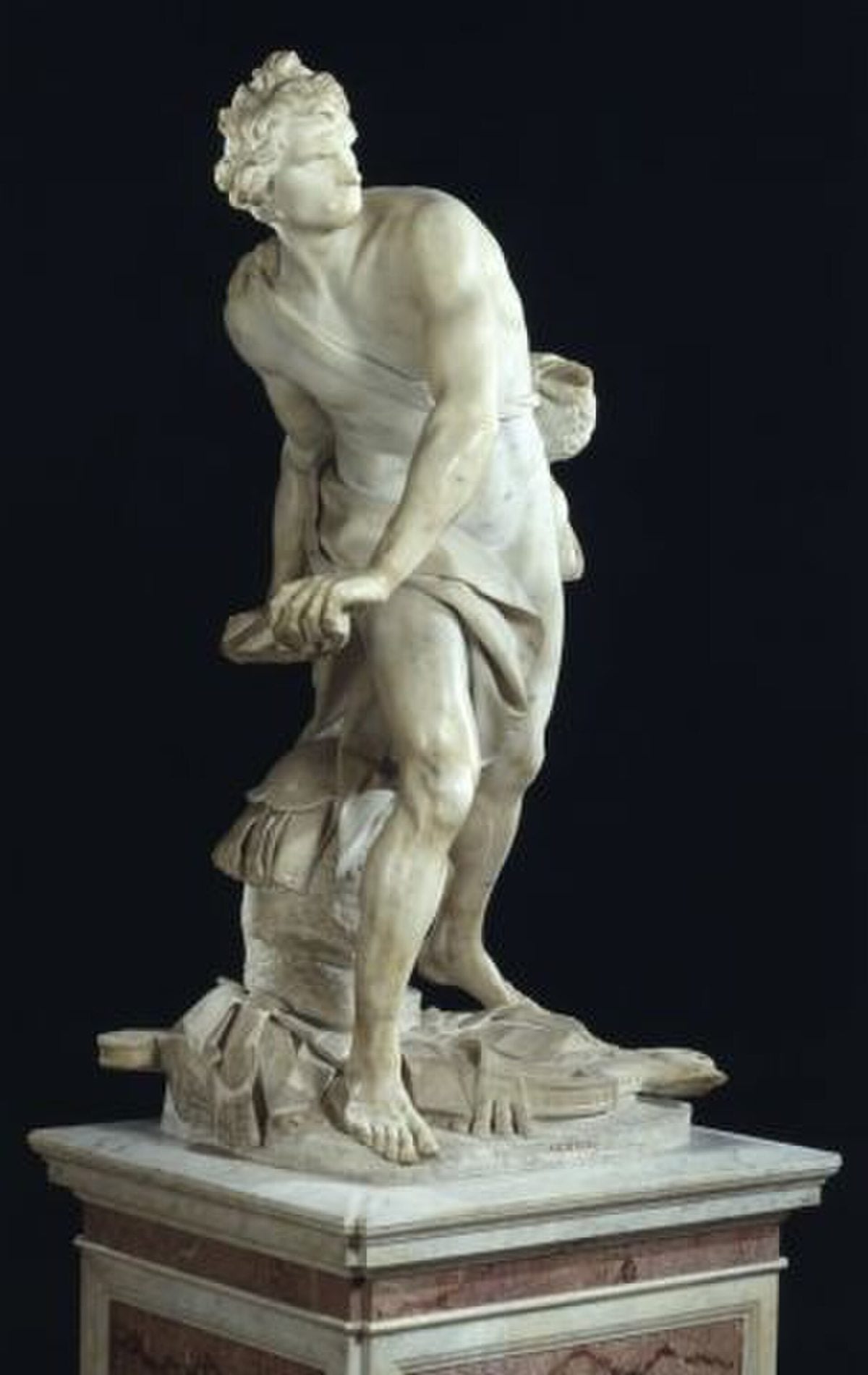
David with the Head of Goliath (Borghese)
David — Bernini, 1623-1624
Gian Lorenzo Bernini, Public domain, via Wikimedia Commons
Bernini's David in the Galleria Borghese is one of three great David sculptures of the Renaissance and Baroque — the others being Donatello's (Florence, c.1440s) and Michelangelo's (Florence, 1501-1504) — and the only one that captures David in the act of fighting rather than before or after. Bernini shows David at the moment of the sling's release — his body coiled and twisted, his face set in fierce concentration, the sling held back before being launched.
The coiling energy of the body, the psychological intensity of the face, and the dynamic forward movement all define the Baroque approach to narrative sculpture. According to tradition, Bernini used his own face as the model for David's, having studied it in a mirror held by Cardinal Scipione Borghese himself.
The commission came in 1623, when Bernini was 24. He completed it in approximately seven months — remarkable for a full-length marble figure. The face is the key to the sculpture's character: unlike Donatello's dreamy adolescent David or Michelangelo's composed hero, Bernini's David is ferocious with purpose.
The bitten lip and furrowed brow are expressions of the fierce attention of a fighter in action. The innovation — showing the moment of action rather than its preparation or aftermath — would define a new approach to figural sculpture. The sculpture was designed to be viewed in a corner position, so the David's gaze extends into the room toward an implied Goliath just outside the frame.
Stand at the right side of the sculpture to see the torsion of the body most clearly — David winds his body like a spring before releasing. The drapery fallen at his feet, the sling held in both hands, the bare feet placed on the ground for maximum leverage: these are specific athletic observations.
The Goliath's head (at David's feet) is a generalised piece; the David's face above is individual and self-referential. Notice how the composition points outward — the gaze, the trajectory of the sling — making the viewer aware of the space outside the sculpture as dramatically active.
When standing before this work, look carefully: David — Bernini, 1623-1624. Give it time — what seems decorative often carries the central meaning.
When standing before this work, look carefully: David's face — Bernini's own features. Give it time — what seems decorative often carries the central meaning.
When standing before this work, look carefully: The coiled body — torsion at the moment of release. Give it time — what seems decorative often carries the central meaning.
When standing before this work, look carefully: The full figure in Galleria Borghese context. Give it time — what seems decorative often carries the central meaning.
Galleria Borghese, Room II. The David is one of three major Bernini sculptures in the museum (alongside Aeneas, Anchises and Ascanius, and Apollo and Daphne). All three were made within a few years of each other and demonstrate the explosive development of Bernini's sculptural language between 1619 and 1625.