
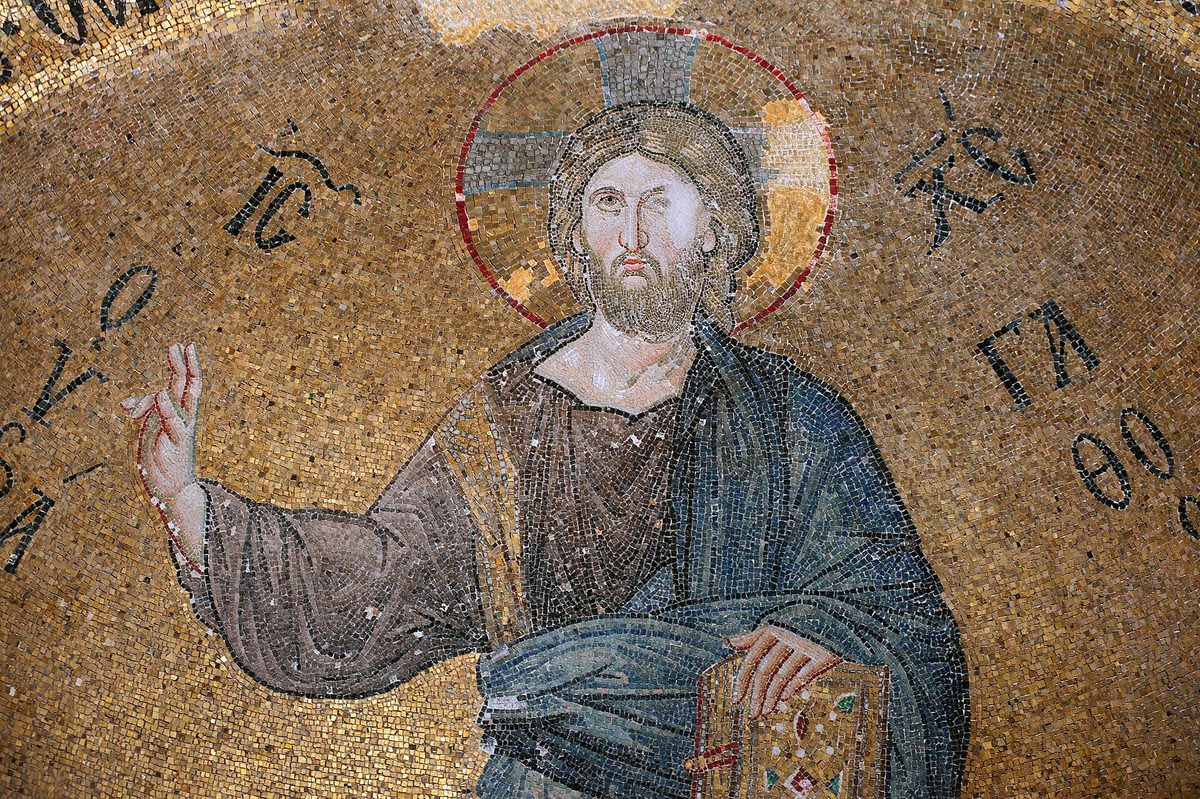
Deesis Mosaic and Apse Mosaics
Deesis mosaic — Christ flanked by Virgin and John, c.1261
Byzantine, Public domain, via Wikimedia Commons
Hagia Sophia contains some of the finest Byzantine mosaics in existence — the supreme examples being the Deesis mosaic in the upper gallery (c.1261, South Gallery) and the apse mosaic of the Theotokos (9th century). The Deesis (Greek: 'prayer' or 'supplication') shows Christ Pantocrator at the centre flanked by the Virgin Mary (left) and St John the Baptist (right) — both inclining their heads toward Christ in intercession for humanity.
The scale, the quality of the tesserae work, and the psychological depth of the three faces make this mosaic the greatest single Byzantine work in Constantinople. The tessera (individual glass cubes) are set at slightly different angles to catch the light — a deliberate technique to create a shimmering, gold atmospheric effect. The apse mosaic (c.867) shows the Theotokos enthroned with the Christ Child on her knee, the oldest original mosaic in Hagia Sophia following the Byzantine Iconoclasm.
Hagia Sophia was built by the Emperor Justinian I in 532-537 and consecrated as a Christian cathedral. It was converted to a mosque in 1453 after the Ottoman conquest, reconverted to a museum by Ataturk in 1934, and reconverted to a mosque in 2020.
The mosaics were plastered over during the Ottoman period and revealed during the 1930s museum restoration; in the current mosque configuration, the mosaics remain visible but some areas have been covered. The Deesis mosaic is of exceptional quality: the face of Christ has a warmth and psychological complexity that goes beyond the standard Byzantine formula — this is a portrait of a specific human face used to portray the divine.
The Deesis mosaic in the upper gallery is reached by a long ramp from the main floor. The three faces — Christ, Mary, and John — are among the finest portraits in any medium from the Byzantine world.
Christ's face is notable for its asymmetry (Byzantine convention uses symmetrical faces for divinity; this Christ is slightly asymmetrical, suggesting a more humanistic approach consistent with the Palaeologan Renaissance of the 13th century). The Virgin's expression is one of concentrated maternal intercession; John's is gaunt, ascetic, consumed by prophetic intensity. The apse mosaic is best seen from directly below the apse: the scale (the Theotokos is approximately 4.5 metres tall) and the gold ground create an overwhelming effect of heavenly presence.
When standing before this work, look carefully: Deesis mosaic — Christ flanked by Virgin and John, c.1261. Give it time — what seems decorative often carries the central meaning.
When standing before this work, look carefully: Apse mosaic — Theotokos enthroned, c.867. Give it time — what seems decorative often carries the central meaning.
When standing before this work, look carefully: Christ's face — the Deesis mosaic detail. Give it time — what seems decorative often carries the central meaning.
When standing before this work, look carefully: Hagia Sophia interior — dome and upper gallery. Give it time — what seems decorative often carries the central meaning.
Hagia Sophia (Ayasofya), Sultan Ahmet, Istanbul. Now a functioning mosque — visitors must cover their heads and remove shoes. The mosaics are visible to visitors except during prayer times.