
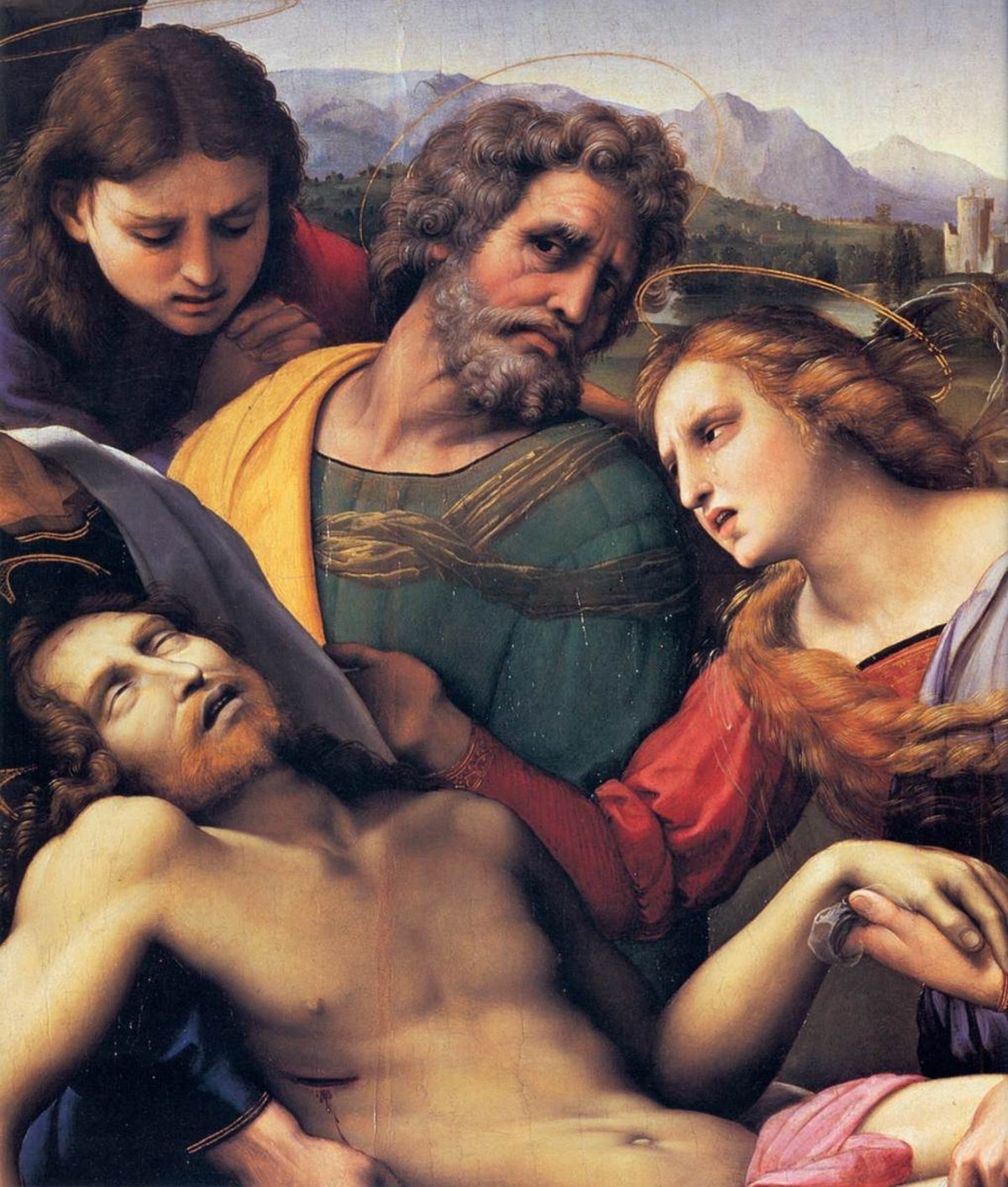
Raphael, Public domain, via Wikimedia Commons
Raphael's Deposition (also called the Baglioni Altarpiece or the Borghese Entombment) is the climax of the painter's Florentine period and his most ambitious attempt to compete with Michelangelo's dynamism and Leonardo's psychological depth. Commissioned by Atalanta Baglioni of Perugia in memory of her son Grifonetto (murdered in the 1500 Baglioni massacre), it was stolen from Perugia by agents of Cardinal Scipione Borghese in 1608 and has been in Rome ever since.
The painting shows the transport of Christ's body from the cross to the tomb — a moment of movement and transition — with a group of bearers carrying the body while the Virgin and her companions react with grief. The composition is a cascade of figures from the upper right to the lower left, ending in the limp body being carried.
Raphael (1483–1520) made extensive preparatory drawings for the Deposition — more than survive for any other of his works — that reveal the evolution of the composition from a static lamentation to the dynamic transport we see in the final painting. The change reflects the influence of antique reliefs (particularly the Meleager sarcophagus, which depicts a dead hero being carried in a similar manner) and of Michelangelo's Doni Tondo and his Battle of Cascina drawings.
The figure of the bearer who faces toward the viewer over his shoulder is directly indebted to Michelangelo's figure vocabulary. Yet the painting remains Raphaelesque in its beauty of line, the idealization of the faces, and the harmonious colour.
The composition reads from upper right (the swooning Virgin supported by two figures) across to the left (the bearers with Christ's body). Christ's body is extraordinarily beautiful — relaxed in death, the face serene, the skin pale and polished against the earth tones around it. The foot of Christ protrudes into the lower foreground with a perspective that drew contemporary comment.
The landscape behind is a Umbrian evening scene, pale and dreamlike. Raphael's Deposition was hung near Caravaggio's Deposition in the Pinacoteca Vaticana for many years; the contrast between the two approaches to the same subject was one of the great art-historical juxtapositions in Rome. They can now be compared with a short taxi ride.
When standing before this work, look carefully: Deposition — Raphael, 1507. Give it time — what seems decorative often carries the central meaning.
When standing before this work, look carefully: Christ's body — Raphael's idealized treatment. Give it time — what seems decorative often carries the central meaning.
When standing before this work, look carefully: The bearer facing the viewer — Michelangelo's influence. Give it time — what seems decorative often carries the central meaning.
When standing before this work, look carefully: The swooning Virgin and her companions. Give it time — what seems decorative often carries the central meaning.
Galleria Borghese, Rome. Timed entry required. The Deposition is in Room IX — one of the centrepieces of the Borghese collection.