
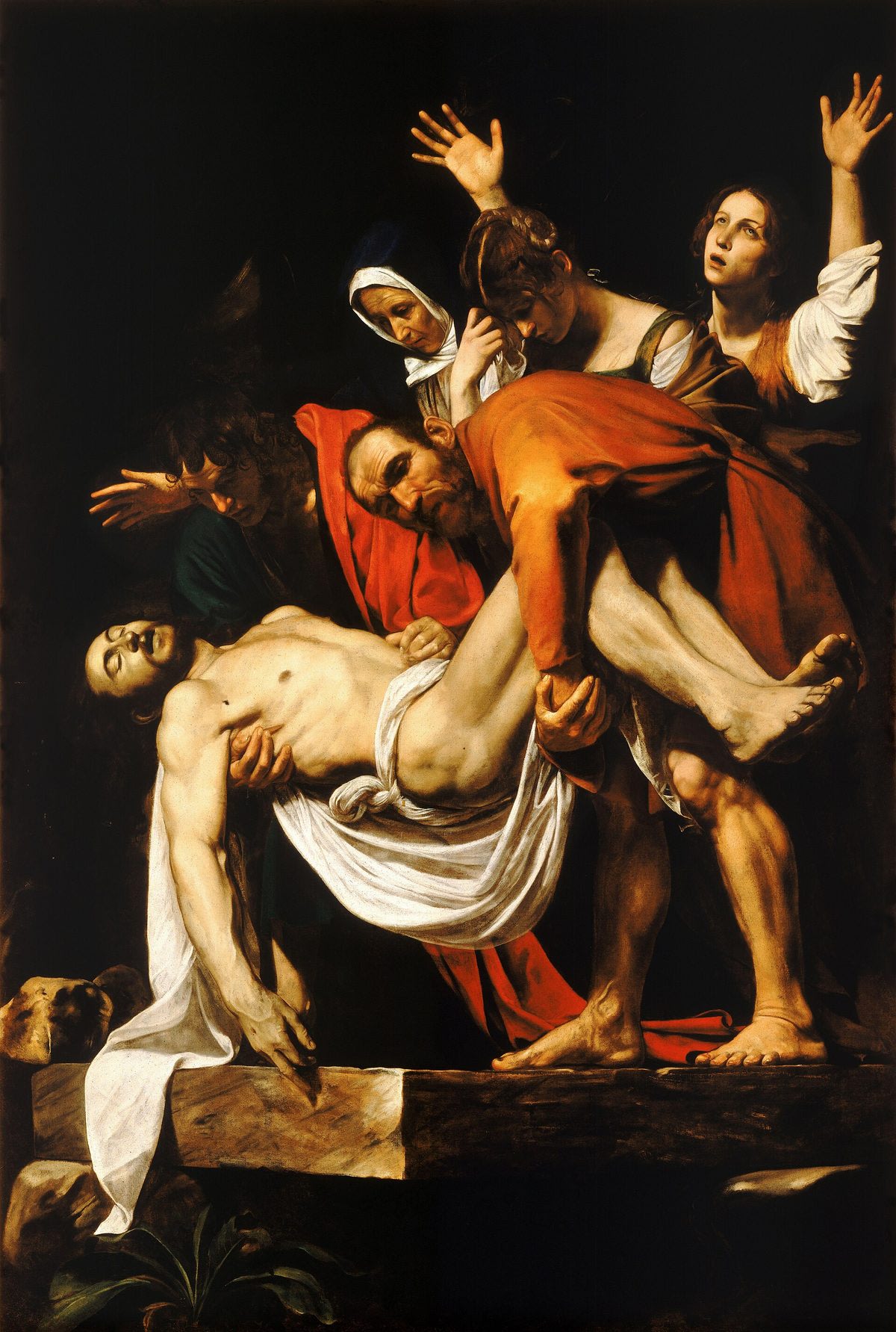
Deposition (The Entombment of Christ)
Deposition — Caravaggio, 1602-1604
Caravaggio's Deposition is the most important altarpiece of his career — originally painted for the Oratorian church of Santa Maria in Vallicella (the Chiesa Nuova) in Rome and now in the Pinacoteca Vaticana. It depicts the moment of Christ's entombment: five figures — Nicodemus, St John, the Virgin, Mary Magdalene, and Mary of Clopas — lower Christ's body into a stone sarcophagus (or onto a stone slab).
The composition is a single massive diagonal from the upper right (Mary of Clopas, arms raised in grief) to the lower left (the stone edge of the tomb). Nicodemus bears the weight of Christ's legs, looking directly at the viewer; Christ's right arm hangs limp, his hand almost touching the stone edge.
The Deposition was Caravaggio's longest sustained engagement with a single composition — he probably worked on it from 1602 to 1604. It represents a deliberate challenge to Raphael's Deposition (1507, in the Borghese Gallery nearby), which handles the same subject with a classicizing grace.
Caravaggio's version replaces Raphael's elegant processional with the grunt and labour of actual burial — the physical difficulty of moving a dead adult male body. The stone edge at the bottom of the painting cuts across the lower foreground as a horizontal emphasis, as if the picture plane is a surface on which this weight is being placed. The composition was widely copied and its influence on subsequent depictions of the Deposition is incalculable.
The painting rewards extended attention to its triangular figure structure. At the apex, Mary of Clopas raises her arms in a gesture that — by deliberate quotation — echoes the Lamentation figures in ancient sarcophagus relief sculpture, giving the image a quality of classical tragedy. Below, Mary Magdalene weeps, turned away.
The Virgin reaches forward, an arrested gesture of relinquishing possession of her son's body. John supports Christ's torso, his face close to Christ's in the intimacy of grief. Nicodemus bears the legs. Christ's white winding cloth and the red of John's cloak provide the only warmth in an otherwise brown-shadowed composition.
When standing before this work, look carefully: Deposition — Caravaggio, 1602-1604. Give it time — what seems decorative often carries the central meaning.
When standing before this work, look carefully: Nicodemus looking directly at the viewer. Give it time — what seems decorative often carries the central meaning.
When standing before this work, look carefully: Christ's limp hand against the stone. Give it time — what seems decorative often carries the central meaning.
When standing before this work, look carefully: Room VIII — Caravaggio and Raphael together. Give it time — what seems decorative often carries the central meaning.
Pinacoteca Vaticana, Vatican Museums. Room VIII (the Raphael room) also contains Raphael's Transfiguration — viewing the two paintings in the same room demonstrates the contrast between the classical and baroque approaches to sacred narrative.