
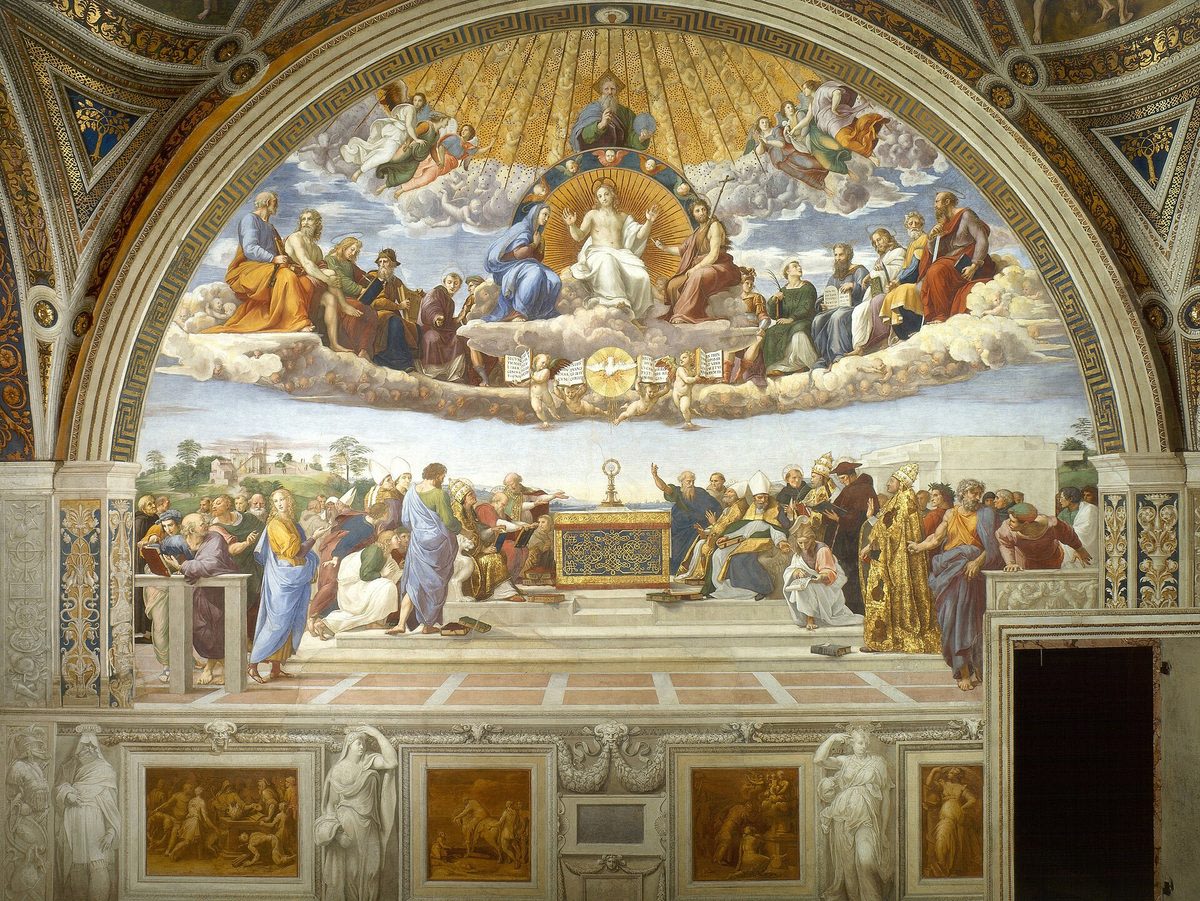
Disputation of the Holy Sacrament
Disputation of the Holy Sacrament — full fresco
Raphael, Public domain, via Wikimedia Commons
The Disputation of the Holy Sacrament (Disputa del Sacramento) faces the School of Athens directly across the Stanza della Segnatura — together they represent the two great traditions of human knowledge: revealed theology and classical philosophy. The Disputa, painted first (1509-1510), depicts the Church Triumphant in a heavenly semicircle above and the Church Militant gathered in learned debate around the altar of the Eucharist below.
At the very centre of the composition, on the altar, is the Host in a monstrance — the theological axis around which all heaven and earth is organized. It is Raphael's theological manifesto and arguably the single most comprehensive image of Catholic doctrine ever painted.
The Disputa was Raphael's first fresco in Rome — the test piece with which Julius II's programme began. He was 26 years old.
The composition's challenge was enormous: integrating a heavenly realm of timeless figures with an earthly realm of historical theologians in a single coherent space. Raphael solved it through the semicircular arrangement of heaven (mirrored in the curved hem of the altar cloth below) and through the golden light that fills the entire upper half. The figures of the Trinity — Father, Son, and Holy Spirit (as a dove) — are arranged on a vertical axis from sky to altar.
In the upper register: God the Father at the apex, Christ at the centre flanked by the Virgin and John the Baptist, and below them the dove of the Holy Spirit. Around Christ: apostles, patriarchs, and saints on cloud banks.
On earth below: theologians and Doctors of the Church — identifiable portraits including Dante (in laurel crown, left group), Savonarola (in a friar's hood), possibly Sixtus IV and Julius II in papal robes. The Host on the altar is lit by a ray from the dove above — the theological point made visually explicit: the Eucharist is not merely bread but the body of Christ, connected by the Spirit to the heavenly Christ himself. Look for the two columns of smoke rising from the altar — incense joining earth and heaven.
When standing before this work, look carefully: Disputation of the Holy Sacrament — full fresco. Give it time — what seems decorative often carries the central meaning.
When standing before this work, look carefully: The heavenly realm — Trinity, Christ, and the saints. Give it time — what seems decorative often carries the central meaning.
When standing before this work, look carefully: The altar with the Host — the theological centre. Give it time — what seems decorative often carries the central meaning.
When standing before this work, look carefully: The Stanza della Segnatura showing both facing walls. Give it time — what seems decorative often carries the central meaning.
Same room as the School of Athens. Entering the Stanza della Segnatura from the standard museum circuit, the Disputa is on the wall facing you, the School of Athens on the wall behind. The full dialogue between the two walls — theology and philosophy — is best grasped by standing in the centre of the room and turning slowly.