
Doge's Mosaic Programme and Pala d'Oro
San Marco interior — gold mosaic programme
Public domain, via Wikimedia Commons
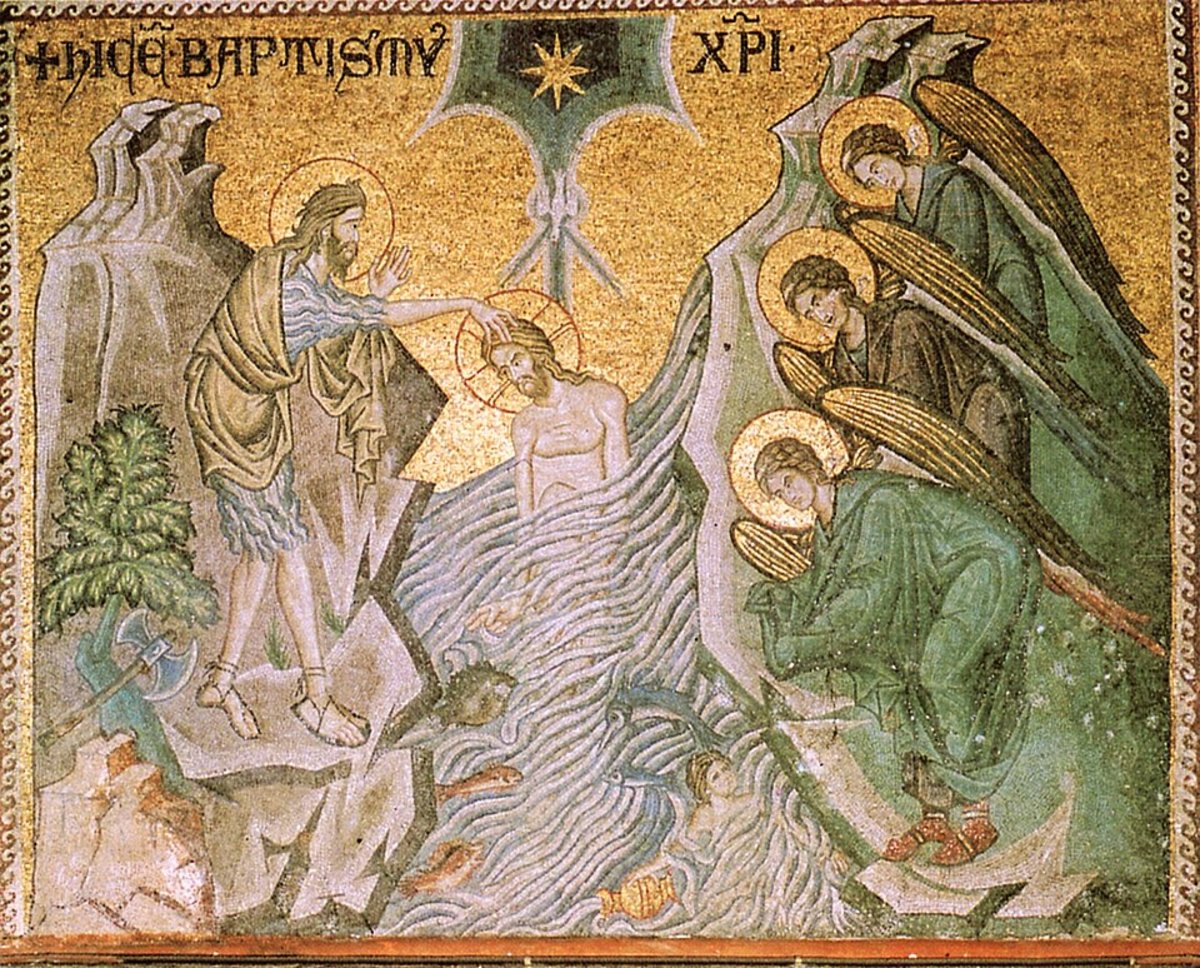
The Basilica of San Marco in Venice contains the most extensive and magnificent Byzantine mosaic programme in the Western world — covering approximately 8,000 square metres of vaults, domes, arches, and walls with gold-ground mosaics executed over a period of more than three centuries (c.1063-1400s). The programme follows a theological structure of extraordinary coherence: the Creation of the World in the narthex (first dome, c.1220-1270), the Life of Christ and the feasts of the Church in the central nave and transepts, the life of the Apostles in the crossing domes, and the Apocalypse in the west dome.
The primary dome (the Ascension, c.1065-1085) shows Christ ascending surrounded by the twelve apostles and the Virgin — the oldest and most important of the central mosaics. The Pala d'Oro (c.1105, extended 1209 and 1345) is a gold and enamel altarpiece approximately 1.4 by 3.48 metres, studded with 2,000 precious stones and over 300 enamel medallions — the most elaborate liturgical altarpiece in existence.
San Marco was built (1063-1094) as the private chapel of the Doge of Venice and modelled on the Church of the Holy Apostles in Constantinople. The mosaic programme was inspired by Constantinople's church decoration and executed by Byzantine masters brought to Venice and by Venetian craftsmen trained in Byzantine techniques.
The sack of Constantinople in 1204 (the Fourth Crusade, in which Venice played a leading role) brought Byzantine objects and craftsmen to Venice; the programme was enriched and expanded with Byzantine spoils. The Pala d'Oro was also substantially enlarged with Byzantine enamel plaques acquired in 1209.
San Marco requires multiple visits. Start in the narthex: the Creation dome (Genesis scenes in a circular composition covering the entire first dome of the narthex) is one of the finest Romanesque narrative mosaic cycles in Europe.
Then enter the basilica for the central programme: look up at the Ascension dome, then at the Pentecost dome (above the entrance), then walk through the crossing to appreciate the complete spatial effect of gold-ground mosaics in all directions. The Pala d'Oro is visible behind the high altar for a fee; binoculars are essential for its detail.
When standing before this work, look carefully: San Marco interior — gold mosaic programme. Give it time — what seems decorative often carries the central meaning.
When standing before this work, look carefully: Ascension dome mosaic — c.1065-1085. Give it time — what seems decorative often carries the central meaning.
When standing before this work, look carefully: Pala d'Oro — gold and enamel altarpiece. Give it time — what seems decorative often carries the central meaning.
When standing before this work, look carefully: Creation dome in the narthex — Genesis narrative. Give it time — what seems decorative often carries the central meaning.
Basilica di San Marco, Piazza San Marco, Venice. Open daily (restricted hours on Sunday mornings during Mass).
Free admission to the basilica; fee for the treasury (Pala d'Oro) and museum. Queues can be very long; advance booking recommended.