
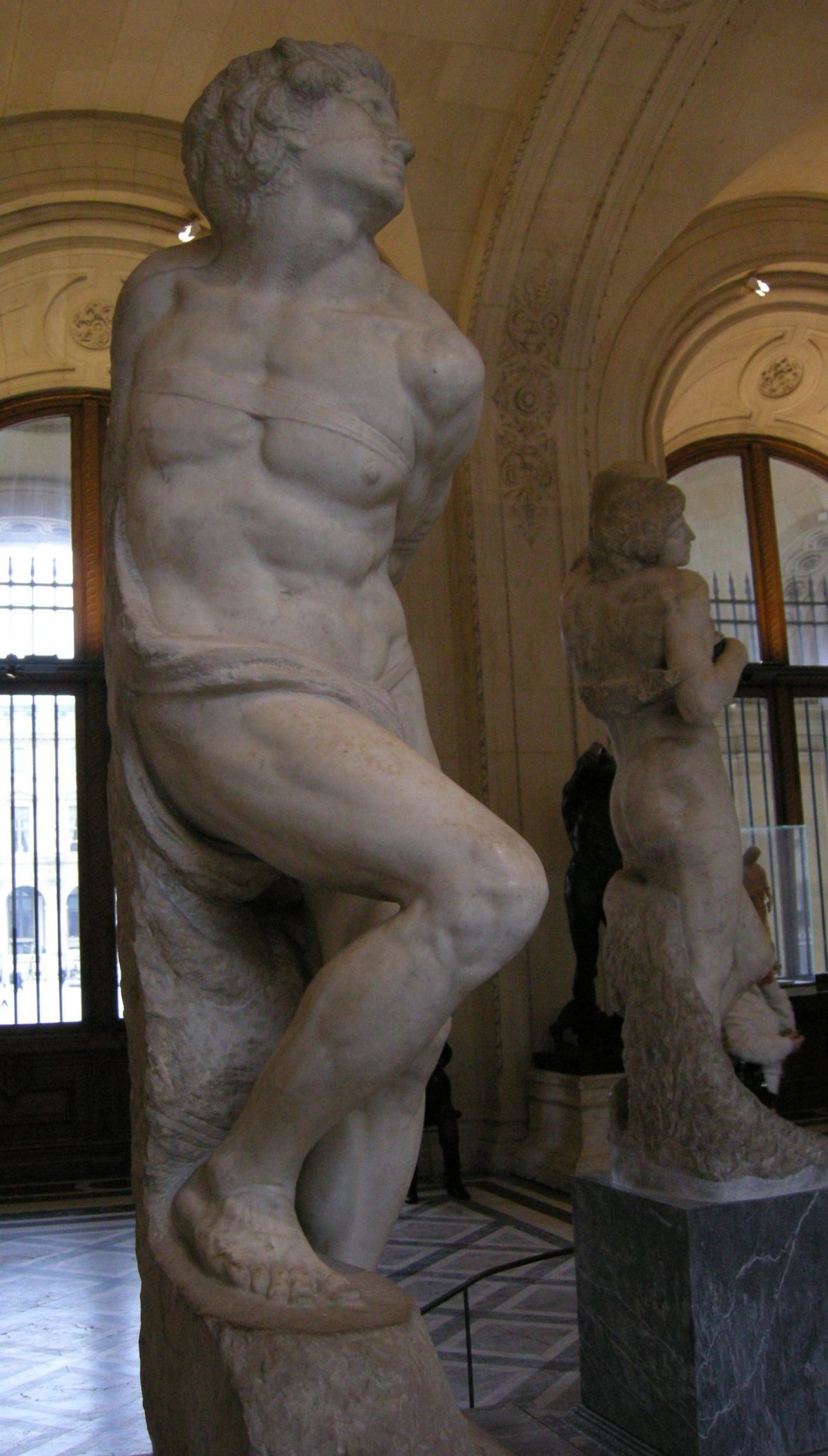
Dying Slave and Rebellious Slave
The Dying Slave — Michelangelo, c.1513-1516
Michelangelo, Public domain, via Wikimedia Commons
Michelangelo's Dying Slave and Rebellious Slave are two of the figures originally planned for the monumental tomb of Pope Julius II — the great tragedy of Michelangelo's career. Of the planned forty-plus figures, only these two (given to Roberto Strozzi in 1546, who gave them to Francis I of France) and Moses (now in San Pietro in Vincoli, Rome) reached completion.
The Dying Slave (also called the Captive) shows a nude male figure in a posture of relaxed, apparently pleasurable surrender — arms raised and arched back, face tilted upward in an expression that hovers between sleep, death, and ecstasy. The Rebellious Slave shows a different mood: the figure strains forward against an unseen constraint, head bowed, muscles engaged in struggle. Together they are often read as allegories of the two aspects of artistic creation — the submission to inspiration and the struggle against material resistance.
The iconographic programme of the Julius tomb has been debated since Condivi's 1553 biography of Michelangelo: the slaves were probably intended to represent the liberal arts enslaved by the death of Julius (their patron) or the lands conquered by Julius and now mourning him. Michelangelo himself gave multiple explanations at different times.
What is certain is that the two figures are among the most psychologically complex male nudes in Western sculpture — each one explores a different register of physical and emotional experience, and each one demonstrates Michelangelo's ability to convey inner states through exterior form. The Dying Slave's quality of suspended motion — the absolute relaxation of a body not in death but in a state beyond ordinary consciousness — has no predecessor in the tradition.
The Dying Slave is the more celebrated of the two: stand in front of it and observe the total physical release — every muscle relaxed, the head back, the arm raised in an S-curve above. The quality of the surface — the polished skin against the rough stone behind the figure (a deliberately unfinished background that makes the polished skin seem to emerge from the stone) — is one of Michelangelo's most deliberate formal choices.
The monkey-like creature at the figure's left leg has been variously interpreted as a symbol of painting (the ape of art) or of the enslaved arts. The Rebellious Slave is rougher and more dynamic: the head bows forward, the arm raises, the contraposto is more extreme.
When standing before this work, look carefully: The Dying Slave — Michelangelo, c.1513-1516. Give it time — what seems decorative often carries the central meaning.
When standing before this work, look carefully: The Rebellious Slave — contrast in struggle. Give it time — what seems decorative often carries the central meaning.
When standing before this work, look carefully: The Dying Slave's face — between ecstasy and death. Give it time — what seems decorative often carries the central meaning.
When standing before this work, look carefully: The Louvre sculpture gallery with both slaves. Give it time — what seems decorative often carries the central meaning.
Musée du Louvre, Room 4, Denon Wing (Gallery of Sculptures). The two slaves are displayed together; the room also contains Michelangelo's four Prisoners (unfinished works from a later phase of the tomb project).