
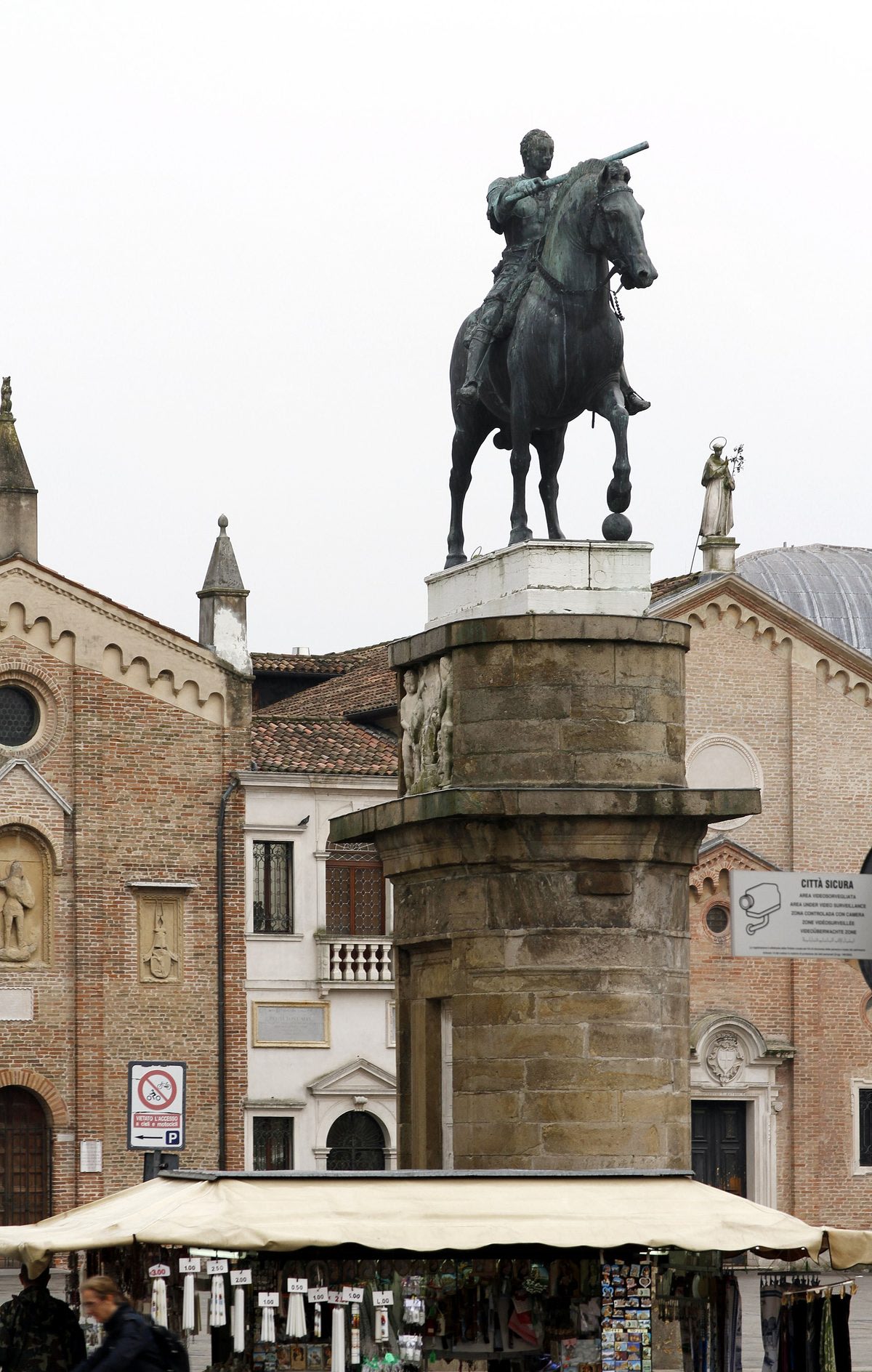
Equestrian Monument of Gattamelata (Erasmo da Narni)
Equestrian monument of Gattamelata — Donatello, 1443-1453, Padua
Donatello, Public domain, via Wikimedia Commons
Donatello's Gattamelata (the equestrian monument of the Venetian mercenary captain Erasmo da Narni, known as the Gattamelata — 'the honeyed cat') in the Piazza del Santo, Padua, is the first monumental bronze equestrian statue since antiquity — a work that revived a tradition of public commemorative sculpture dormant for over a thousand years. The bronze horse and rider (approximately 340 by 390 cm) dominates the square in front of the Basilica of St Anthony.
The pose — the horse walking with deliberate authority, the rider sitting with commanding stillness — derives from the Marcus Aurelius equestrian statue in Rome (the only ancient equestrian bronze to survive the Middle Ages, because it was mistakenly believed to represent Constantine). Donatello gave his rider an individualised face rather than an idealised one, and the combination of monumental public scale with psychological specificity is characteristic of his revolutionary approach.
Donatello went to Padua in 1443, attracted by a commission from the Venetian Republic for this monument to their recently deceased condottiere (mercenary captain). He spent approximately ten years in Padua, also creating the bronze high altar of the Basilica of St Anthony — a decade that was formative for Venetian and North Italian Renaissance art. The Gattamelata was the first public secular monument in Italy since antiquity — it established the Renaissance tradition of civic commemorative sculpture.
The Gattamelata stands in the open square and can be examined from all angles. Walk around the monument: the horse's anatomy is observed with a precision unprecedented in monumental sculpture; the rider's armour is a hybrid of Roman and contemporary forms; the circular motif on the baton in the rider's hand is a characteristic Donatello detail. The monument should be seen against the backdrop of the Basilica of St Anthony — the placing of the secular monument of human achievement adjacent to the basilica of Christian sanctity is a statement of Renaissance civic humanism.
When standing before this work, look carefully: Equestrian monument of Gattamelata — Donatello, 1443-1453, Padua. Give it time — what seems decorative often carries the central meaning.
When standing before this work, look carefully: The rider's face — individualized psychological portrait. Give it time — what seems decorative often carries the central meaning.
When standing before this work, look carefully: The horse — unprecedented anatomical observation. Give it time — what seems decorative often carries the central meaning.
When standing before this work, look carefully: Piazza del Santo — monument against the Basilica. Give it time — what seems decorative often carries the central meaning.
Piazza del Santo, Padua. The equestrian monument stands in the open square — visible at all hours, free.
The Basilica di Sant'Antonio is immediately adjacent. Padua is 40 km west of Venice (approximately 30 minutes by train).