
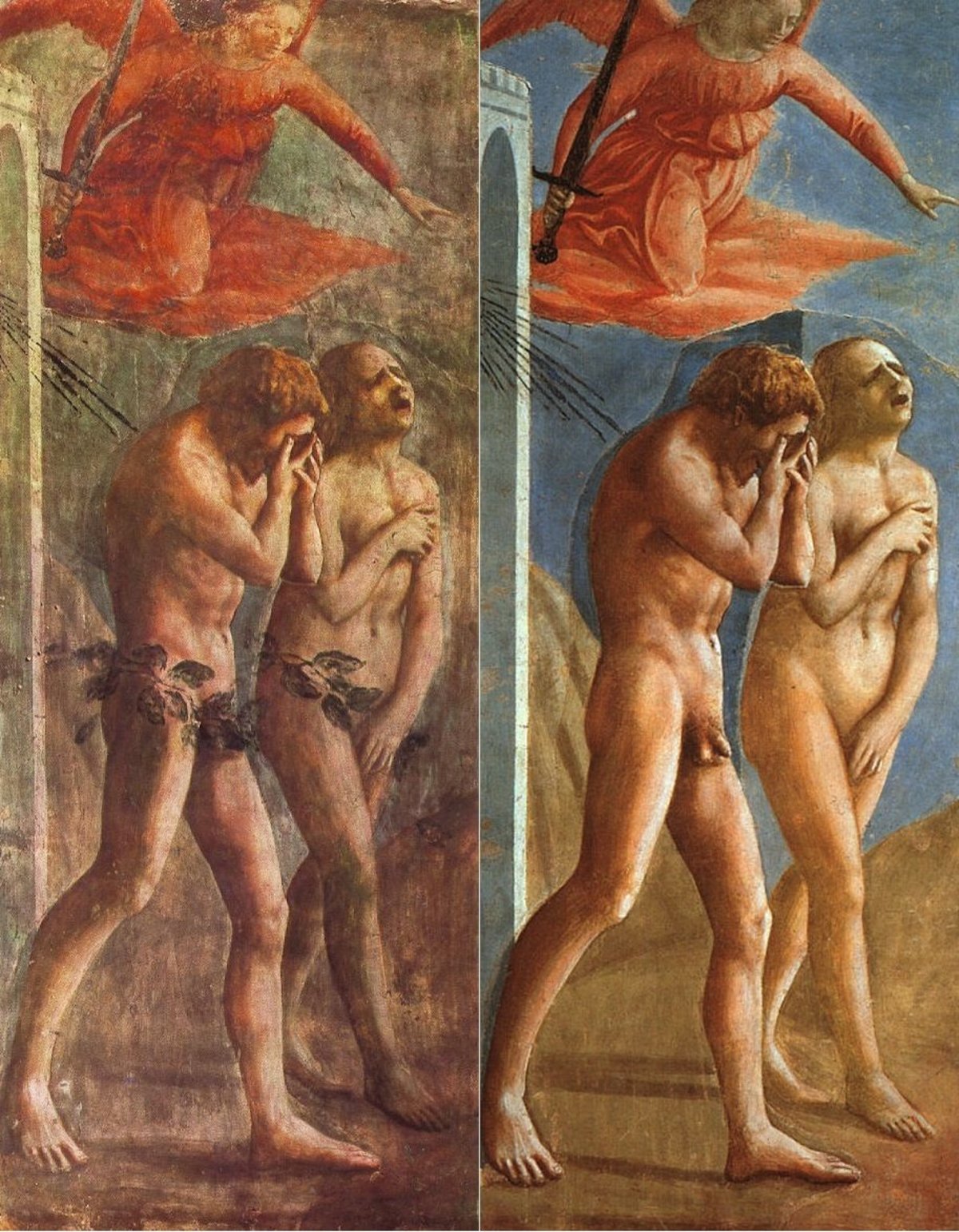
Expulsion from the Garden of Eden
Expulsion from the Garden — Masaccio
Masaccio, Public domain, via Wikimedia Commons
Masaccio's Expulsion from the Garden of Eden is the most powerful and psychologically devastating depiction of the Fall in all of Western art. It occupies a pilaster at the entrance of the Brancacci Chapel, paired with Masolino's Temptation (showing Adam and Eve before the Fall, graceful and unashamed, in the flat decorative style of the older artist). The contrast between the two pilasters — Masolino's serene pre-Fall pair and Masaccio's agonised post-Fall pair — is one of the most resonant formal arguments in painting.
Masaccio's Eve screams with open mouth, her face contracted in grief, her hands covering her nakedness; Adam bows his head and covers his face with his hands, unable to bear the light he is being expelled into. An angel with a sword drives them forward. Behind them, the gate of Eden closes.
The comparison between Masolino's and Masaccio's Adams and Eves is a perfect demonstration of the difference between the Gothic and Renaissance approaches to the human body. Masolino's pair are elegant, linear, patterned — their bodies decorative objects in a flat pictorial space.
Masaccio's pair are three-dimensional bodies under stress: the muscles engage, the weight shifts, the faces express specific emotional experience. Eve's open-mouthed scream is perhaps the most raw depiction of human grief in 15th-century painting — it has no precedent and few successors until Grünewald's Isenheim mourners. The paintings were partly restored in a 1980s cleaning that removed an 18th-century addition of fig leaves over Adam and Eve's nudity.
The compositional simplicity is part of the power: two figures, an angel, a gate, a blank sky. There is no landscape, no background, no decoration — only the forward stumbling motion of two people in grief entering a world they have not previously inhabited.
Eve's left hand covers her breasts, her right covers her groin — the gesture of shame that Masaccio invented from scratch (the classical Venus Pudica gesture, borrowed here for a new theological purpose). Adam's covered face is an inward contraction: his shame is directed not outward (as Eve's scream is) but inward, toward his own consciousness of what he has done.
When standing before this work, look carefully: Expulsion from the Garden — Masaccio. Give it time — what seems decorative often carries the central meaning.
When standing before this work, look carefully: Eve's open-mouthed scream — raw grief. Give it time — what seems decorative often carries the central meaning.
When standing before this work, look carefully: Adam covering his face — shame directed inward. Give it time — what seems decorative often carries the central meaning.
When standing before this work, look carefully: Masolino's Temptation — the contrast before the Fall. Give it time — what seems decorative often carries the central meaning.
Same location as the Tribute Money — Brancacci Chapel, Santa Maria del Carmine. The Expulsion is on the entrance pilaster (left side); the Temptation (Masolino) faces it on the right. The juxtaposition is best appreciated by standing at the chapel entrance and looking at both simultaneously.