
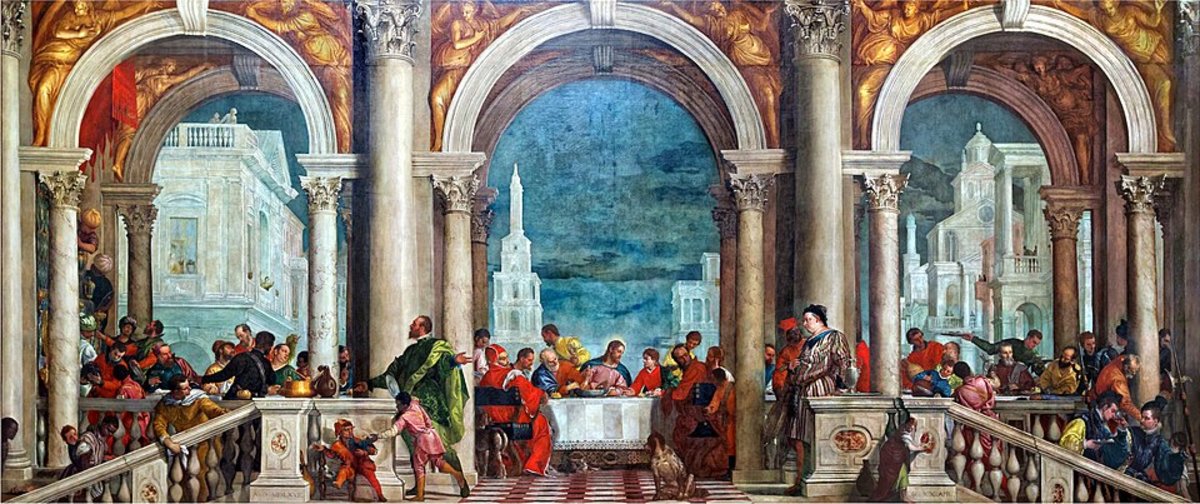
Feast in the House of Levi
Feast in the House of Levi — Veronese, 1573
Paolo Veronese, Public domain, via Wikimedia Commons
Paolo Veronese's Feast in the House of Levi (originally titled The Last Supper) is one of the most spectacular paintings of the Venetian Renaissance — a monumental canvas approximately 5.55 by 12.8 metres originally painted for the refectory of the Dominican convent of Santi Giovanni e Paolo. The composition shows a grand feast in a Renaissance loggia with classical architecture, attended by apostles, servants, dwarfs, German soldiers, dogs, parrots, and other figures of secular Renaissance life — Christ and his disciples at the centre, surrounded by the abundance and exuberance of a great Venetian banquet.
The painting was originally intended as a Last Supper, but the Inquisition objected to the secular and exotic elements (the dwarfs, the German soldiers with halberds, the dogs at the feet, the servants carrying meat). Veronese appeared before the Inquisition in 1573 and defended his right to paint with 'the freedom that poets and madmen possess'; the Inquisition compromised — the painting was retitled 'Feast in the House of Levi' (a different Gospel feast), changing the subject without changing the image.
Paolo Veronese (Paolo Caliari, 1528-1588) was the third of the great Venetian painters of the 16th century (after Titian and Tintoretto) — his work characterised by a delight in colour, surface, and secular exuberance that brings the splendour of Venice's mercantile prosperity into sacred narrative. The Inquisition trial of 1573 is the most important documented confrontation between an artist and religious authority in Renaissance history; the record of Veronese's testimony survives and is one of the primary documents for understanding the relationship between religious art and artistic freedom in the Counter-Reformation.
The width of the painting (12.8 metres) requires standing at the far end of the Accademia's room to see the complete composition. Begin with the overall effect — the three arches of the loggia framing the composition, the crowd of figures, the feast table at the centre — then move closer to read the individual details: the dwarfs, the dog under the table, the parrot on the balustrade, the Venetian serving staff, and finally Christ and the disciples at the centre, entirely absorbed in their conversation despite the spectacular surrounding activity.
When standing before this work, look carefully: Feast in the House of Levi — Veronese, 1573. Give it time — what seems decorative often carries the central meaning.
When standing before this work, look carefully: The full 12.8-metre canvas — three arches and the feast. Give it time — what seems decorative often carries the central meaning.
When standing before this work, look carefully: Christ and the disciples at the centre. Give it time — what seems decorative often carries the central meaning.
When standing before this work, look carefully: The secular details — dogs, dwarfs, parrots, soldiers. Give it time — what seems decorative often carries the central meaning.
Gallerie dell'Accademia, Campo della Carità 1050, Venice. Open Tuesday-Sunday; admission fee. The Veronese Feast is in Room 10 of the Accademia — a room dedicated to the large-format Venetian narrative paintings.