
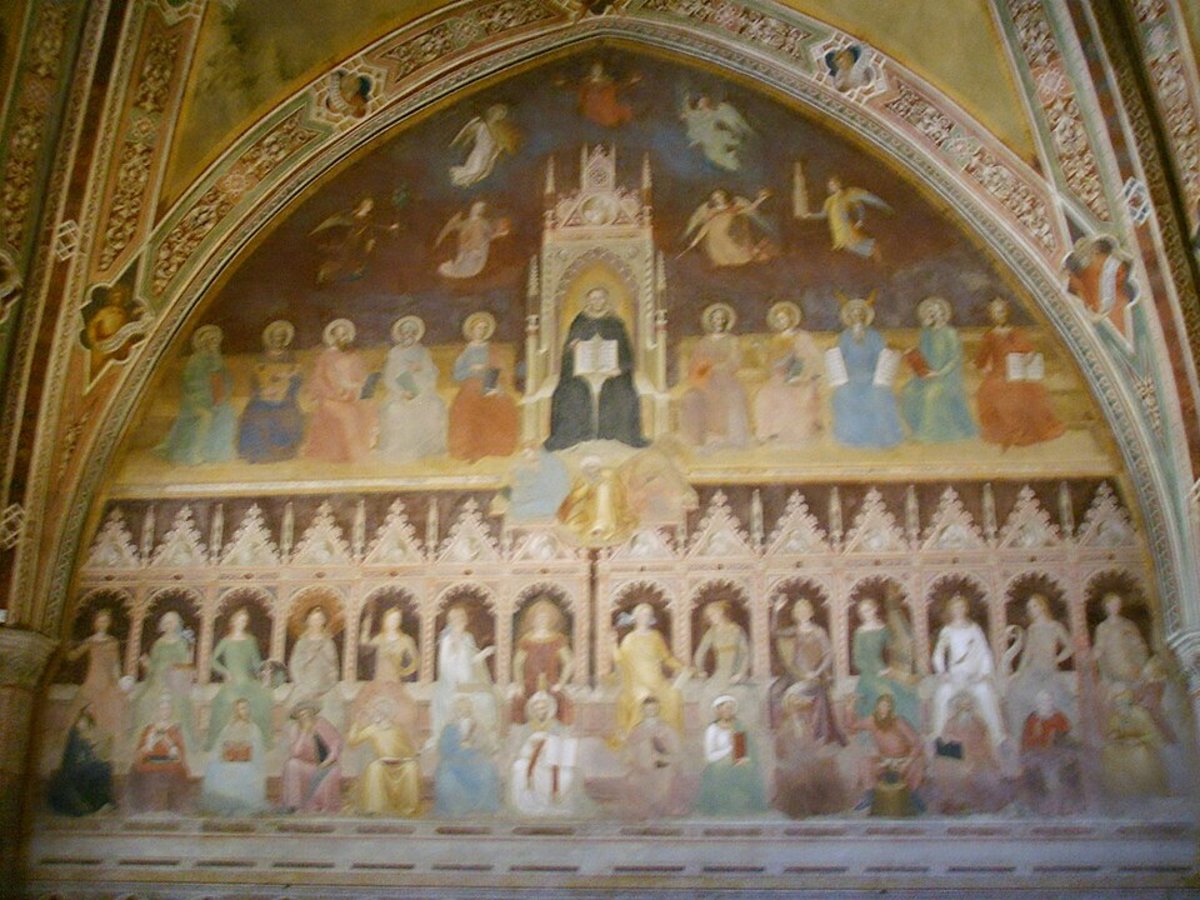
Frescoes of the Spanish Chapel (Cappellone degli Spagnoli)
Triumph of the Church — Andrea di Bonaiuto, c.1365-1368
Andrea di Bonaiuto, Public domain, via Wikimedia Commons
Andrea di Bonaiuto's frescoes in the Spanish Chapel of Santa Maria Novella in Florence are the most complete surviving Dominican theological programme in Italian medieval painting. The chapel (built c.1350) was decorated for the Dominican order: the frescoes cover all four walls with an elaborate allegorical and theological scheme. The south wall shows the Triumph of the Church and the Dominican Order (the Via Veritatis — a visual encyclopaedia of the Church, theology, and the liberal arts).
The north wall shows the Navicella (ship of the Church), the Descent into Limbo, and the Resurrection. The east wall shows the Crucifixion with attendant scenes. The west wall (entrance) shows scenes from the life of St Peter Martyr. The chapel was later given to the Spanish community in Florence (hence 'Spanish Chapel') but its decoration is entirely Dominican.
Andrea di Bonaiuto (active c.1346-1379) was a Florentine painter whose major surviving work is this chapel. The theological programme was almost certainly devised by the Dominican prior of Santa Maria Novella; Andrea's role was to translate the programme into visual form.
The Triumph of the Church fresco (south wall) is the most complex: it shows the Dominican order as the guardians of orthodoxy (the Dominicans are the 'dogs of the Lord' — Domini canes — and Andrea shows them as white and black dogs, the Dominican colours, guarding the Church against wolves). Florence Cathedral (still under construction in 1365) is shown as already complete — a projected vision of the completed building.
The Triumph of the Church fresco is best approached with a guidebook or with preparation — it is a dense theological allegory in which every figure has an identifiable role. The visible representation of Florence Cathedral as it would look when completed (with dome, though Brunelleschi's dome was not built until 1420-1436) is an extraordinary example of architectural projection in medieval painting.
When standing before this work, look carefully: Triumph of the Church — Andrea di Bonaiuto, c.1365-1368. Give it time — what seems decorative often carries the central meaning.
When standing before this work, look carefully: South wall — full Via Veritatis allegory. Give it time — what seems decorative often carries the central meaning.
When standing before this work, look carefully: Dominican dogs guarding the Church — allegory. Give it time — what seems decorative often carries the central meaning.
When standing before this work, look carefully: Florence Cathedral projected as complete — architectural vision. Give it time — what seems decorative often carries the central meaning.
Santa Maria Novella, Piazza di Santa Maria Novella, Florence. Open Monday-Thursday 9:00-17:30, Friday 11:00-17:30, Saturday 9:00-17:30, Sunday 12:00-17:30. Admission fee applies to the museum; the Spanish Chapel is included.