
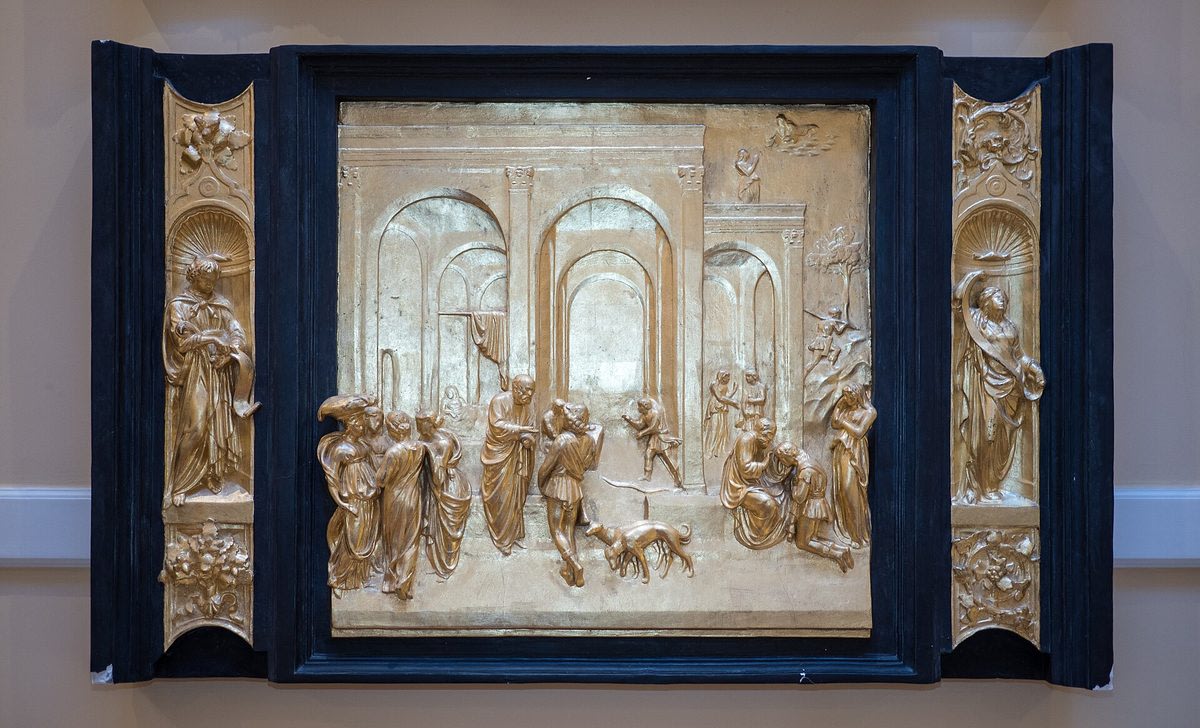
Gates of Paradise (Porta del Paradiso)
Gates of Paradise — Ghiberti, 1425-1452
Lorenzo Ghiberti, Public domain, via Wikimedia Commons
Ghiberti's Gates of Paradise — the east doors of the Florence Baptistery — are the supreme achievement of 15th-century Florentine sculpture and the work that gave the Renaissance its term for achieving the impossible: Michelangelo is said to have remarked that they were 'so beautiful they could be the gates of Paradise.' Ten large panels depict scenes from the Old Testament (Genesis through Solomon) in a revolutionary new format: each panel contains multiple narrative episodes in a single landscape space, with small-scale background figures receding into atmospheric depth and large-scale foreground figures in high relief, creating the equivalent of a painted spatial illusion in bronze. The originals (replaced by replicas on the Baptistery since the 1990 flood) are in the Museo dell'Opera del Duomo.
Lorenzo Ghiberti (1378-1455) won the Baptistery door commission in 1401, in a famous competition, beating Brunelleschi with his panel of the Sacrifice of Isaac (both panels survive and are in the Bargello). The original North Doors commission (scenes from the New Testament) occupied him from 1403 to 1424.
The East Doors (Gates of Paradise) commission followed immediately and occupied him from 1425 to 1452 — twenty-seven years. They are the product of a lifetime of accumulated technical mastery: the ten panels synthesise advances in linear perspective (from Brunelleschi), psychological portraiture (from Donatello), and atmospheric landscape rendering (from contemporary Flemish painting) in a medium — gilded bronze — that none of these other advances had touched. Ghiberti also included a self-portrait on the border: a small bronze head looking out from the frame.
Each of the ten panels is a compositional masterpiece. The Story of Jacob and Esau is often cited as the supreme example: in a single panel, Ghiberti depicts Rebekah consulting God, the birth of the twins, Isaac sending Esau hunting, Rebekah preparing Jacob, Jacob receiving Isaac's blessing, and Esau returning to find his blessing stolen — six sequential episodes in a unified architectural space with figures in different planes of relief depth.
Look also at the Meeting of Solomon and the Queen of Sheba (a scene of ceremonial grandeur) and the Story of Adam and Eve (the opening panel). Ghiberti's self-portrait head is in the left door frame, approximately at eye level — a bald, slightly smiling face looking directly at the visitor.
When standing before this work, look carefully: Gates of Paradise — Ghiberti, 1425-1452. Give it time — what seems decorative often carries the central meaning.
When standing before this work, look carefully: The Jacob and Esau panel — multiple episodes in one space. Give it time — what seems decorative often carries the central meaning.
When standing before this work, look carefully: Ghiberti's self-portrait in the door frame. Give it time — what seems decorative often carries the central meaning.
When standing before this work, look carefully: The Gates on the Florence Baptistery. Give it time — what seems decorative often carries the central meaning.
Museo dell'Opera del Duomo, Piazza del Duomo 9, Florence. The originals are in the museum; replicas are on the Baptistery. The museum displays many other masterworks from the Duomo complex, including Michelangelo's Bandini Pietà (entry 56) and Donatello's Penitent Magdalene (entry 57).