
Ghent Altarpiece (Adoration of the Mystic Lamb)
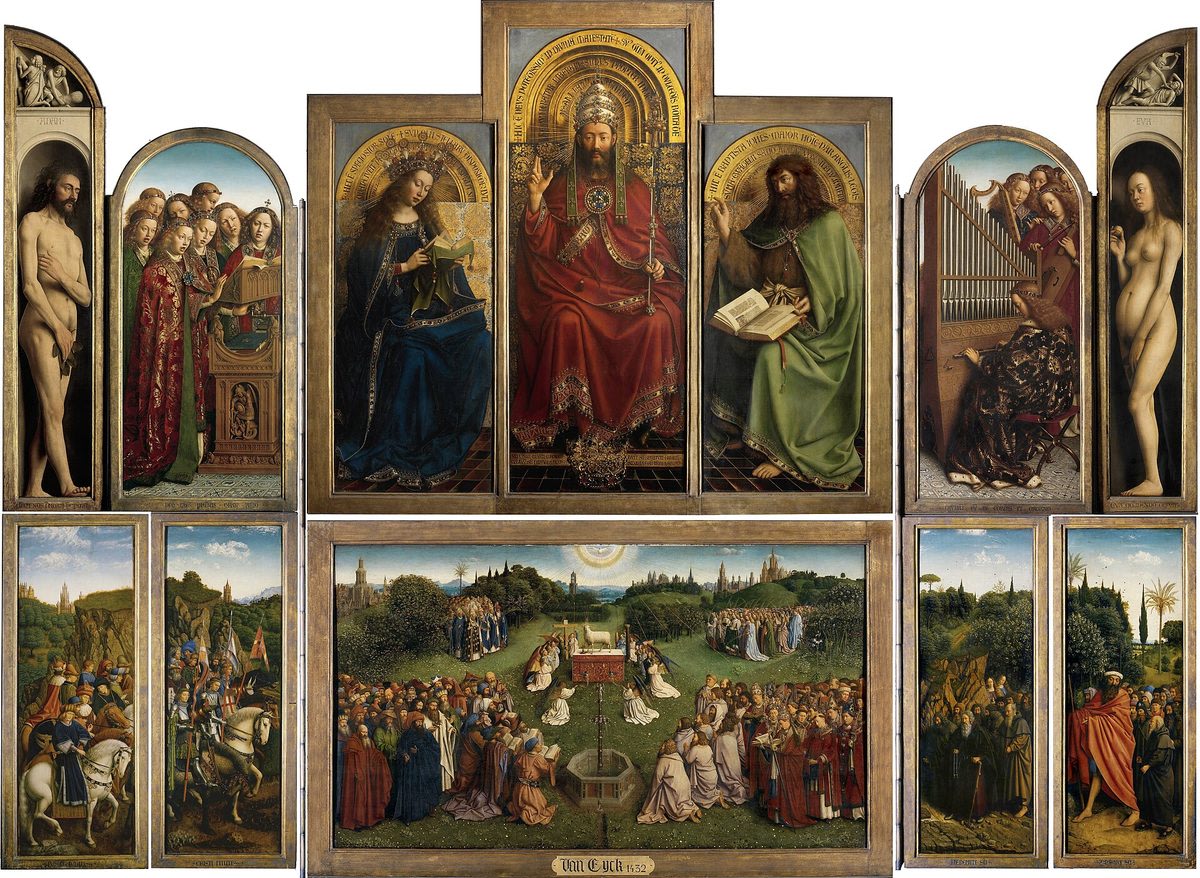
Ghent Altarpiece — opened, showing all twelve panels
Jan and Hubert van Eyck, Public domain, via Wikimedia Commons
The Ghent Altarpiece is the most important and most stolen painting in the history of Western art — a polyptych of twelve panels completed in 1432 by Jan van Eyck (and attributed in part to his older brother Hubert, who died in 1426) that has been stolen thirteen times and was the subject of the most sophisticated art theft operation of World War II (the Nazis' Operation Salamander). The open altarpiece is 3.5 by 4.6 metres — an overwhelming object. The central lower panel, the Adoration of the Mystic Lamb, depicts the Lamb of God on an altar, surrounded by worshipping angels and converging processions of prophets, apostles, martyrs, confessors, and virgins from all four directions.
Above the Lamb is a heavenly court: the Virgin, God the Father (enthroned in papal-Imperial regalia), and John the Baptist. The upper outer wings show the Annunciation. On the closed altarpiece, the donors kneel before painted grisaille statues of John the Baptist and John the Evangelist.
Jan van Eyck (c.1390-1441) is the founder of Netherlandish painting and the man who developed (or perfected) oil painting as a technique capable of infinite surface detail, atmospheric depth, and gem-like colour saturation. The Ghent Altarpiece is his and his brother Hubert's masterwork — an encyclopaedic image of salvation, depicting all of saved humanity converging on the Lamb of God.
The painting's history of theft and survival is extraordinary: it was seized by Napoleon, recovered, disassembled by the Nazis, hidden in a salt mine in Austria, recovered by the Monuments Men, and returned to Ghent. One panel (The Just Judges) was stolen in 1934 and has never been recovered — a copy hangs in its place.
The scale, detail, and theological programme of the Ghent Altarpiece cannot be fully absorbed in a single visit. Focus on the Mystic Lamb panel: the crowd of worshippers converging from all directions represents the whole of redeemed humanity — prophets, patriarchs, apostles, martyrs, popes, kings, virgins — with individual faces so precisely painted that one has the impression of actual portraiture. The Lamb on the altar, bleeding into a chalice, is an image of the Eucharist.
The fountain in the foreground is the Fountain of Life. The enclosed garden setting is the New Jerusalem. Then look at the upper panels: the God the Father enthroned is the most powerful image of divine majesty in Northern European painting.
When standing before this work, look carefully: Ghent Altarpiece — opened, showing all twelve panels. Give it time — what seems decorative often carries the central meaning.
When standing before this work, look carefully: The Adoration of the Mystic Lamb — central lower panel. Give it time — what seems decorative often carries the central meaning.
When standing before this work, look carefully: God the Father enthroned — central upper panel. Give it time — what seems decorative often carries the central meaning.
When standing before this work, look carefully: The closed altarpiece — grisaille saints and donors. Give it time — what seems decorative often carries the central meaning.
St Bavo's Cathedral (Sint-Baafskathedraal), Sint-Baafsplein, Ghent. The altarpiece is in a purpose-built visitor pavilion within the cathedral with controlled viewing conditions. Entry requires a ticket; advance booking recommended.