
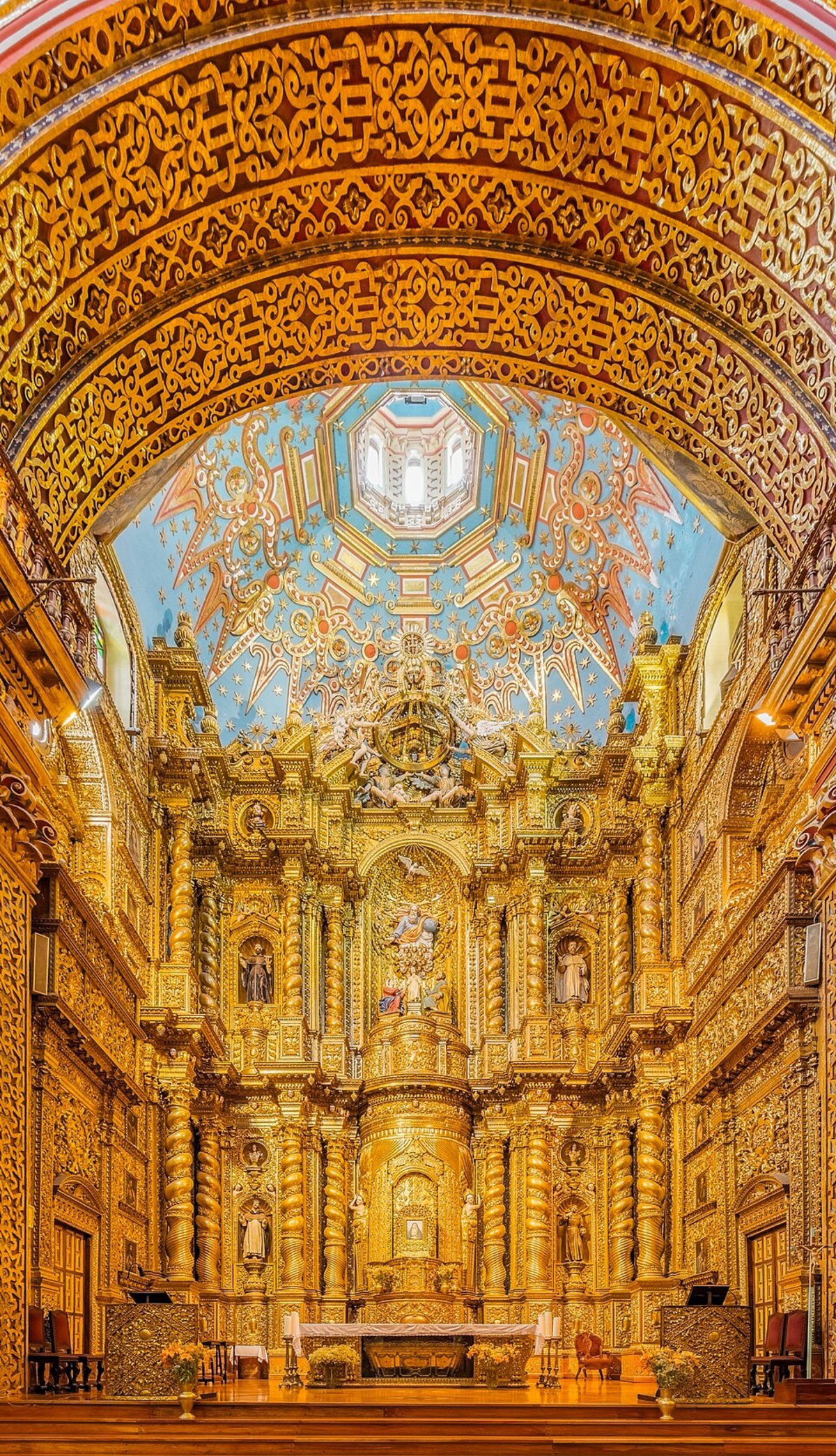
Gilded Interior and Church Architecture
La Compañía de Jesús facade — Quito, 1722
Public domain, via Wikimedia Commons
La Compañía de Jesús in Quito is considered the most ornate Jesuit church in the Americas and one of the most elaborately decorated Baroque interiors in the world — its nave, side chapels, vaults, and dome entirely covered with gilded carving in a style that combines European Baroque forms with indigenous Andean iconographic elements. The church was built between 1605 and 1765, over 160 years; the interior decoration, executed primarily in the 18th century, uses an estimated seven tonnes of gold applied in sheets and powder to carved wood, stucco, and plaster surfaces.
The interior programme combines saints' images, theological symbols, Marian imagery, and Andean plants and animals (including the maracuya/passion flower, native to Ecuador, which was immediately adopted as a symbol of the Passion of Christ because of its features). The facade (completed 1722) is equally elaborate — a three-storey composition of columns, niches, and sculptural decoration that was inspired by the Gesù church in Rome but transformed by Andean Baroque taste into something uniquely American.
The Jesuits arrived in Quito in 1586 and began building La Compañía in 1605 as the principal church of their Ecuadorian province. The construction was repeatedly interrupted — by earthquakes, by the expulsion of the Jesuits from Spain and its colonies (1767), and by the appropriation of the church after independence.
The gilded interior was executed by multiple generations of craftsmen, including indigenous and mestizo artists trained in the workshops of the Quito School (Escuela Quiteña), which developed a distinctive style of polychrome religious carving in the 17th and 18th centuries. The church was listed as a UNESCO World Heritage Site as part of the Quito Historic Centre (1978), the first site to be so listed.
The interior of La Compañía must be experienced in two conditions: by daylight (to see the carving detail) and by candlelight or lamp-light (to see the gold shimmer in the way it was designed). The nave is approximately 52 metres long and entirely gilded from floor to vault; the side chapels each have individual altarpieces of the same quality.
Look for the Andean iconographic elements: passion flowers, native birds, maize, and other indigenous plants integrated into the floral carving. The main altarpiece shows St Ignatius of Loyola and St Francis Xavier flanking the central tabernacle; the ceiling fresco above the crossing is attributed to the Quiteño painter Hernando de la Cruz.
When standing before this work, look carefully: La Compañía de Jesús facade — Quito, 1722. Give it time — what seems decorative often carries the central meaning.
When standing before this work, look carefully: The gilded nave interior — seven tonnes of gold. Give it time — what seems decorative often carries the central meaning.
When standing before this work, look carefully: A gilded side chapel — Quito School craftsmanship. Give it time — what seems decorative often carries the central meaning.
When standing before this work, look carefully: Vault detail — gilded carving and fresco. Give it time — what seems decorative often carries the central meaning.
La Compañía de Jesús, García Moreno and Sucre streets, Historic Centre, Quito, Ecuador. Open daily; a modest admission fee is charged for the interior. Part of the Quito World Heritage Site.