
Giorgione Madonna Panels and the Castelfranco Altarpiece
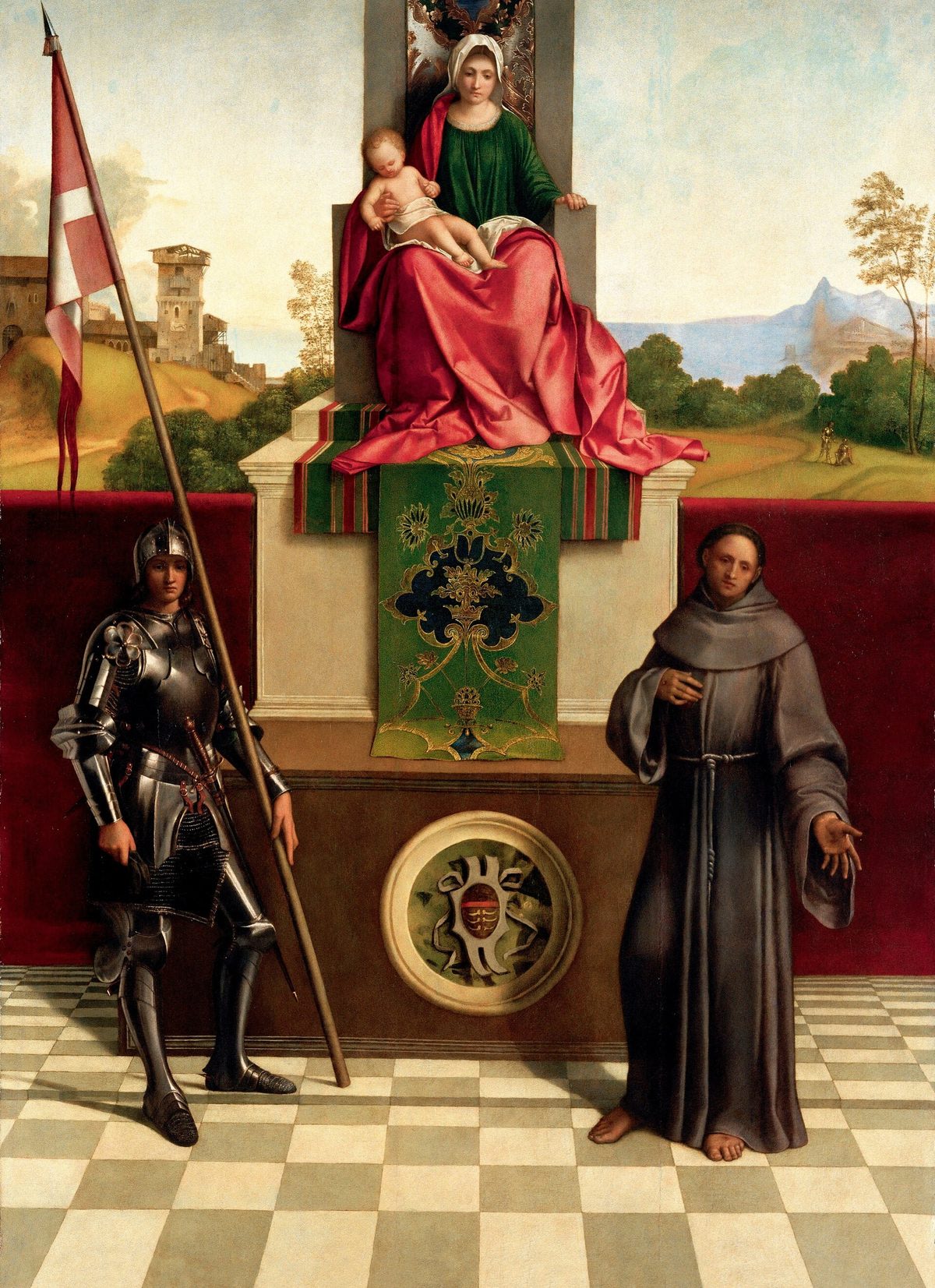
Castelfranco Madonna — Giorgione, c.1503-1504
Giorgione, Public domain, via Wikimedia Commons
Giorgione (c.1477/78-1510) is the most mysterious and influential painter of the Venetian Renaissance — he died young (of the plague) leaving only a handful of securely attributed works, yet his influence on Titian and subsequent Venetian painting was profound. The Accademia's Giorgione collection includes panels that have been debated in attribution (some assigned to Giorgione, others to Titian or the early workshop), but the primary devotional work attributed to him is the Castelfranco Altarpiece (Madonna Enthroned with Saints Liberalis and Francis, c.1503-1504) in the Cathedral of Castelfranco Veneto — his hometown. The altarpiece shows the enthroned Virgin and Child elevated on a high throne above a landscape, flanked by two knights-in-armour (St Liberalis, patron of Castelfranco) and a Franciscan friar (St Francis); the landscape behind the throne is the most famous landscape in the history of Venetian painting — a sunset-hour Veneto plain with a specific atmospheric quality that gave the entire tradition of Venetian landscape painting its vocabulary.
Giorgione's influence on the history of Western art is disproportionate to his surviving work: the atmospheric landscape tradition (the dissolving of precise forms in air and light), the enigmatic quality of his figures (the Tempest, the Three Philosophers — secular works of uncertain meaning), and the radical unification of figure and landscape all derive from him. The Castelfranco Altarpiece demonstrates his religious programme: the enthroned Madonna as a presence within the natural world, her throne inserted into the landscape, the landscape itself charged with spiritual meaning.
The Castelfranco Altarpiece is in the Cathedral of Castelfranco Veneto (approximately 35 km northwest of Venice by train). The altarpiece is in the Costanzo Chapel; the quality of the landscape (and the specific sunset light) must be experienced in the original — no reproduction captures it adequately. The Accademia's Giorgione panels (including the Small Madonna) allow comparison of his approach to the Madonna subject at intimate scale.
When standing before this work, look carefully: Castelfranco Madonna — Giorgione, c.1503-1504. Give it time — what seems decorative often carries the central meaning.
When standing before this work, look carefully: The landscape — Venetian atmospheric painting's founding document. Give it time — what seems decorative often carries the central meaning.
When standing before this work, look carefully: St Liberalis and St Francis flanking the throne. Give it time — what seems decorative often carries the central meaning.
When standing before this work, look carefully: Castelfranco Veneto Cathedral — Giorgione's hometown. Give it time — what seems decorative often carries the central meaning.
Castelfranco Veneto Cathedral (Castelfranco Madonna): Piazza Giorgione 1, Castelfranco Veneto. Open daily; free admission. Gallerie dell'Accademia, Venice (small panels): see entry 240.