
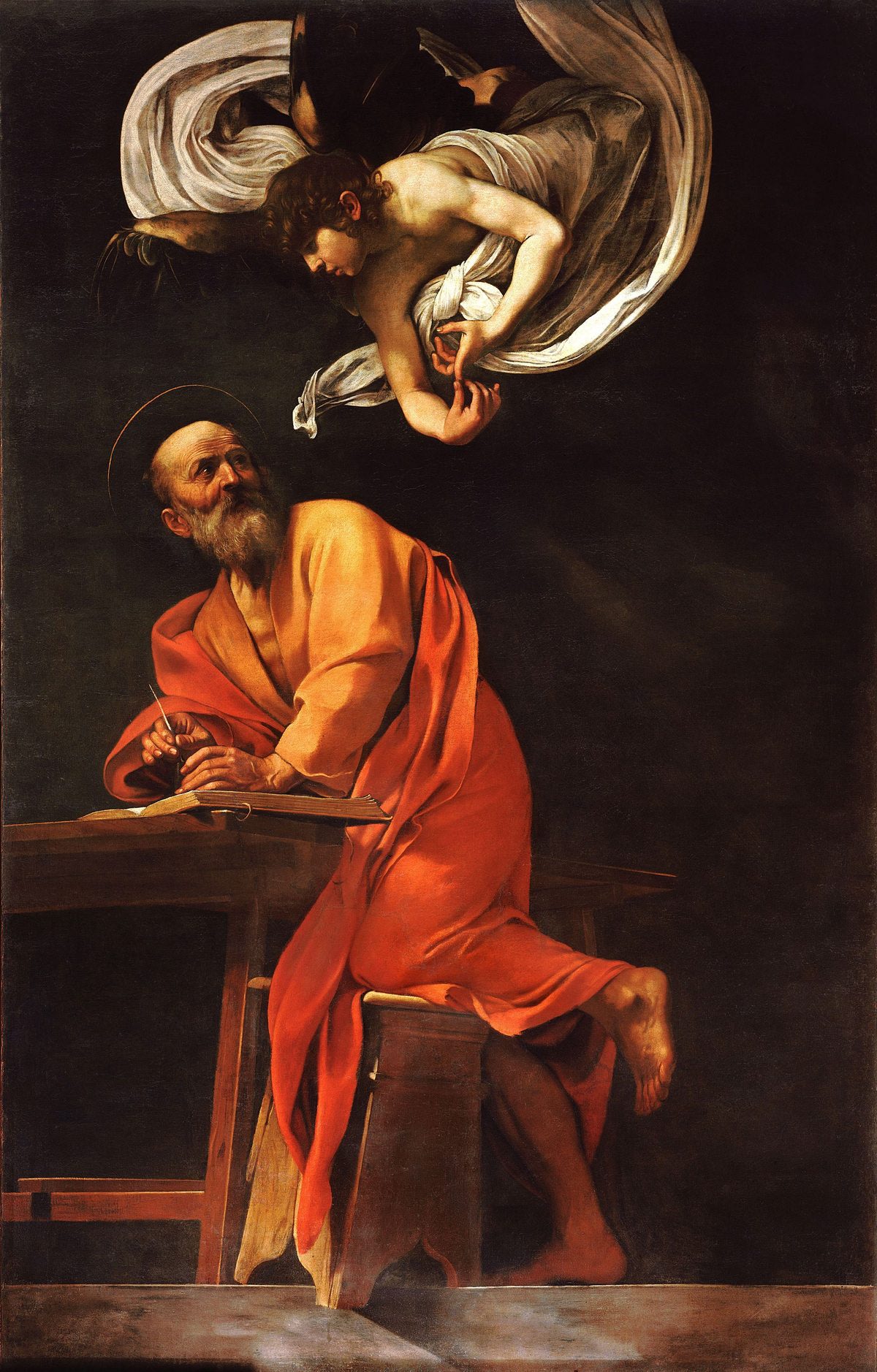
Inspiration of St Matthew
Inspiration of St Matthew — the altar painting
Caravaggio, Public domain, via Wikimedia Commons
The Inspiration of St Matthew hangs above the altar of the Contarelli Chapel — the culminating panel of the three-work programme — and depicts the evangelist writing his Gospel with an angel beside him, guiding his hand or dictating the words. Caravaggio's first version of this composition (now destroyed) was rejected by the chapel patrons as too crude — Matthew's feet were raised toward the viewer, his face was too coarse, the angel's posture was too intimate. The second version (the one now in place) is more conventionally reverential but still powerfully characteristic: Matthew is shown as an older man, rough-featured, straining to write, his face turned toward the angel who hovers beside him with fingers raised as if counting the syllables.
The first version of this painting was destroyed in Berlin during World War II — it is known only from a black-and-white photograph. It showed Matthew with bare, dirty feet raised toward the viewer, his face coarse and unidealized, the angel physically guiding his hand. The patrons found it indecorous for an altarpiece.
The second version (the surviving one) is slightly more decorous: Matthew's feet are no longer prominent, his features are somewhat less rough. But Caravaggio retained the essential quality: Matthew is not a serene inspired author but a working man struggling with the physical act of writing, dependent on the angel's guidance. The divine inspiration is not remote; it is a physical collaboration.
The angel in the surviving version does not touch Matthew's hand; instead, he holds up fingers (counting, perhaps — or indicating the next words) while Matthew writes. The old man's face shows the effort of concentration.
The composition is vertical and intimate — two figures in close proximity in a dark space, the angel airborne but not distant, the saint earthbound but not unelevated. Look at the texture of Matthew's cloak — Caravaggio's fabric is among the most physical in all of Western painting — and the quality of the table and book: the objects are real, documentary, present. The Gospel is being written now, in a Roman room, by a man who needs help.
When standing before this work, look carefully: Inspiration of St Matthew — the altar painting. Give it time — what seems decorative often carries the central meaning.
When standing before this work, look carefully: The destroyed first version — known from photograph. Give it time — what seems decorative often carries the central meaning.
When standing before this work, look carefully: The altar with all three Caravaggio panels visible. Give it time — what seems decorative often carries the central meaning.
When standing before this work, look carefully: The angel counting syllables — detail. Give it time — what seems decorative often carries the central meaning.
Above the altar in the Contarelli Chapel. The most important viewing sequence: enter the chapel, let your eyes adjust, then read the three paintings together — left wall (Calling), right wall (Martyrdom), altar wall (Inspiration).